Sunday, April 29, 2012

So Long, US Dollar

There's a major shift under way, one the US mainstream media has left largely untouched even though it will send the United States into an economic maelstrom and dramatically reduce the country's importance in the world: the demise of the US dollar as the world's reserve currency.
For decades the US dollar has been absolutely dominant in international trade, especially in the oil markets. This role has created immense demand for US dollars, and that international demand constitutes a huge part of the dollar's valuation. Not only did the global-currency role add massive value to the dollar, it also created an almost endless pool of demand for US Treasuries as countries around the world sought to maintain stores of petrodollars. The availability of all this credit, denominated in a dollar supported by nothing less than the entirety of global trade, enabled the American federal government to borrow without limit and spend with abandon.
The dominance of the dollar gave the United States incredible power and influence around the world… but the times they are a-changing. As the world's emerging economies gain ever more prominence, the US is losing hold of its position as the world's superpower. Many on the long list of nations that dislike America are pondering ways to reduce American influence in their affairs. Ditching the dollar is a very good start.
In fact, they are doing more than pondering. Over the past few years China and other emerging powers such as Russia have been quietly making agreements to move away from the US dollar in international trade. Several major oil-producing nations have begun selling oil in currencies other than the dollar, and both the United Nations and the International Monetary Fund (IMF) have issued reports arguing for the need to create a new global reserve currency independent of the dollar.
The supremacy of the dollar is not nearly as solid as most Americans believe it to be. More generally, the United States is not the global superpower it once was. These trends are very much connected, as demonstrated by the world's response to US sanctions against Iran.
US allies, including much of Europe and parts of Asia, fell into line quickly, reducing imports of Iranian oil. But a good number of Iran's clients do not feel the need to toe America's party line, and Iran certainly doesn't feel any need to take orders from the US. Some countries have objected to America's sanctions on Iran vocally, adamantly refusing to be ordered around. Others are being more discreet, choosing instead to simply trade with Iran through avenues that get around the sanctions.
It's ironic. The United States fashioned its Iranian sanctions assuming that oil trades occur in US dollars. That assumption – an echo of the more general assumption that the US dollar will continue to dominate international trade – has given countries unfriendly to the US a great reason to continue their moves away from the dollar: if they don't trade in dollars, America's dollar-centric policies carry no weight! It's a classic backfire: sanctions intended in part to illustrate the US's continued world supremacy are in fact encouraging countries disillusioned with that very notion to continue their moves away from the US currency, a slow but steady trend that will eat away at its economic power until there is little left.
Let's delve into both situations – the demise of the dollar's dominance and the Iranian sanction shortcuts – in more detail.
Signs the Dollar Is Going the Way of the Dodo
The biggest oil-trading partners in the world, China and Saudi Arabia, are still using the petrodollar in their transactions. How long this will persist is a very important question. China imported 1.4 million barrels of oil a day from Saudi Arabia in February, a 39% increase from a year earlier, and the two countries have teamed up to build a massive oil refinery in Saudi Arabia. As the nations continue to pursue increased bilateral trade, at some point they will decide that involving US dollars in every transaction is unnecessary and expensive, and they will ditch the dollar.
When that happens, the tide will have truly turned against the dollar, as it was an agreement between President Nixon and King Faisal of Saudi Arabia in 1973 that originally created the petrodollar system. Nixon asked Faisal to accept only US dollars as payment for oil and to invest any excess profits in US Treasury bonds, notes, and bills. In exchange, Nixon pledged to protect Saudi oilfields from the Soviet Union and other potential aggressors, such as Iran and Iraq.
That agreement created the foundation for an incredibly strong US dollar. All of the world's oil money started to flow through the US Federal Reserve, creating ever-growing demand for both US dollars and US debt. Every oil-importing nation in the world started converting its surplus funds into US dollars to be able to buy oil. Oil-exporting countries started spending their cash on Treasury securities. And slowly but surely the petrodollar system spread beyond oil to encompass almost every facet of global trade.
The value of the US dollar is based on this role as the conduit for global trade. If that role vanishes, much of the value in the dollar will evaporate. Massive inflation, high interest rates, and substantial increases in the cost of food, clothing, and gasoline will make the 2008 recession look like nothing more than a bump in the road. This will be a crater. The government will be unable to finance its debts. The house of cards, built on the assumption that the world would rely on US dollars forever, will come tumbling down.
It is a scary proposition, but don't bury your head in the sand because countries around the world are already starting to ditch the dollar.
Russia and China are leading the charge. More than a year ago, the two nations made good on talks to move away from the dollar and have been using rubles and renminbi to trade with each other since. A few months ago the second-largest economy on earth – China – and the third-largest economy on the planet – Japan – followed suit, striking a deal to promote the use of their own currencies when trading with each other. The deal will allow firms to convert Chinese and Japanese currencies into each other directly, instead of using US dollars as the intermediary as has been the requirement for years. China is now discussing a similar plan with South Korea.
Similarly, a new agreement among the BRICS nations (Brazil, Russia, India, China, and South Africa) promotes the use of their national currencies when trading, instead of using the US dollar. China is also pursuing bilateral trades with Malaysia using the renminbi and ringgit. And Russia and Iran have agreed to use rubles as a means of currency in their trades.
Then there's the entire continent of Africa. In 2009 China became Africa's largest trading partner, eclipsing the United States, and now China is working to expand the use of Chinese currency in Africa instead of US dollars. Standard Bank, Africa's largest financial institution, predicts that $100 billion worth of trade between China and Africa will be settled in renminbi by 2015. That's more than the total bilateral trade between China and Africa in 2010.
The idea of moving away from the dollar is also finding support from major international agencies. The United Nations Conference on Trade and Development has stated that "the current system of currencies and capital rules that binds the world economy is not working properly and was largely responsible for the financial and economic crises." The statement continued, saying "the dollar should be replaced with a global currency." The International Monetary Fund agrees, recently arguing that the dollar should cede its role as global reserve currency to an international currency, which is in effect a basket of national currencies.
There is also a host of countries that have started using their own currencies to complete oil trades, a move that strikes right at the heart of US-dollar dominance. China and the United Arab Emirates have agreed to ditch the dollar and use their own currencies in oil transactions. The Chinese National Bank says this agreement is worth roughly $5.5 billion annually. India is buying oil from Iran with gold and rupees. China and Iran are working on a barter system to exchange Iranian oil for Chinese imported products.
Speaking of Bartering for Oil… How about Those Iranian Sanctions?
The United States and the European Union based their Iran sanctions on the financial system behind Iran's oil trade. The country uses its central bank to run its oil business – the bank settles trades through the Belgium company Swift (Society for Worldwide Interbank Financial Telecommunication) and the trades are always in US dollars. Once they take full effect in July, US and EU sanctions against Iran will make transactions with the Iranian central bank illegal. When that occurs, this official avenue of trade will shut down. In fact, Iran was shut out of Swift a few weeks ago, so that road is already blockaded.
But the arrogance in the sanctions is the assumption that Iran can only use this one, dollar-based avenue. In reality, the Islamic Republic is considerably more agile than that; removing its ability to trade in the official manner is only encouraging the country to find imaginative new methods to sell its oil.
Since the sanctions were announced, Tehran's official oil sales have certainly declined. Iran actually preemptively halted oil shipments to Germany, Spain, Greece, Britain, and France, which together had bought some 18% of Iran's oil. But covert sales have curbed or perhaps even reversed the reduction in shipments. It is impossible to know the details, as buyers and sellers involved in skirting the sanctions are being very discreet, but the transactions are undoubtedly happening.
As mentioned above, Iran is selling oil to India for gold and rupees. China and Iran are working on a barter system to exchange Iranian oil for Chinese imported products. China and South Korea are also quietly buying Iranian oil with their own currencies.
The evidence? Millions of barrels of Iranian oil that were in storage in Iranian tankers a few weeks ago now seem to have disappeared. Officially, no one knows where the oil went. Was it rerouted? Has production been shut in? Is the oil being stored elsewhere?
Oil is fungible, which means one barrel of crude is interchangeable with another. Once it leaves its home country, it can be nearly impossible to know where a barrel of oil originated, if its handlers so desire. And it's not just barrels that are hard to track – even though oil is carried on ships so large they are dubbed "supertankers" it is surprisingly difficult to keep tabs on every tanker full of Iranian oil.
And the Iranians are using every trick in the book to move their oil undetected. In the last week it became apparent that Tehran has ordered the captains of its oil tankers to switch off the black-box transponders used in the shipping industry to monitor vessel movements and oil transactions. As such, most of Iran's 39-strong fleet of tankers is "off radar." According to Reuters, only seven of Iran's Very Large Crude Carriers (VLCCs) are still operating their onboard transponders, while only two of the country's nine smaller Suezmax tankers are trackable.
Under international law ships are required to have a satellite tracking device on board when travelling at sea, but a ship's master has the discretion to turn the device off on safety grounds, if he has permission from the ship's home state. Some tankers turned off their trackers to avoid detection last year during the Libyan civil war in order to trade with the Gaddafi government.
And Iran is about to gain even greater flexibility in disguising the locations of oil sales, as the National Iranian Tanker Company (NITC) is about to take delivery of the first of 12 new supertankers on order from China. The new tankers will add much-needed capacity to NITC's fleet at a time when the number of maritime firms willing to transport Iranian crude has dwindled significantly, forcing Iran's remaining buyers to rely on NITC tankers. Thankfully for NITC, the 12 new VLCCs – each capable of transporting two million barrels of crude – will significantly expand the company's current fleet of 39 ships.
Sanctions or no sanctions, Iran is moving its oil. But even having your own, off-radar ships to transport oil bought in renminbi or rupees or won doesn't mean all these tricks and maneuvers don't have a cost.
Freight costs for each voyage add up to nearly $5 million, a sizeable hit for Tehran. Iran is often also shelling out millions of dollars in insurance for each oil shipment, because the majority of international shipments are insured through a European insurance consortium that is backing away from Iranian vessels because the EU sanctions will make such transactions illegal.
And since business is business, buyers are also demanding much better credit terms from the National Iranian Oil Company (NIOC) than normal. Traders are reporting agreements giving the buyer as much as six months to pay for each two-million-barrel cargo, a grace period that would cost Tehran as much as $10 million per shipment.
For Tehran to cover freight costs, insurance, and the cost of generous credit terms wipes out as much as 10 percent of the value of each supertanker load. Beyond that, customers are also negotiating better prices. For example, the flow of Iranian oil to China did slow in the first quarter of the year, but not because China endorsed the sanctions. Rather, Chinese refiner Sinopec reduced purchases to negotiate better prices with the National Iranian Oil Company. The country's imports from Iran are expected to climb back to the 560,000 barrel-per-day level in April.
That trade, along with non-dollar-denominated deals with India, Turkey, Syria, and a long list of other friendly nations, will keep Iran's finances afloat for a long time. The sanctions may be preventing Tehran from banking full value for each tanker of oil, but there is still a lot of Iranian oil money flowing.
The mainstream media is avoiding all discussion of the demise of the US dollar as the world's reserve currency. Even fewer people are talking about how sanctions based on Iran's supposed need to use the US dollar to sell its oil leave loopholes wide enough for VLCCs to sail right through.
Without acknowledging the elephant in the room, articles about Iranian tankers turning off their transponders or India using gold to buy Iranian oil invariably sound like plot developments in a spy thriller. Much more useful would be to convey the real message: The world doesn't need to revolve around US dollars anymore and the longer the US tries to pretend that the dollar is still and will remain dominant, the more often its international actions will backfire.

Duration Risk: How the Fed is Creating the Next Financial Crisis

"The gods had condemned Sisyphus to ceaselessly rolling a rock to the top of a mountain, whence the stone would fall back of its own weight. They had thought with some reason that there is no more dreadful punishment than futile and hopeless labor… I leave Sisyphus at the foot of the mountain! One always finds one's burden again. But Sisyphus teaches the higher fidelity that negates the gods and raises rocks. He too concludes that all is well. This universe henceforth without a master seems to him neither sterile nor futile. Each atom of that stone, each mineral flake of that night filled mountain, in itself forms a world. The struggle itself toward the heights is enough to fill a man's heart. One must imagine Sisyphus happy."
"The Myth of Sisyphus"
Albert Camus

Over the weekend, we got to go through a lot of accumulated reading, the majority of which only confirms our view that US markets and investors are living in the eye of the proverbial hurricane. White the equity and bond markets in the US still have the outward appearance of normalcy, in the EU and around the world financial markets are in disarray. The only question seems to be when Americans will get the wake-up call. As the character Leon said memorably to Harrison Ford in Bladerunner: "Wake up. Time to die."

One of the stranger sensations we get on a weekly basis is when we are asked how long US interest rates will remain low. The question is interesting because we all hope that the Fed keeps things as they are. An increase in interest rates pretty much implies the apocalypse, if you know what we mean, so asking about Ben Bernanke easing up on the gas pedal could be seen as a sign of economic naiveté. But leaving things as they are has a cost too.

Here in the good old U.S.A, we've been enhancing consumer purchasing power with low rates from the Fed and deficit spending by the Treasury for some 30 years. We all know we are living on borrowed time and that the immediate future is likely to be a complete fiasco, but somehow the smiling gold miner in us all allows the American people to remain optimistic. Bill Greider, writing in The Nation, finds rays of hope in the willingness of the Fed to print even more money:

"In this sorry situation, there is really only one governing institution with the courage to dissent from the conventional wisdom -- the Federal Reserve. The central bank declines to participate in the happy talk about recovery or in the righteous sermons attacking the deficit. In its muted manner, the Fed keeps explaining why the house is still on fire, why more aggressive action is needed, and is gently nudging the politicians who decide fiscal policy to step up. But its message is ignored by Congress and the president and viciously attacked by right-wing Republicans who say, Butt out."

The sad fact is that for members of the American left like Bill Greider and Paul Krugman, "aggressive action" from Washington has been reduced to deficit spending and more inflation. For example, when Chairman Bernanke talks about the US eventually resuming "normal" levels of economic growth and job creation, how does he keep a straight face? American Banker reports that "While by law the Federal Reserve Board must worry about price stability and unemployment, Chairman Ben Bernanke appears to have charted a third mandate for the central bank: financial stability." Really?

Our view is that the Fed is setting up the US economy for another financial crash a la the mortgage bubble, which was created from 2001 by Fed Chairman Alan Greenspan and his new colleague, governor Bernanke. Yet after three decades of pump priming and other variations on neo-Keynesian stimulus, the proverbial well is empty. Indeed, if one takes an economic metaphor from the Greek legend of Sisyphus, the boulder is rolling back downhill. It may take decades for the US economy to regain these levels of employment and housing prices regardless of the actions taken by the Fed.

The draft presentation from Josh Rosner at Graham Fisher is certainly an eye opener. A lot of familiar stuff in the early pages, but some downright scary confirmation about the end of the US real estate market as we know it. Like the changes in household formation by age, a chart which is enough to make us nauseous. Like did we really take out 3 to 4 million households in the 45-54 age group during the past decade? Yup. Guess what that does for housing prices.

Part of the reason for our selection of the Sisyphus metaphor is that Chairman Bernanke and other policy makers increasingly are frustrated by the inability of ZIRP to affect short-term economic performance. The fact of fewer buyers for a burgeoning supply of homes means that the time line for a recovery in the housing sector is now likely to be measured in decades, not merely years.

But when Chairman Bernanke shows his naiveté by stating in public that there is no problem with the housing sector or that Fed rate policy is not causing problems for financial institutions, we have to worry. The problems with housing we think are pretty much in our collective faces, even if Chairman Bernanke and other inhabitants of Washington refuse to admit that a problem exists.

Chariman Bernanke should re-read the Federal Reserve white paper published in early January to understand what ails housing finance and why the large banks and GSEs are preventing the most reliable monetary policy transmission mechanism -- housing refinance -- from working. But how about the mounting problem of interest rate risk created by the Fed's zero rate policies? Our friend Alan Boyce wrote two years ago about the duration risk created by Fed low rate approach:

"The Federal Reserve has been successful in raising the price of mortgage backed securities. They have withdrawn several years of duration from the bond market and created the world's largest short options position. They have not been able to stimulate a large refinancing wave, which would have been the most effective mechanism to reduce the stress on homeowners having a hard time making their mortgage payments. They have not eliminated the threat to the bond market from the gigantic duration extension event buried in our existing mortgage system. Mortgage extension risk remains as the 'other shoe to drop' in the slowly unfolding drama of the financial crisis. The scale of the extension risk is multiples of the risk to the bond market from extended periods of large budget deficits or the threat of coordinated selling of Treasuries by foreign central banks."

For some time now, we have worried about the duration risk facing home owners with ARMs. Think of duration as the time it takes for you to get half your cash investment back from a Treasury bond. The change in price for a change in yield is another way to look at duration. If you buy a ten year zero, then the answer is ten years. If you hold a T-bond with a 10% coupon, the duration is a little over five years. Given a change in interest rates, the zero coupon instruments moves a lot more than the bond with a 10% coupon because of the lack of cash flow.

In a rising rate environment, home owners with adjustable rate mortgages will default in droves, fulfilling the worst predictions of housing experts when it comes to strategic defaults. But the more profound risk is actually carried by financial institutions, banks, insurers and securities dealers that make loans and invest in bonds with lower and lower cash flows.

For a number of years now, US banks have been loading up on low yielding paper that is a function of the Fed's efforts to reflate the US economy. Since many Americans are not able to refinance their home mortgage, the Fed's efforts are not particularly effective, but we are not supposed to talk about housing. Banks and corporations have been able to refinance their debts, lowering interest expenses but also increasing the volatility - that is, the duration -- of bonds and related swaps and options.

The trouble with low interest rates is that as coupons fall, the duration on a given bond lengthens exponentially. Whereas the duration on a Fannie Mae 5 or 6 can be measured and managed using traditional interest rate risk management tools, in a low or zero rate environments the effective duration on low or no coupon securities becomes so long and so difficult to manage that hedging becomes problematic.

Keep in mind that most banks today are seeking to maximize net interest margins on an interest rate book where the effective yield is falling. There is little incentive to lend cash or securities to other banks given that rates are zero, so banks simply place their excess cash into government and agency debt that has little cash flow yield and essentially infinite duration risk - risk that cannot be hedged.

"Of course, the banks also own a lot of duration…1.35 trillion of GSE MBS, notes one of the members of our mortgage finance discussion thread. "The Chinese had to sell to someone." But such levity aside, the fact is that most banks are not even trying to hedge their interest rate books because cash flows on earning assets are so paltry. Thus as and when interest rates do rise, many larger banks that fund themselves in the markets will come under immediate pressure.

Everyone on Wall Street has fled to the apparent safety of the full faith and credit of US Treasury and agency paper, but the real risk from this paper comes from duration, not from credit risk. So let the Fed pretend that there is no downside risk from using ZIRP to reflate an over-indebted nation. As and when short-term yields do start to move, the damage done to corporate and financial balance sheets will show that the Fed's cure of low interest rates has created even more financial and economic problems than we had prior to the start of QE2 and ZIRP.

Does Government Have a Revenue or Spending Problem?

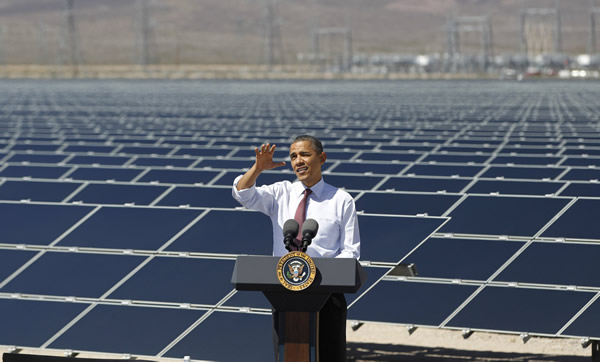
President Windmill: Where’s the Outrage Over THESE Executives Getting Huge Compensation?


When insurance giant AIG paid lucrative bonuses to top executives after receiving federal support, President Obama asked, “How do they justify this outrage to the taxpayers who are keeping the company afloat?”
But three years later, numerous green energy companies backed financially by the administration are paying out large salaries and bonuses to their executives, even as the companies struggle to stay financially solvent.
Scribe recently reported that Ecotality, a stimulus-backed electric vehicle charging station manufacturer that has received about $141 million in Energy Department grants, increased “executive and director” compensation by 150% in 2011.
Meanwhile, the company is struggling financially. “We have a history of losses which may continue and may negatively impact our ability to achieve our business objectives,” Ecotality notes in its latest filing with the Securities and Exchange Commission.
The company posted net losses of $22.5 million last year, and “a large percentage of our revenues depends on the progress of our activities under grants from the DOE,” the SEC filing notes, meaning taxpayers are contributing mightily to the company’s continued survival, even while it increases executive compensation.
First Solar, which received nearly $1.5 billion stimulus-backed DOE loan guarantees, recently announced it would lay off 2,000 workers. But during First Solar’s quick financial decline, the company paid its CEO $32 million in salary and bonuses over three years. He was fired after presiding over a nearly 30% decline in the value of the company’s stock.
The stock price for electric vehicle battery manufacturer A123 Systems is languishing at a meager $0.86, down from a high of $25.77 in 2009. But the company, which received nearly $250 million in stimulus funds, continues to hike the pay of its top executives.
Like Ecotality, A123 is dependent upon federal support. “The failure to obtain [additional federal] funds or other incentives,” the company notes in a recent SEC filing, “could materially and adversely affect our ability to expand our manufacturing capacity and meet planned production levels.”
In 2011, four of A123’s top employees received an average 20% increase in their base salaries. Three of those executives saw further increases in their 2012 salaries, to an average of more than $375,000 apiece. It also awarded 1,210,000 shares of company stock to five of its top executives.
In addition to Ecotality, A123, and First Solar, notorious solar panel manufacturer Solyndra gave its executives pay raises and bonuses after the company went bankrupt, despite having received a $535 million federal loan guarantee through the stimulus package.

Nicely Said.....

“The question is not what anybody deserves. The question is who is to
take on the God-like role of deciding what everybody else deserves.
You can talk about ‘social justice’ all you want. But what death taxes
boil down to is letting politicians take money from widows and orphans
to pay for goodies that they will hand out to others, in order to buy
votes to get re-elected. That is not social justice or any other kind
of justice.”
– Thomas Sowell

Thursday, April 26, 2012

5 New Lies That The Federal Reserve Is Telling The American People

The Federal Reserve says that everything is going to be okay.  The Fed says that unemployment is going to go down, inflation is going to remain low and economic growth is going to steadily increase.  Do you believe them this time?  As you will see later in this article, Federal Reserve Chairman Ben Bernanke has been dead wrong about the economy over and over again.  But the mainstream media and many Americans still seem to have a lot of faith in the Federal Reserve.  It doesn't seem to matter that Bernanke and other Fed officials have been telling the American people lies for years.  As I always say, most people believe what they want to believe, and many people seem to want to have blind faith in the Federal Reserve even when logic and reason would dictate otherwise.  The truth is that things are not going to be getting much better than they are right now.  When the next wave of the financial crisis hits, the U.S. economy is going to fall back into recession, financial markets are going to crash and unemployment is going to absolutely skyrocket.  But you will never hear any of that from the Federal Reserve.
The following are 5 new lies that the Federal Reserve is telling the American people.  After each lie I have posted what The Economic Collapse Blog thinks is actually going to happen....
#1 The Federal Reserve says that the labor market has improved and that unemployment is going to decline significantly over the next few years.
The following is a quote from the FOMC press release that was released on Wednesday....
Labor market conditions have improved in recent months; the unemployment rate has declined but remains elevated.
The Federal Reserve is projecting that the unemployment rate will fall within the range of 7.8 percent and 8.0 percent by the end of 2012.
The Federal Reserve is also projecting that the unemployment rate will fall within the range of 6.7 percent and 7.4 percent by the end of 2014.
The Economic Collapse Blog says that the labor market has not improved.  In March 2010, 58.5 percent of all working age Americans had a job.  Exactly two years later in March 2012, 58.5 percent of all working age Americans had a job.  If the labor market was improving, the percentage of working age Americans with a job should have gone up.
The Economic Collapse Blog also says that while there is a chance the official unemployment rate may go down slightly in the short-term, the truth is that it is going to go up into double digits once the next wave of the financial crisis hits us.
#2 The Federal Reserve says that that U.S. economy is going to experience solid GDP growth over the next couple of years.
In fact, the Federal Reserve is projecting that U.S. GDP will be rising at an annual rate that falls between 3.1 percent and 3.6 percent by the end of 2014.
The Economic Collapse Blog says that a great economic cataclysm is coming....
"When the European banking system crashes (and it will) it is going to reverberate around the globe.  The epicenter of the next great financial crisis is going to be in Europe, and it is getting closer with each passing day."
#3 The Federal Reserve says that we can expect low inflation for an extended period of time.
The Federal Reserve is officially projecting that the annual rate of inflation will not be higher than 2.0 percent by the end of 2012.  Federal Reserve Chairman Ben Bernanke reinforced this projection during his press conference on Wednesday....
“But we expect that to pass through the system, and assuming no new shocks in the oil sector, inflation ought to moderate to about 2 percent later this year.”
The Economic Collapse Blog says that the Fed is being tremendously dishonest and that if inflation was measured the exact same way that it was measured back in 1980, the annual rate of inflation would be more than 10 percent right now.
The truth is that most middle class families know that we do not have low inflation right now.  This is hammered home millions of times a day when average Americans visit the gas station or the grocery store.
At the beginning of the next recession inflation will likely subside, but that will only be because economic activity will be slowing down dramatically.
#4 The Federal Reserve says that it has built up a 30 year reputation for keeping inflation low.
Ben Bernanke actually had the gall to make the following claim during his press conference on Wednesday....
"We, the Federal Reserve, have spent 30 years building up credibility for low and stable inflation, which has proved extremely valuable in that we’ve been able to take strong accommodative actions in the last four, five years to support the economy."
Oh really?
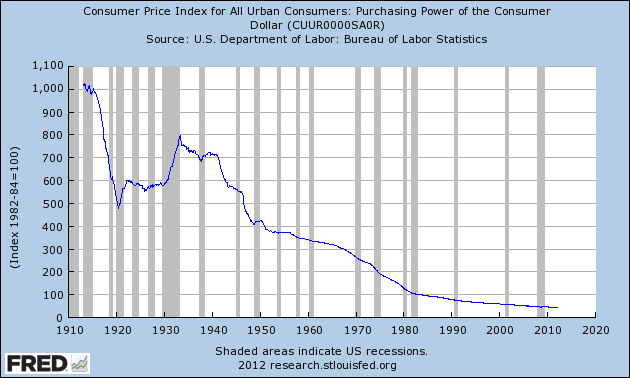
The Economic Collapse Blog says that the Federal Reserve has nearly a 100 year reputation for destroying the value of the U.S. dollar.  Even using the Fed's doctored numbers, the value of the U.S. dollar has declined by more than 95 percent since 1913.
To get a really good idea of just how much the dollar has been destroyed by the Fed over the years, just check out this chart.
#5 Federal Reserve Chairman Ben Bernanke says that we should trust him because the Federal Reserve stands ready to do whatever is necessary to support the U.S. economy.
"If appropriate... we remain entirely prepared to take additional action"
The Economic Collapse Blog says that Federal Reserve Chairman Ben Bernanke is doing a great disservice by not warning the American people about the tremendous crisis that is coming.  In a recent article I stated that this next crisis will blindside most Americans just like the last one did....
"Sadly, just like back in 2008, most people will never even see this next crisis coming."
So who should you trust - the Federal Reserve or all of the half-crazed bloggers out there that are warning about the "serious doom" that is coming.
Well, come back to this article in a year or two and compare how accurate the predictions were.
In the end, time will tell who is telling lies and who is not.
If we do not learn from history, we are doomed to repeat it.
For example, let's take a quick look at Ben Bernanke's track record over the past several years.
The following are statements that Bernanke actually made to the public....
#1 (July, 2005) "We’ve never had a decline in house prices on a nationwide basis. So, what I think what is more likely is that house prices will slow, maybe stabilize, might slow consumption spending a bit. I don’t think it’s gonna drive the economy too far from its full employment path, though."
#2 (October 20, 2005) "House prices have risen by nearly 25 percent over the past two years. Although speculative activity has increased in some areas, at a national level these price increases largely reflect strong economic fundamentals."
#3 (November 15, 2005) "With respect to their safety, derivatives, for the most part, are traded among very sophisticated financial institutions and individuals who have considerable incentive to understand them and to use them properly."
#4 (February 15, 2006) "Housing markets are cooling a bit. Our expectation is that the decline in activity or the slowing in activity will be moderate, that house prices will probably continue to rise."
#5 (February 15, 2007) "Despite the ongoing adjustments in the housing sector, overall economic prospects for households remain good. Household finances appear generally solid, and delinquency rates on most types of consumer loans and residential mortgages remain low."
#6 (March 28, 2007) "At this juncture, however, the impact on the broader economy and financial markets of the problems in the subprime market seems likely to be contained. In particular, mortgages to prime borrowers and fixed-rate mortgages to all classes of borrowers continue to perform well, with low rates of delinquency."
#7 (May 17, 2007) "All that said, given the fundamental factors in place that should support the demand for housing, we believe the effect of the troubles in the subprime sector on the broader housing market will likely be limited, and we do not expect significant spillovers from the subprime market to the rest of the economy or to the financial system.  The vast majority of mortgages, including even subprime mortgages, continue to perform well.  Past gains in house prices have left most homeowners with significant amounts of home equity, and growth in jobs and incomes should help keep the financial obligations of most households manageable."
#8 (January 10, 2008) "The Federal Reserve is not currently forecasting a recession."
#9 (June 10, 2008) "The risk that the economy has entered a substantial downturn appears to have diminished over the past month or so."
But don't worry, Ben Bernanke insists that he knows exactly what is going on this time.
So do you believe him?
A lot of Americans don't.  In fact, an "economic collapse" is the number one catastrophic event that Americans worry about according to one recent survey.
Perhaps that is one reason why so many Americans are preparing for doomsday these days.
The central planners over at the Federal Reserve are not going to solve our economic problems.
The truth is that the Fed is at the very heart of our economic problems.
We have been living in the greatest debt bubble in the history of the world and that debt bubble has been facilitated by the Fed.
Over the past three decades, the total amount of debt in America has increased by about 50 trillion dollars.  By stealing from future generations, we have been able to live like kings and queens, but there is going to be a great price to pay for our foolishness.
Ben Bernanke and the other folks running the Federal Reserve are just going to keep insisting that everything is going to be okay for as long as they possibly can.  They are going to tell you that they know exactly how to fix things and that the economy will be back on track very soon.
Don't be stupid and believe them this time.

22 Red Flags That Indicate That Very Serious Doom Is Coming For Global Financial Markets

If you enjoy watching financial doom, then you are quite likely to really enjoy the rest of 2012.  Right now, red flags are popping up all over the place.  Corporate insiders are selling off stock like there is no tomorrow, major economies all over Europe continue to implode, the IMF is warning that the eurozone could actually break up and there are signs of trouble at major banks all over the planet.  Unfortunately, it looks like the period of relative stability that global financial markets have been enjoying is about to come to an end.  A whole host of problems that have been festering just below the surface are starting to manifest, and we are beginning to see the ingredients for a "perfect storm" start to come together.  The greatest global debt bubble in human history is showing signs that it is getting ready to burst, and when that happens the consequences are going to be absolutely horrific.  Hopefully we still have at least a little bit more time before the global financial system implodes, but at this point it doesn't look like anything is going to be able to stop the chaos that is on the horizon.
The following are 22 red flags that indicate that very serious doom is coming for global financial markets....
#1 According to CNN, the level of selling by insiders at corporations listed on the S&P 500 is the highest that it has been in almost a decade.  Do those insiders know something that the rest of us do not?
#2 Home prices in the United States have fallen for six months in a row and are now down 35 percent from the peak of the housing market.  The last time that home prices in the U.S. were this low was back in 2002.
#3 It is now being projected that the Greek economy will shrink by another 5 percent this year.
#4 Despite wave after wave of austerity measures, Greece is still going to have a budget deficit equivalent to about 7 percent of GDP in 2012.
#5 Interest rates on Italian and Spanish sovereign debt are rapidly rising.  The following is from a recent RTE article....
Spain's borrowing rate nearly doubled in a short-term debt auction as investors fretted over the euro zone's determination to deal with its debts. 
And Italy raised nearly €3.5 billion in a short-term bond sale today but at sharply higher interest rates amid fresh concerns over the euro zone outlook, the Bank of Italy said.
#6 The government of Spain recently announced that its 2011 budget deficit was much larger than originally projected and that it probably will not meet its budget targets for 2012 either.
#7 Amazingly, bad loans now make up 8.15 percent of all loans on the books of Spanish banks.  That is the highest level in 18 years.  The total value of all toxic loans in Spain is equivalent to approximately 13 percent of Spanish GDP.
#8 One key Spanish stock index has already fallen by more than 19 percent so far this year.
#9 The Spanish government has announced a ban on all cash transactions larger than 2,500 euros.  Many are interpreting this as a panic move.
#10 It is looking increasingly likely that a major bailout for Spain will be needed.  The following is from a recent Reuters article....
Economic experts watching Spain don't know how much money will be needed or precisely when, but some are near certain that Madrid will eventually seek a multi-billion euro bailout for its banks, and perhaps even for the state itself.
#11 Analysts at Moody's Analytics are warning that Italy has now reached financially unsustainable territory....
"Italy is already out of fiscal space, in our estimate." said Moody's. "Its debt levels relative to GDP already exceed a manageable level. The manageable limit for Italian 10-year bond yields is estimated at 4.2pc. As of Wednesday, Italian 10-year yields were 5.46pc."
#12 It is being projected that the Portuguese economy will shrink by 5.7 percent during 2012.
#13 There is even trouble in European nations that have been considered relatively stable up to this point.  For example, the Dutch government collapsed on Monday after austerity talks broke down.
#14 The head of the IMF, Christine Lagarde, says that there are "dark clouds on the horizon" for the global economy.
#15 The top economist for the IMF, Olivier Blanchard, recently made this statement: "One has the feeling that at any moment, things could get very bad again."
#16 A recent IMF report admitted that the current financial crisis could lead to the break up of the eurozone....
Under these circumstances, a break-up of the euro area could not be ruled out. The financial and real spillovers to other regions, especially emerging Europe, would likely be very large.
This could cause major political shocks that could aggravate economic stress to levels well above those after the Lehman collapse.
#17 George Soros is publicly declaring that the European Union could soon experience a collapse similar to what happened to the Soviet Union.
#18 A member of the European Parliament, Nigel Farage, stated during one recent interview that it is inevitable that some major banks in Europe will collapse....
There are going to be some serious banking collapses and the impact of that on some sovereign states, will be serious. I’m afraid we’ve gotten to a point where we really can’t stop this now. We’re beginning to reach a stage where however much false money you create, the problem becomes bigger than the people trying to solve it. We are very close to that point.
When I talk about the threats and the risk that this thing could wind up in some kind of rebellion, some sort of awful social cataclysm, they (other European politicians) are now very worried indeed. They will talk to you in private, but in public, nobody dares utter a word.
I think the deterioration, in the last two or three weeks, in the eurozone is very serious indeed. It’s the bond spreads in Italy and Spain. It’s the fact that youth unemployment is now over 50% in some of these Mediterranean countries.
It’s riot and disorder on the streets. And yet a month ago I was here and there was Herman Van Rumpuy telling us, ‘We’ve turned the corner. Everything is solved. There are no more problems with the eurozone.’ What a pack of jokers they look like.”
#19 The IMF is projecting that Japan will have a debt to GDP ratio of 256 percent by next year.
#20 Goldman Sachs is projecting that the S&P 500 will fall by about 11 percent by the end of 2012.
#21 Over the past six months, hundreds of prominent bankers have resigned all over the globe.  Is there a reason why so many are suddenly leaving their posts?
#22 The 9 largest U.S. banks have a total of 228.72 trillion dollars of exposure to derivatives.  That is approximately 3 times the size of the entire global economy.  It is a financial bubble so immense in size that it is nearly impossible to fully comprehend how large it is.
The financial crisis of 2008 was just a warm up act for what is coming.  The too big to fail banks are larger than ever, the governments of the western world are in far more debt than they were back then, and the entire global financial system is more unstable and more vulnerable than ever before.
But this time the epicenter of the financial crisis will be in Europe.
Outside of Europe, most people simply do not understand how truly nightmarish the European economic crisis really is.
Spain, Italy and Portugal are all heading for an economic depression and Greece is already in one.
The European Central Bank was able to kick the can down the road a little bit by expanding its balance sheet by about a trillion dollars over the last nine months, but the truth is that the underlying problems in Europe just continue to get worse and worse.
It truly is like watching a horrible car wreck happen in slow motion.
The good news is that there is still a little time to get yourself into a better position for the next financial crisis.  Don't leave yourself financially exposed to the next crash.
Sadly, just like back in 2008, most people will never even see this next crisis coming.
So do you have any other red flags to add to the list above?  Please feel free to post a comment with your thoughts below....

Help