Tuesday, November 27, 2007

Law Of The Sea Treaty: Lets Get Rid Of This


Law of the Sea treaty should be voted down
Bill McNallyNashua TelegraphMonday November 26, 2007
The big news in 1978 was when Ronald Reagan declared: "No national interest of the United States can justify handing sovereign control of two-thirds of the Earth's surface over to the Third World."
Now we have President Bush and U.S. Sen. Judd Gregg trying to push the United States overboard into LOST – the Law of the Sea Treaty – controlled by the United Nations.
The Senate Foreign Relations Committee is sending this treasonous treaty to the full Senate with a 17-4 approval vote.
You should know that Rep. Ron Paul, R-Texas, a presidential candidate, has a bill (H.R.-1146) that would get the United States out of the United Nations and hopefully the UN out of the United States (www.GetUSout.org).

Call U.S. Reps. Paul Hodes and Carol Shea-Porter and ask them to co-sponsor H.R.-1146.
It's doubtful that Sen. John E. Sununu would dare to vote for LOST because of his re-election bid in 2008.
What has the Republican administration promised Gregg to vote to ratify LOST? You should call Gregg today and tell him "Don't let the USA get LOST."

Fingerprints As Credit Cards...........Oh Brother


Your fingerprints may soon replace credit cards
Thaindian NewsTuesday November 27, 2007
Are you afraid that using a credit card for shopping may make you a victim of an ID fraud? Well, now a new technology based on personalised fingerprints is here to address your worries.
With the revolutionary new system, which is being introduced in Europe, it will be possible to buy a product by paying through fingerprints.
The so called digiPROOF fingerprint payment system is already very popular in Germany.
To pay for the product purchased, a customer will have to press his/her finger or thumb on to a scanner at the till, which acts as a register of customers prints and their bank details. The total will then be deducted from the customers account.
(Article continues below)
Toby Wolff who shops at the Edeka supermarket in Rulzheim, South West Germany, twice or thrice a week describes the system as quick as a flash.
“I always use digiPROOF. It’s good because it’s so fast, and you don’t have to bring your wallet with you,” the Mirror quoted the 22-year-old graphic designer as saying.
In Germany, the technology is popular even amongst old people.
“Older people like it better than young people. Sometimes when they get older, they get shortsighted and it can be embarrassing to fumble around for their coins at the till or peer at their credit cards,” said Werner Schneider, store manager at the luxurious department store, Wagener Gallery.
“We introduced the system two years ago and we now have 6,000 customers using it out of a total of 15,000 regulars. It’s good for the customer as it’s faster and it’s good for us because people who sign up tend to be more loyal shoppers,” Schneider added.
The system is also being used in school canteens, where parents pay into an account and can limit their child’s daily lunch allowance.
The person behind digiPROOF is Ulrich Kipper, chief executive of technology company It-Werke.
According to Kipper, the new system may provide a solution to the current panic about ID fraud.
“Stealing from people’s credit cards would be yesterday’s news with this technology. It would mean the end to credit card fraud. Every time you use a card, you are putting your details out there. But with digiPROOF, you register details once into a secure database,” said Ulrich.
Austria, Sweden, the Netherlands, and several companies in Saudi Arabia have shown interest in using the digiPROOF fingerprint system.
It just takes a few minutes for a customer to sing up to digiPROOF. All one has to do is to fill a form, and swipe an identification proof like a passport and a bank card, and scan once dabs. The registration process completed about five minutes thereafter.
Sion Roberts, director of consumer industries and retail at global technology company EDS, said: “Customers are most concerned with queues, so anything that can be done to speed up a transaction is appealing.
He added: “The other idea is that, if it’s in school canteens, the technology can be used to send parents a report detailing what their child has been eating that week, which may help in fighting childhood obesity.”
Roberts, however, admitted that the digiPROOF fingerprint system might have two major drawbacks.
“Some people might be concerned about putting their driving licence number or passport number on to the database, so there might be a bit of work to do with privacy. Retailers have also just spent a lot on rolling out chip and PIN, and might not be so keen to pay for another new system,” he said.
“Having said that, research shows one-fifth of people would be keen to use biometric payments and many would even be happy to have a chip inserted into their arms. We will probably see more trials of this kind rolling out in the UK over the next 12 to 18 months,” he added.

The EU Becomes Big Brother


Fears over pan-EU electronic identity network

By Philip Johnston, Home Affairs Editor
Last Updated: 2:54am GMT 27/11/2007
New concerns have been raised over the Government's multi-billion-pound ID project as it emerged that Britain's identity database could be shared with 26 other European Union countries.
The Home Office is taking part in a scheme, codenamed Stork, which aims to make all EU electronic identity networks ''inter-operable'' within three years.
David Davis, the shadow home secretary, said this development was particularly worrying following the loss of the nation's child benefit records by HM Revenue and Customs.
advertisement
He added: ''How are they going to prevent a repetition of the disaster of the last few weeks when sensitive personal data is held by 27 countries?"
Speaking in the Commons, Mr Davis said: "If the Government gives away your bank account details, that's a disaster but at least you can change your bank account. What, precisely, do you do if the Government gives away your biometric details?"
Michael Wills, the data protection minister, yesterday conceded that the ''deplorable'' loss of 25 million records had implications for the ID card scheme.
"We are going to obviously have to look at the national identity register in the light of all this,'' he told Parliament's joint human rights committee.
''We are going to have to learn the lessons. Everything will have to be scrutinised and then we will assess it again.''
However, Mr Wills said this did not mean the ID scheme - due to start next year for foreign nationals - would be scrapped.
The Stork project, spearheaded by the Identity and Passport Service, will ensure electronic identity systems recognise each other and can be used across the EU.
Eventually, the Stork project is intended to allow easy access to social security, medical prescriptions and pension payments.
However, Britain's national ID database will be the most comprehensive in the EU by far. No other country has plans for such a sophisticated database containing so much information.

Why Do Cities Need Drone Planes?


CNN: What is Houston planning to do with drone planes?
Katie BakerRaw StoryMonday November 26, 2007
When neighbors noticed black trucks, satellite dishes, swirling radars, and "a portable launch pad, with something covered up" on a Waller County Ranch, they had no idea what to think. CNN's Houston affiliate KPRC has partially solved the mystery: Houston police plan to start using unmanned drone aircraft. But, a question still remains: what, exactly, will the drones be used for?
The mood surrounding Waller County Ranch was highly secretive. At the entrance to the test site stood a Houston police road block, making sure only those invited were let through. HPD lieutenants refused to answer any questions from KPRC reporters, but KPRC still managed to gain footage of the "test [we] were not supposed to see."
"[The] drone was able to use a high-powered camera to track us," says Stephen Dean, who tracked the drone for KPRC. "Those cameras can actually look into people's homes or even follow them in moving cars."
(Article continues below)
Drone Planes are not new to the United States. The military has been using drones for secret war zone surveillance for years; drones were also used to put out the California wildfires last month. The drones used for the test in Houston weigh only 40 pounds, but can carry 15 pounds more in gear. They are able to stay airborn 15 to 24 hours without landing.
According to Dean, the fact that Houston police will be able to employ such high tech security devices raises "all sorts of new questions." One question: how will law enforcers will utilize the drones? A policeman conducting a search needs probable cause or a warrant -- will drone planes adhere to the same laws?
When the HPD realized their "secret test" was being filmed, they "hustled together" a news conference.
"I wasn't ready to publicize this," said Martha Montalvo, the executive assistant police chief.
She said that potential public safety applications include "mobility, evacuations, homeland security, search and rescue, as well as tactical."
Montalvo said that it was "too early to tell" what else HPD will do with the aircraft.
Police helicopter pilots said the entire air space surrounding the test site was restricted and, according to Dean, "threatened ... two investigative pilots with action from the FAA if [they] didn't leave."
But, when KPRC checked with the FAA, they learned there never was a flight restriction.
For Dean, that leaves some wonder "whether the police are now ready to use terrorism fears since 911 to push the envelope further into our private lives."
"We've seen that some of these technologies that are being used in the aftermath of 9/11 that we thought were necessary to protect our security in that time are now being used to diminish privacy in other contexts," said an unidentified male filmed by KPRC. "And that is extremely worrisome."

The Anti-2nd Amendment Gang Is At It Again


Gun-Grabbers Crank Up Anti-Second Amendment Propaganda
Kurt NimmoTruthNewsTuesday November 27, 2007


Now that the Supremes have agreed to rule on the Second Amendment, the corporate media has launched a full-court press to convince America it does not have a right to bear firearms.
“Activists on both sides of the steaming debate over guns ought to be able to agree, at the very least, on two things. The first is that the language of the Second Amendment is, grammatically speaking, incomprehensible. The second is that the time has come for clarity from the Supreme Court about whether the “right to bear arms” is an individual or collective one,” writes Andrew Cohen for CBS News.
In fact, the Second Amendment is quite explicit: “A well regulated Militia, being necessary to the security of a free State, the right of the people to keep and bear Arms, shall not be infringed.”
Cohen and other gun-grabbers concentrate on “the three, jarring, comma-spliced clauses of the amendment,” that is to say they attack the grammar of the amendment and would have us believe our forefathers were indecisive and “were no more willing or capable of making tough decisions about contentious issues (like gun rights) than are their modern-day counterparts,” that is to say a gaggle of appointed statists determined to dismantle the Constitution.

Cohen is a postmodern apologist for state power over the individual. The Supremes, he declares, “should chart a course that does to the Second Amendment what we long ago did to the First Amendment; identify a strong individual right but allow for that right to be trumped from time to time by certain kinds of regulations.” In other words, the state should agree in principle that the individual has a right to bear firearms but that principle should be “trumped,” that is to say denied, by the exigencies of state power. Put another way, you may have a right to bear arms, at least on paper, but in practice the state will “regulate” (deny) that right.
“So we would then get a Second Amendment that both recognizes our right to own and possess guns and recognizes the government’s ability to restrain that right in certain, yet-to-be-determined ways.”
Nonsense. The founders realized that the individual had a natural, indivisible right to possess firearms precisely because of the nature of state power. It has nothing to do with “certain, yet-to-be-determined” exigencies of the state.
In regard to grammar and the trickery Andrew Cohen has in mind, founder George Mason, who co-authored the Second Amendment, wrote during Virginia’s Convention to Ratify the Constitution in 1788: “I ask, Sir, what is the militia? It is the whole people. To disarm the people is the best and most effectual way to enslave them.”
That should resolve Cohen’s grammatical problem, but it will not, of course.
In Letters from the Federal Farmer to the Republic, Richard Henry Lee wrote: “A militia, when properly formed, are in fact the people themselves.”
Zachariah Johnson, arguing in The Debates in the Several State Conventions on the Adoption of the Federal Constitution, wrote: “The people are not to be disarmed of their weapons. They are left in full possession of them.”
“And that the said Constitution be never construed to authorize Congress to infringe the just liberty of the Press, or the rights of Conscience; or to prevent the people of the United States, who are peaceable citizens, from keeping their own arms,” declared Samuel Adams in the Philadelphia Independent Gazetteer, August 20, 1789.
George Washington understood well what Cohen and the gun-grabbers do not: “Firearms stand next in importance to the constitution itself. They are the American people’s liberty teeth and keystone under independence … from the hour the Pilgrims landed to the present day, events, occurences and tendencies prove that to ensure peace security and happiness, the rifle and pistol are equally indispensable … the very atmosphere of firearms anywhere restrains evil interference — they deserve a place of honor with all that’s good.”
Thomas Paine knew that “horrid mischief” would ensue if the people were denied their right to arms. “The supposed quietude of a good man allures the ruffian; while on the other hand arms, like laws, discourage and keep the invader and plunderer in awe, and preserve order in the world as property. The same balance would be preserved were all the world destitute of arms, for all would be alike; but since some will not, others dare not lay them aside.”
Thomas Jefferson: “Those who hammer their guns into plowshares will plow for those who do not.”
In fact, Jefferson considered it not only a right for the individual to be armed, but a duty. Predictably, Cohen and the gun-grabbers do not make mention of this philosophic attitude, preferring instead to tell us the founders were conflicted and, absurdly, wanted to postpone the debate “for another day.”
Cohen and crew believe Congress, after a Supreme Court “decision,” has the right to regulate our firearms out of existence. Patrick Henry had something to say about this: “Are we at last brought to such humiliating and debasing degradation, that we cannot be trusted with arms for our defense? Where is the difference between having our arms in possession and under our direction and having them under the management of Congress? If our defense be the real object of having those arms, in whose hands can they be trusted with more propriety, or equal safety to us, as in our own hands?”
Finally, Thomas Jefferson explained precisely why there is a Second Amendment: “What country can preserve its liberties if their rulers are not warned from time to time that their people preserve the spirit of resistance. Let them take arms.”
Indeed, let them… before it is too late.

CNN Finally Catches Up To SOC: The Recession Is Here


Don't look now: Here comes the recession
Even with a boost from holiday spending, the U.S. economy looks shaky, thanks to slumping housing prices, Wall Street woes and debt-laden consumers. How bad could it get?
By Colin Barr, senior writer
NEW YORK (Fortune) -- The cash registers were ringing on Black Friday, but make no mistake: American consumers are jittery, and seem all but certain to push the U.S. economy into recession.
After years of living happily beyond their means, Americans are finally facing financial reality. A persistent rise in energy prices will mean bigger heating bills this winter and heftier tabs at the gas pump. Job growth is slowing and wage gains have been anemic. House prices are sliding, diminishing the value of the asset that's the biggest factor in Americans' personal wealth. Even the stock market, which has been resilient for so long in the face of eroding consumer sentiment, has begun pulling back amid signs of deep distress in the financial sector.
The latest evidence of the long-awaited consumer retrenchment: Chic discounter Target (Charts, Fortune 500) last week reported a weaker-than-expected third quarter, as sales of higher-margin apparel and home goods slowed. Starbucks (Charts, Fortune 500) reported for the first time that customer traffic in its stores declined in its latest quarter compared to a year earlier. Wal-Mart (Charts, Fortune 500) shares hit a six-year low in September after the retail giant posted another wan sales increase.
With consumer spending accounting for about three-quarters of U.S. economic activity, some economists say it is inevitable that the economy will stop growing at some point in the coming year, for the first time since the mild recession of 2001. "Right now, the question is how bad it's going to get," said David Rosenberg, chief North American economist at Merrill Lynch. "The question is one of magnitude."
Not everyone agrees. Many economists believe the Federal Reserve will steer the economy into a period of slow growth but avoid a recession, which is typically defined as two or more consecutive quarters of economic contraction. Indeed, the Fed already has twice cut its overnight interest-rate target, and options markets show investors expect the Fed to cut by another quarter-point at its Dec. 11 meeting, taking the Fed funds bank-lending rate down to 4.25%.
Government officials have steered well clear of recession talk, with recent Fed documents citing instead the risk of "an unexpectedly severe weakening in economic activity." But Rosenberg and others are skeptical of the Fed's influence on an economy staggering under a mountain of personal, corporate and government debt. The economic recovery underway in 2002 was driven by low interest rates and abundant credit availability -- helped along by then-Fed chief Alan Greenspan's decision to cut interest rates as low as 1% in 2003.
Rosenberg said the low rates and easy underwriting meant loans were available to just about anyone with a pulse, so recent economic gains were more credit-induced "by a factor of four" than any other U.S. expansion on record. Now many of those loans are going bad, which is why investors are fleeing any debt riskier than U.S. Treasury securities.
Making matters worse, the banking system is coming under severe strain. Wall Street has recognized more than $40 billion in losses this year on souring subprime mortgages and a related problem, the toxic debt known as collateralized debt obligations. The losses could constrain the economy by forcing banks and brokerages to sock money away rather than lending it out to businesses and individuals.
Freddie Mac (Charts, Fortune 500), the big government-sponsored mortgage investor, provided some insight into that dynamic last week, when it said a $2 billion third-quarter loss had wiped away two-thirds of its regulatory capital surplus -- raising the prospect that the company will have to become a seller of mortgages at a time when the limping housing market desperately needs Freddie to be a buyer.
"The infection that started in housing is spreading," said Northern Trust chief economist Paul Kasriel. He says banks are extremely vulnerable to the defaults and foreclosures now sweeping American neighborhoods, with mortgage exposure amounting to 63% of U.S. banks' earning assets.
As a result of that exposure - and the hefty losses that financial institutions are going to have to take as more loans go bad -- Kasriel believes Fed chief Ben Bernanke is in a very different position than Greenspan was seven years ago, when the economy last showed signs of heading into recession.
"I'm wondering if Bernanke will have the same latitude" to cut rates, Kasriel said, referring both to the uncertain health of the banking system and the persistent weakness of the U.S. dollar, which is trading at lows unseen since the end of the gold standard in 1971. When Greenspan slashed U.S. interest rates in the early part of the decade, "the financial system was intact," Kasriel said. "Banks were able to extend cheap credit."
But with banks choking on bad loans, Kasriel doesn't expect to see the return of the easy lending standards that fueled the housing boom. Instead, he expects to see "greater risk aversion" that will slow credit growth and reduce the value of assets like property. He says the median U.S. house price would need to fall 17% to return to its 2001 level, which he notes was hardly at the bottom of the house-price cycle. A decline of that magnitude will further erode home-equity borrowing by Americans and, presumably, deliver one more blow to consumers' wallets.
The American consumer seems to grasp the risks. A growing number of Americans expect the economy to tip into recession in the next year -- 40% last week, up from 31% in October, going by a Reuters/Zogby poll released last week. Rosenberg said government statistics show that 500,000 self-employed workers have lost their jobs since July -- a greater loss than was seen in all of 2001. Reported unemployment figures remain low, but Kasriel says those numbers "smell worse than a week-old fish."
The combination of an emerging consumer recession and a heavily stressed financial system has some experts suggesting that a financial meltdown looms.
"In short, the financial markets are at a critical point," fund manager John Hussman of the Hussman Funds wrote last week in a Web site post devoted to discussing a possible financial crisis. "It's possible that investors will somehow adopt a fresh willingness to speculate, but my impression is that in the weeks ahead, investors will be forced to recognize that the recession risk has tipped."
Others are more direct. Nouriel Roubini, an economics professor at New York University who has been predicting the collapse of the housing bubble for years, wrote recently that not only is a recession inevitable, he also sees "the risk of a severe and worsening liquidity and credit crunch leading to a generalized meltdown of the financial system of a severity and magnitude like we have never observed before."
Such a meltdown, he writes, would include bank runs such as the one seen earlier this year at Britain's Northern Rock and the bankruptcy of some broker-dealer firms.
That view isn't widely shared, of course. Few expect Americans to find themselves out on the street corner soon selling apples. Jim Griffin, an economist who writes for ING Investment Weekly in Hartford, Conn., shuns recession forecasts as unreliable and believes worries about the nation and the financial system are mostly overstated.
Griffin sees this fall's turmoil as "part of the next historical phase" in the global economy, as the U.S. shifts from driving world growth to riding behind developing nations. He expects U.S. export growth to help cushion the blows dealt by the housing bust and related bad debt.
Merrill Lynch's Rosenberg is less sanguine than Griffin, but he too discounts the voices of doom. "We've had consumer recessions before," Rosenberg said. "The world doesn't end." Let's hope not.

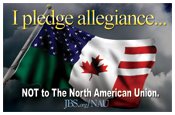
While Others Call Out Loudly For It, The Prognosticators Of The NAU Deny It


Denying the North American Union
Kurt Nimmo

TruthNews November 26, 2007
Now that Alex Jones, Jerome Corsi, and others have exposed the plot to establish a “North American community,” that is to say eradicate the national sovereignty of the United States, Canada, and Mexico in favor of a “United Nations of America” based on the European Union, the corporate media and globalist apologists have kicked into over-drive with a propaganda effort to deny reality.
“Nobody is proposing a North American Union,” declared Robert Pastor, correctly identified as the father of the NAU and author of “Towards a North American Community: Lessons from the Old World for the New,” a book published by the Council on Foreign Relations Press in association with the Canadian Council of Chief Executives and the Consejo Mexicano de Asuntos Internacionales. Pastor may insist the elite of the three countries, at the behest of transnational corporations, are not interested in a merged superstate, but his argument betrays the fact the former national security advisor dreams of an American version of the European Union.
Pastor is an advocate of NAFTA on steroids, or “NAFTA Plus.” According to Miguel Pickard, in “the early 1990s, when NAFTA negotiators were still wrangling over arcane language, Pastor was proposing ways to ‘improve’ the treaty. According to Pastor, NAFTA was off to a bad start, since negotiators were mostly seeking to dismantle trade tariffs. For Pastor it was crucial to find ways of integrating the three countries, similarly (but with important differences) to what the Europeans had done since the 50s. Years later, Pastor would bemoan that NAFTA’s promise had gone unfulfilled, since it lacked a ‘grand vision’ for the three countries, i.e., a much richer perspective than the emphasis put on trade.” In other words, NAFTA was simply a trade treaty minus the “grand vision” of global integration.
But there is a problem with Pastor’s “grand vision,” namely the people of the United States, Canada, and Mexico are reluctant to give up their national sovereignty.
Pastor, in a conversation with Jerome R. Corsi, “was careful to distinguish that his proposals were designed to create a North American Community and that he never has proposed to create a North American Union as an EU-style regional government,” thus Pastor’s insistence “nobody is “proposing a North American Union.”
But this is, to say the least, deceptive. “The idea seems to be to put new structures in place that change the look of the landscape,” writes Corsi. “[WorldNetDaily] pointed out to Pastor that this step-by-step approach is the same approach taken to create the European Union. The memoirs of Jean Monnet, regarded as the architect of European unity, finally disclosed he had used a strategy of deceit, knowing his plan to form a European Union would never succeed if it were openly disclosed.”
“Pastor in an article entitled ‘NAFTA is Not Enough,’ argued for an incremental process that could head toward the creation of the NAU, all the while providing cover for participating politicians and governments to deny that creating the NAU was their goal,” Corsi argues in a News with Views editorial. In the article, Pastor provides key details on how this stealth process works:
While the three governments of North America are unlikely to step into the debate on long-term goals at the current time, nongovernmental organizations, research institutes, and universities should fill the void with new ideas and old-fashioned cross-border dialogue.
Short of this sort of shadowy incrementalism, the NAU project may be dropped on the fast track by other means, according to Corsi. “Dr. Pastor seems to prescribe that a fear formula is all that is needed for the American people need to begin begging SPP to produce the NAU right now. Pastor openly writes as if the next 9/11 terrorist attack or a future outbreak of some health epidemic such as the avian flu could be just what the NAU doctor ordered as the prescription for the American people to abandon sovereignty in favor of super-regional government control, all in the interest of ’security’ leading to ‘prosperity.’ Or, is it ‘prosperity’ which necessitates more ’security’ via surrender to Big Brother government?”
In predictable fashion, the corporate media is tasked with characterizing those who document the emerging NAU as tinfoil hatters, nut cases, mental patients, conspiracy theorists, etc.
For instance, neocon Charles Krauthammer told Fox News: “I love this stuff because if you ever doubt your own sanity, all you have to do is read this stuff and realize that you’re okay” (see video), while “conservative” Michael Medved lamented what he calls the “paranoid and groundless frenzy… fomented and promoted by a shameless collection of lunatics and losers; crooks, cranks, demagogues and opportunists, who claim the existence of a top secret master plan to join the U.S., Canada and Mexico in one big super-state,” never mind the above, well-documented. “I’m sorry to sound cynical and intolerant about this stupidity, but I’m furious, actually – ashamed to be part of a proud medium (conservative talk radio) that increasingly encourages this paralyzing, puerile paranoia,” apparently a reference to Alex Jones and others who continue to flesh out the “incremental” conspiracy Medved refuses to acknowledge.
Drake Bennett writes for the Boston Globe:
Government officials say a continental union is out of the question, and economists and political analysts overwhelmingly agree that there will not be a North American Union in our lifetimes. But belief in the NAU — that the plans are very real, and that the nation is poised to lose its independence — has been spreading from its origins in the conservative fringe, coloring political press conferences and candidate question-and-answer sessions, and reaching a kind of critical mass on the campaign trail. Republican presidential candidate and Texas congressman Ron Paul has made the North American Union one of his central issues.
Government officials of the sort, no doubt, that told us Saddam Hussein was about use weapons of mass destruction against the United States or that the air at Ground Zero in New York was safe to breathe.
Finally, it is no mistake the Boston Globe has rolled Ron Paul into its diatribe of transparent denial, as Paul must be roundly discredited and characterized as a kook, primarily because a Paul presidency would most certainly put an end to Robert Pastor’s dream of an American version of the European Union once and for all.