Sunday, December 2, 2007

Kinda Early For 2008 Prognostications; But Here Goes...........


The Fed is Singin' the Blues for 2008

Well if the Fed is right, then stocks are going to struggle in 2008.
And if stocks struggle, then the U.S. dollar is also going to be volatile due to the Fed. As usual, the Fed will remain "data dependent" next year. That's code for "the Fed doesn't know what's going to happen, so they'll have to wait and see and respond as they see things unfold."
Hence if stocks fall, then the Fed will cut rates and hurt the dollar.
While the Fed claims to anticipate the economy's actions, it's been my experience that the Fed sits back and "responds to" the market. After all, isn't that what they did when they recently changed their tune about rate cuts? Certainly.
So the Fed will probably cut rates further. I think the Fed actually says it best when they list all their observations about the economy. There's not much to be hawkish about these days.
What's Left to Brag About?
Let's see: Business spending has slowed down. The standards have been raised on consumer loans. (Interpretation: They are harder to get now.) The Fed says there is a "glut of unsold homes weighing on prices."
The Fed also said that retail inventories were too high. Keep in mind that Sears just reported a huge loss in the third quarter and agreed with the Fed's assessment. The Fed is also pessimistic about holiday sales.
One "good" point: The Fed said that the weaker dollar helped factories and tourism. Well bravo for resort hotels, airlines and factories. Meanwhile, the Fed made everyone else in the country pay for boosting their sales. The dollars in your wallet had to become a little more worthless in order for their sales to go up.
Seven out of the 12 districts of the country reported a "slower pace of growth." The remaining districts described their growth as "moderate or mixed." Notice: No one said, "My portion of the country is doing great."
They stated that the housing sector would not turn around until "well into 2008 at the earliest." So don't look for your home values to improve anytime soon.
Advertisement
Bernanke getting ready to slash rates! AGAIN!U.S. Dollar set to plunge! Japanese yen to soar!
If You're a Lawyer, This is Your Year!
The Fed mentioned one area that could be construed as a bright spot in the economy. They said the demand for legal services was doing well. So why are lawyers doing so well? As I dug a little further, I found out: bankruptcy filings. Lawyers are profiting while Americans lose their homes and assets.
Sadly, that means the only bright spot the Fed has to talk about are the lawyers that are benefiting from everyone's housing misery. Even that "bright spot" wasn't that bright at all.
The Fed also stated that food and energy prices were still rising overall. Translation: Your falling dollars have to pay even more to keep you fed and your house warmed and cooled.
The weaker dollar is also increasing the price of imported goods. Wait, didn't the Fed say that the falling dollar doesn't affect Americans? It seems to me it does when your food, energy and imports all rise. To me that's a real cost that I'm feeling.
The Unemployment Lines Are About to Get Longer
Oh and then don't forget the Fed's new "transparency" policy. It just means they're releasing their economic forecasts more often. The Fed's men stated just weeks ago that the unemployment rate was expected to rise in 2008. So on top of all of this, many will be losing their jobs next year. Yet the high costs of living won't go down.
So maybe it's just me. But I'm a little curious why Wall Street is rejoicing and snatching up stocks like there's no tomorrow. When an economy slows, that's because corporate earnings and consumer spending slowed.
So with all of this in play, it's hard for me to see a bright spot for the U.S. economy just yet. When it appears, I assure you I'll be one of the first to start shouting it from the roof tops. After all, I live in the U.S. and ideally, I'd like my country to prosper. Until then, I have to call it like I see it.
Look for the Yen and Swiss franc to Benefit from the U.S. Turmoil
So look for currencies like the Japanese yen and the Swiss franc to benefit as each of these stock rallies are sold. The yen and franc have had huge runs lately.
Stocks could get their temporary break that they've been wanting. However, after that, look for yen buying and franc buying to resume.

The Demise Of The Liberty Dollar

Several readers have written and asked me why I haven't been "all over" this story from the start. I've been waiting to see if there is an actual case against this NORFED organization, or if it was a simple money-grab by some greedy bureaucrats. We see now it was both. the fact that more Americans aren't coming to Norfed's defense says bad things. SOC~Ed.
Liberty Dollars

November 28, 2007

Alvaro Vargas Llosa
WASHINGTON—Recently, The Washington Post carried a front-page story about a federal raid on the headquarters of the National Organization for the Repeal of the Federal Reserve Act and Internal Revenue Code (Norfed). The Indiana-based company, which advocates “sound money,” has been selling coins and paper certificates backed by gold and silver for years, in effect trying to compete with the dollar.
The government ignored Norfed’s “Liberty Dollars” for a long time—until the group started selling thousands of coins with Ron Paul’s likeness to show support for the Republican presidential candidate. Paul also wants to abolish the Federal Reserve.
To the public at large, the activities of Norfed seem utopian, naive and even downright fraudulent. The idea that the world’s greatest economy could be run without a central bank and private parties could replace the government as issuers of currency is one that many people will find scary. With the dollar in something of a free fall and the United States in the midst of a housing and credit crisis that has sent some of the nation’s top CEOs packing, Americans will be looking for financial security, not monetary adventures.
And yet it is precisely in such a financially wobbly environment that the actions of Norfed should invite a critical look at the way money is managed. Some of the country’s greatest economists, including Nobel Prize winners, have been saying for years that the Federal Reserve has probably caused more problems than it has solved since its creation in 1913. Its role in the last century’s boom and bust cycles is a matter of record; it looks as though it played a similar role in the current housing market crisis too.
While the creation of the Federal Reserve was essentially a response to a series of bank runs, those crises were mild compared to the ones that were to follow. In 1913, the United States was under the gold standard. Although the government issued currency, the fact that currency was tied to gold meant the authorities could not manipulate the money supply easily. The Fed’s initial mission was to guarantee the convertibility of deposits into currency on demand. A few decades later, the United States abandoned the gold standard and the Federal Reserve became the country’s most powerful economic institution, exercising its monopoly in issuing currency based on the discretionary power of its board of governors.
All in all, financial instability has been far greater since the creation of the Federal Reserve. What did the Great Depression teach us? Essentially that even with the best of intentions, it is impossible for the authorities to manage the supply of money in accordance with the exact needs of the economy. A country’s economy is the sum of millions of people making decisions that no single individual is in a position to anticipate. As economist Murray Rothbard showed in his book “America’s Great Depression,” in the 1920s the Federal Reserve pumped up the money supply, expanding credit by more than 60 percent. Because the economy was very productive, this monetary expansion did not show up in the regular inflation figures. But, as is always the case with inflation, many resources went to the wrong kind of investments—until the crisis hit. The late Milton Friedman showed how the Fed made things worse by not providing the system with enough liquidity once the Depression was obvious.
The current housing market and debt market crises are in good part the children of the Federal Reserve. By cutting rates 13 times between 2001 and 2003, and then keeping them very low for years, monetary policy contributed to the housing bubble. That is not to say other factors—including financial instruments that made it difficult to see that the underlying foundation was not as solid as it seemed—did not play a part too. But, once again, the Fed has turned out to be a factor of financial instability.
In this context, Norfed’s attempt to prove to the Fed that the market is ready to trust private currency backed by gold is a welcome occasion to take a second look at some of the economic institutions we take for granted. Naive and utopian? You bet. But that is probably because of how far the world has moved from the time when money was too important to be left to the politicians.

Military Threat From Russia? How About China, Pat??


Blowback From Moscow
by Patrick J. Buchanan
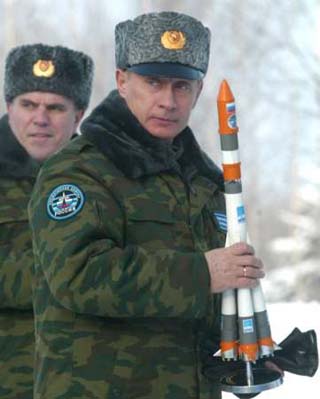
Our next president will likely face a Russia led by Prime Minister Vladimir Putin, determined to stand up to a West that Russians believe played them for fools when they sought to be friends.
Americans who think Putin has never been anything but a KGB thug will reject accusations of any U.S. role in causing the ruination of relations between us.
Yet the hubris of Bill Clinton and George Bush I, and the Russophobia of those they brought with them into power, has been a primary cause of the ruptured relationship. And the folly of what they did is evident today, as Putin's party, United Russia, rolls to triumph on a torrent of abuse and invective against the West.
Entering the campaign's final week, Putin, addressing a rally of 5,000, ripped the Other Russia coalition led by chess champion Gary Kasparov as poodles of the United States, "who sponge off foreign embassies ... and who count on the support of foreign resources and governments, and not of their own people."
"Those who oppose us," roared Putin, "don't want our plans to be completed. They have completely different tasks and a completely different view of Russia. They need a weak, sick state, a disoriented, divided society, so that behind its back they can get up to their dirty deeds and profit at your and my expense."
Putin is referring to the time of the "oligarchs" of the Yeltsin era, who looted Russia when its state assets were sold off at fire-sale prices.
Putin is also accusing his opponents of attempting to use the Western-devised tactics of mass street protests to bring down his government. "Now that they have learned some things from Western specialists and tried them in the neighboring republics, they are going to try them on our streets."
Putin is talking here about the "color-coded" revolutions that the U.S. and NATO embassies, the National Endowment for Democracy, and allied foundations and front groups engineered in Ukraine and Georgia. Governments tilting toward Moscow were dumped over and pro-Western regimes installed – to bid for membership in NATO and the European Union.
Blowback is a term broadly used in espionage to describe the unintended consequences of covert operations. The revolution that brought the Ayatollah to power is said to be blowback for the U.S.-engineered coup to overthrow Mossadegh in 1953 and install the Shah.
The nationalism and anti-Americanism rife in Putin's Russia is blowback for our contemptuous disregard of Russian sensibilities and our arrogant intrusions into Russia's space. How did we lose a Russia that Ronald Reagan and Bush I had virtually converted into an ally?
We pushed NATO into Moscow's face, bringing six ex-Warsaw Pact nations and three ex-Soviet republics – Lithuania, Latvia and Estonia – into our Cold War alliance and plotted to bring in Ukraine and Georgia.
We financed a pipeline from Baku through Georgia to the Black Sea to cut Russia out of the Caspian oil trade. After getting Moscow's permission to use old Soviet bases in Central Asia to invade Afghanistan, we set about making the bases permanent. We pulled out of the Anti-Ballistic Missile treaty over Moscow's objection, then announced plans to plant ABM radars in the Czech Republic and anti-missile missiles in Poland.
Putin has now responded in kind, and who can blame him?
As we tried to cut him out of the Azerbaijan oil with a Black Sea pipeline, he is slashing subsidies on Ukraine's oil and colluding with Germany on a Baltic Sea pipeline to cut Poland out of the oil trade with Western Europe.
As we moved our alliance and bases into his front and back yard, he has entered a quasi-alliance with China and four nations of Central Asia to expel U.S. military power from the region.
As we abandoned the ABM Treaty, the Duma, in November, voted 418 to 0 to suspend participation in the Conventional Forces in Europe Treaty, which restricts the size of the Russian army west of the Urals.
If we recognize Kosovo as independent, at the expense of Serbia, Putin is now threatening to recognize South Ossetia and Abkhazia, the breakaway republics of Georgia and Transdneister, claimed by Moldova.
Where we backed the Orange Revolution in Ukraine and the Rose Revolution in Georgia, Russia backs its favorites in Kiev and supports street protests in Tbilisi against the pro-American regime of Mikhail Saakashvili, whom the United States now seems powerless to help.
It was not NATO that liberated Eastern Europe. Moscow did – by pulling out the Red Army after half a century. Why, then, did we think moving NATO into Eastern Europe was a surer guarantee of their continued independence than the goodwill of Russia?
Many among our foreign policy elite now talk of a Second Cold War. John McCain wants Russia kicked out of the G-8.
But do we not have enough enemies already that we should add the largest nation on earth?

ETFs Fail Spur Platinum & Palladium


Platinum ETF unlikely for New York

David McKayPosted: Thu, 29 Nov 2007
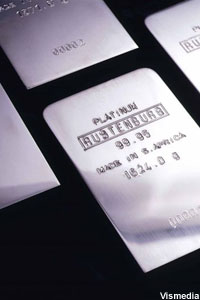
[miningmx.com] -- INVESTORS interested in the fortunes of platinum mining companies such as Anglo Platinum and Impala Platinum may be interested to know two exchange traded funds (ETFs) backed by platinum and palladium have failed to ignite the market.
The ETFs were introduced in April and May after much speculation and controversy. Platinum producers were generally hostile to the products because, in the words of one analyst, they stood to artificially create selling and buying pressure.
When metal prices are good, platinum-backed ETFs have the potential to create more demand and extra tightness in a market than might otherwise exist; the reverse happens when metal prices are weaker.
The extra volatility they create would be bad news for the jewellery market which could suffer as a result. In the minds of producers, fickle ETF demand should not damage long-term, permanent jewellery demand.
That however, doesn’t look likely and the price of platinum will be a less volatile than had the ETFs succeeded. That’s good news for producers because it makes planning easier; the future more stable.
According to Johnson Matthey (JM), the UK-based precious metals refiner, demand for platinum and palladium by ETF products – of which two in each metal were launched – totalled no more than 60,000 oz of platinum and 255,000 oz of palladium this year. The funds were intended to contain a combined 150,000 oz of platinum and 400,000 oz of palladium.
“In fact, volumes of purchases in all funds have been relatively low post-launch and we have even seen some redemptions of metal,” said JM in its interim report published in November.
However, there has been talk of a platinum-backed ETF being launched in New York where appetite for such a product might be much greater than in other financial centres. It is thought New York was the wings behind gold-backed EFTs. But again, JM thinks this unlikely, at least for the next 12 months.
“There just isn’t the supply for platinum ETFs to grow,” he says. Palladium backed ETFs would have Russian metal inventories to draw from, but even these are unknown in size and finite. By contrast, there’s an estimated 33.000 tonnes of above-ground gold supplies that could feed into ETF products.
And the situation isn’t going to improve much for the platinum industry either.
Both Lonmin and Anglo Platinum have announced lower than expected production levels this year, owing to a host of factors, some of them technical. Moreover, JM reckons metal proudction from new projects will be slower than expected.

Nicely Said.............................


"In general, the art of government consists in taking as much money as possible from one party of the citizens to give to the other." -Voltaire

You'd Be Snooty Too If...............


"The snooty attitude that we have sometimes seen under the motto of `we are cleverer than the others' ended in disaster," commented German Finance Minister Peer Steinbrueck this morning. When asked who was to blame for the global credit squeeze, Peer pointed his finger at the banking community itself.
If it weren’t for “snooty” bankers and their opaque balance sheets, we wouldn’t be in this mess. Heh. This is funny stuff.
"Months have gone by since the end of July, and some managers still don't know what the impact is on their accounts,” said Steinbrueck, fed up with the bankers who refuse to admit mistakes, thus keeping world markets in limbo…
Amen.

1 Million Rounds A Minute? Think Of What'll Happen To The Price Of Lead!


Metal Storm reaches Navy test range
Posted by Mark Rutherford
(Credit: Metal Storm)
After years of development, a new class of weapon that uses computer-controlled electronic ignition instead of primers to fire projectiles may be finally taking its much coveted place in the U.S. military inventory.
Brisbane, Australia-based Metal Storm has delivered a four-barrel weapon to the Naval Surface Warfare Center for testing that uses a small electrical current instead a conventional firing pin to deliver stacked rounds at an astounding rate.
How astounding? Try 1 million rounds per minute. That's the rate, by the way, not the volume; still, there's no way you want to be anywhere near the wrong end of one of these puppies.
One version, the Redback, features a remotely operated 40mm that can automatically track targets by slewing around at almost 2 complete revolutions per second, according to the company. "The employment of Metal Storm's stacked round technology for a U.S. military weapon system is a huge step for us," Metal Storm CEO Lee Finniear said in the company's press release.
Electronically fired weapons and the general concept have been around for awhile--Austrian company Voere offers an electric, bolt-action hunting rifle--but nothing has approached Metal Storm (PDF). Metal Storm weapons use multiple, "lightweight, economical barrels" mounted in pods on a variety of platforms that can fire a wide selection of munitions.
The projectiles are stacked in-line in the barrel--nose to tail--so there are no magazines, no shell casings, and no mechanical components. This makes them ideal for unattended area denial or picket duty. They are also easily adapted to light vehicles and robot platforms. In fact, the company just signed an MOU with iRobot Government & Industrial Robots to combine its robot platforms with Metal Storm's scalable systems.
"Together with Metal Storm, we aim to develop a superior next-generation weapons platform that ensures absolute safety and always places a human in the decision loop," iRobot's Joe Dyer promised in announcing the agreement. "When you are talking about weaponizing robots, there is no margin for error."
Especially at a million rounds per minute.