Monday, June 4, 2012

Debt Up $1.59T Under GOP House—More in 15 Months Than First 97 Congresses Combined

The Republican-controlled House of Representatives, which took office in January 2011, has enacted federal spending bills under which the national debt has increased more in less than one term of Congress than in the first 97 Congresses combined.
In the fifteen months that the Republican-controlled House of Representatives--led by Speaker John Boehner--has effectively enjoyed a constitutional veto over federal spending, the federal government’s debt has increased by about $1.59 trillion.
Article 1, Section 9, Clause 7 of the Constitution says: “No Money shall be drawn from the Treasury, but in Consequence of Appropriations made by Law.” A law appropriating money cannot be enacted unless it is approved by the House.
The approximately $1.59 trillion in new debt accumulated since the Republican-controlled House gained a veto over federal spending legislation is more than the total increase in the federal debt between 1789, when the first Congress convened, and October 1984, when the 98th Congress was nearing the end of its second session.
Rep. Frederick Muhlenberg of Pennsylvania served as speaker in the first Congress. Rep. Tip O’Neill of Massachusetts served his third term as speaker in the 98th Congress.
When Boehner became speaker on Jan. 5, 2011, the federal government was operating under a continuing resolution that had been passed on Dec. 21, 2010 by a lame-duck Congress. That CR expired on March 4, 2011.
On March 1, 2011, Boehner agreed to a new short-term spending deal with President Barack Obama and Democratic congressional leaders to keep the government running past the March 4, 2011 expiration of the old CR. Since March 4, 2011, federal expenditures have been carried out under a series of CRs approved by both the Republican-controlled House and the Democrat-controlled Senate and signed into law by President Obama.
At the close of business on March 4, 2011, the total federal debt was $14,182,627,184,881.03, according to the Treasury Department's Bureau of the Public Debt. At the close of business on May 31, 2012, it was 15,770,685,085,364.14. That is an increase of $1,588,057,900,483.11—in just 15 months.
All of the debt accumulated by the federal government throughout the history of the country did not exceed $1.588 trillion until October 1984.
Under the Republican-controlled House, the federal debt has been increasing at an average pace of about $105.9 billion per month.
Frederick Muhlenberg served two non-consecutive terms as speaker--in the first and third Congresses. At the end of the first Congress, in 1791, the total debt of the federal government was about $75.5 million, according to the U.S. Treasury.
Tip O’Neill served as speaker in the 95th through 99th Congresses, from 1977 through 1986.
At the end of September 1984, during the 98th Congress, the total national debt was approximately $1,572,266,000,000.00, according to the Treasury Department’s Monthly Statement of the Public Debt for that month. At the end of October 1984, it was $1,611,537,000,000.00, according to the Monthly Statement of the Public Debt.

Why American Riots Will Be The Worst In The World


Sobering stuff.  Pay attention to what happens in Europe, dear readers.

Friday, June 1, 2012

50,000 Pages of JFK Assassination–Related Documents Still Classified

What gets declassified?
Next year will be a half-century since the death of JFK. And the Obama Administration thinks we need to keep secret the records on the matter … a little longer yet.
Believe it or not, more than 50,000 pages of JFK assassination–related documents are being withheld in full. And an untold number of documents have been partially withheld or released with everything interesting blacked out. But why?
Since the government and the big media keep telling us there was no conspiracy and that it was all Lee Harvey Oswald acting on his own, why continue to keep the wraps on?
We don’t have an answer, but in understanding this and any number of other mysteries, we can begin looking for patterns in the way the administration handles information policy.
We Want to Hear from You (But That’s It — We Just Want to Hear from You)
Earlier this year, the National Archives and Records Administration (NARA) asked, on its online Open Government Forum, for suggestions from the public about what it could do to create greater transparency. The #1 most popular idea? Get those Kennedy records out — before Nov. 22, 2013, the fiftieth anniversary of the Dallas tragedy.
But instead of dealing honestly with this matter, the feds have resorted to disinformation. In an interview with the Boston Globe, the Archivist of the United States claimed that at two public forums held on open records, the most public comments came from people interested either in the JFK assassination or … in UFOs.
Except for one thing: James Lesar, an attorney and co-founder of the Assassination Archives and Research Center (AARC), a D.C.-based nonprofit that has fought a long and valiant fight on behalf of the public interest in disclosure, attended both of those forums and says that, as he recalls, there were no people there asking about UFOs, or that at most it was of negligible interest. In fact, a look at NARA’s online idea forum (now closed) showed no UFO proposals or comments.
So, what’s with claiming otherwise? One could be excused for seeing in the Archivist’s statement a deliberate, and unworthy, attempt to smear the legitimacy of JFK inquiries by trying to make them appear “kooky.” (Not to judge the merits of the idea that there could be life elsewhere in the Universe, but the term “UFO conspiracist” is a well-worn dysphemism.)
Here’s what actually happened at the NARA forums.
The first was held in 2010. The assistant archivist, Michael Kurtz, said that withheld JFK assassination records would be processed, along with other documents, for declassification — and that the process should be completed by the end of 2013.
But by 2011, Kurtz, who had been at NARA for decades, had retired. At the 2011 forum, Jim Lesar was told that JFK assassination records are not part of the declassification process. Hence, they will not be reviewed for release.
Huh? What Happened
For some perspective, meet Sheryl Shenberger. She’s the head of the Archives’ National Declassification Center. What would you guess Sheryl’s professional background would be? Library of Congress? Academic research? Nope. Before NDC, Sheryl worked for … the Central Intelligence Agency.
The most logical and reasonable explanation for this is that the Obama administration placed an ex-spook in charge of declassification because this would induce her old colleagues in Langley to cooperate. (Which of course raises the question of whether, in a real democracy, you would want to have a bunch of people secretly deciding to do whatever they wanted with 50-year-old documents pertaining to a supposed loony loner who whacked a president.)
Frustrated by the administration’s foot-dragging on JFK, AARC sent a letter urging the government to get off its duff. One signer was G. Robert Blakey, who served as a Chief Counsel to the House Select Committee on Assassinations (which in its 1978 final report said that, um … it looks like an organized conspiracy was responsible for JFK’s death.)
ARRC’s letter was dated January 20, 2012According to Lesar, there has still been no reply — though NARA says it is working on it.
Release of the remaining documents, under the President John F. Kennedy Assassination Records Collection Act of 1992, can be postponed until October 26, 2017. Not so bad, you say? Actually, the Act further states that even in 2017, the president may decide to drag this on further, by withholding records indefinitely.
Records activists expect the CIA to petition for just such a decision. Any bets on President Hillary or President Mitt — or, quite possibly, President Jeb Bush, doing the right thing? What about all the secrets Jeb’s father has to hide?
Playing Games with Numbers
One of the problems is that we’re being asked to trust these folks at all. Even the number of documents being withheld — 50,000 — is a guess. At the 2010 public forum, Asst. Archivist Kurtz said that only about one percent of the five million pages had been withheld. Now the government is likely to say the number is even smaller. But think about it: What would they withhold, except the stuff that really tells us something important? So whether it is 50,000 or 500 documents, it appears that government officials are hiding something, and they’re not about to give it up.
One of the many wonderful spook tricks is to designate files as “Not Believed Relevant.” Among those so designated when the House Assassinations Committee investigated in the 1970s, we later learned, were files on the Soviet defector Yuri Nosenko. He had claimed to have been in charge of the KGB’s Oswald files. Also branded were files on the Cuban Revolutionary Council, a CIA front group set up by the ubiquitous master planner E. Howard Hunt that was connected in multiple ways to the Oswald story.
“Not Believed Relevant”? We’ll take one of each of those documents, please.
***
Amazingly, the CIA under George W. Bush may turn out to be more compliant than Obama’s “open government” advocates. In 2004, on Bush’s watch, the agency voluntarily agreed to accelerate the release of postponed JFK assassination documents, and it did indeed release some early. 
By contrast, in the spring of 2012, three D.C. attorneys with long experience in litigating Freedom of Information cases expressed their disappointment with Obama in an opinion piece. They noted that the Department of Justice under Eric Holder seems willing to go to bat for any and every agency and department that wants to withhold information.
Open Government Plans … So Where’s the Open Government?
On his first day in office, President Obama signed a government-wide directive — widely reported by the media — establishing a whole new level of commitment to openness and transparency. The administration has made some real strides. But arguably not on the most sensitive — and hence most important — matters.
On April 9, federal agencies were supposed to post updates to their Open Government Plans, this according to Cass Sunstein, administrator of the Office of Information and Regulatory Affairs, writing on the White House blog. Some agencies, including the Environmental Protection Agency, did so. But others, such as the Department of Labor , did not — and still have not. NARA is one of those that has not complied.
As the expression goes, sunshine is the best disinfectant. Opening up the nooks and crannies of government to public view was supposed to aid the process of discovering and rooting out the rot. This would, we were assured, help return Washington to the people. Obama selected Sunstein, a Harvard professor and old friend, to oversee this effort.
Not long ago, when I asked to discuss this with Sunstein, I was told he was “not available” for interviews.
Here’s the exchange:
From: Russ Baker
Sent: Wednesday, April 11, 2012 11:12 PM
To: Sunstein, Cass R.
Subject: interview request
Mr. Sunstein, wonder if I might be able to do a phone interview with you about Open Records policy?
From: Strom, Shayna L.
Sent: Thursday, April 12, 2012 12:25 PM
To: Russ Baker
Subject: FW: interview request
Unfortunately, Administrator Sunstein is unavailable for an interview.  That said, you might try the Archivist of the United States at NARA?  Best of luck!
Warmly,
Shayna
From: Russ Baker
Sent: Thursday, April 12, 2012 12:33 PM
To: Strom, Shayna L.
Subject: RE: interview request
Is he generally unavailable for interviews? What is the policy on that? Seems relevant given that this is about open government.
From: Strom, Shayna L.
Sent: Thursday, April 12, 2012 5:00 PM
To: Russ Baker
Cc: Mack, Moira K.
Subject: RE: interview request
No, he’s not generally unavailable—but the Archivist is intimately involved in one of our big open government initiatives (records modernization), so he’s just a particularly good person to speak to on this.
So the person in charge of the overall governmental effort on open records wants me to talk to the person running one of the agencies that is … having difficulties complying with the spirit if not letter of Obama’s announcement.
No Mr. Sunshine, That Mr. Sunstein
Actually, Sunstein has good reason to lay low. Watch this slightly raw video  of someone confronting him about a paper he wrote a few years ago. In it, he actually advocated for “cognitive infiltration” of groups that espouse alternative views on controversial issues like the events of Sept. 11 (i. e, conspiracy theories).
Here’s a quote from Sunstein’s paper:
[W]e suggest a distinctive tactic for breaking up the hard core of extremists who supply conspiracy theories: cognitive infiltration of extremist groups, whereby government agents or their allies (acting either virtually or in real space, and either openly or anonymously) will undermine the crippled epistemology of those who subscribe to such theories. They do so by planting doubts about the theories and stylized facts that circulate within such groups, thereby introducing beneficial cognitive diversity.
Sunstein is a sort of caricature of everything people don’t like and don’t trust about government. The fact that he’s in charge of “open government” speaks volumes.
Apparently not a great enthusiast for the Freedom of Information Act, Sunstein has said that judges are not qualified to second-guess executive branch decisions on what the public should or should not be told.
In light of this record, it’s useful to consider Sunstein’s broader mandate: to make government more efficient and accountable. Releasing records involves, in part, cutting red tape. Another aspect of cutting red tape is getting rid of bureaucracy. And that’s where things get even more interesting. Under cover of making government more accountable, Sunstein gets to push for elimination of regulations that corporations find onerous. Here’s a Washington Post article on Sunstein holding up (for more than a year) food safety legislation that the industry doesn’t like.
What’s going on here? Why the seeming shift away from Obama’s initial commitment to openness? One attorney involved with these matters says he suspects this may be traceable to Obama’s order, shortly after he took office, to release many of the so-called “torture memos.” The President seemed taken aback by vociferous public demands that he prosecute the torturers — a perilous policy due to internal resistance — and quickly shifted to favoring the intelligence community and restricting disclosure. As the attorney points out, the broader concept — that transparency leads to public awareness, which in turn leads to demands for political changes — certainly does not sit well with dominant sectors in this country. Obama has hardly distinguished himself for seriously taking on those sectors. Maybe because he doesn’t want to, maybe because … he can’t. (For more on this, see our 2010 piece, “What Obama Is Up Against.”)
***
NARA is now saying that the White House gave “small agencies” (meaning NARA) a June deadline for publishing its revised open government plan. But no White House postings support that claim. In any case, even if and when NARA becomes more responsive, don’t bet on the government releasing the most valuable JFK-related documents … in your lifetime.
By the way, here’s more on the new head of the Archives’ declassification center: “Ms. Shenberger served as a Branch Chief in the CIA Counter Terrorism Center between 2001 and 2003” before being assigned declassification work for the Agency.
That’s very interesting — since one gets the sense that the Agency is not eager to release inside dope on the government’s astounding failures relating to one particular date in 2001.

World stock markets plunge as global crisis deepens

Stock markets hit to their lowest level in 2012 as poor US jobless figures and weak manufacturing data from Europe sparked renewed fears of a global slowdown
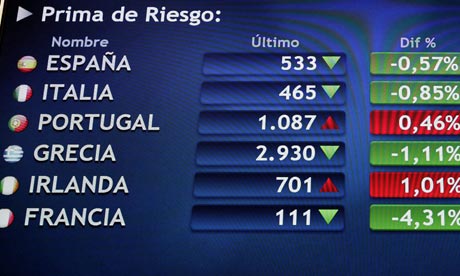
Bond trading - eurozone risk premiums (versus German bonds). Photograph: Sergio Barrenechea/EPA
World markets plunged to their lowest level this year as poor US jobless figures and weak manufacturing data from Europe sparked renewed fears of a global slowdown.
European risk premiums at the Spanish floor in Madrid, Spain, 01 June 2012As traders sold off shares in favour of safer assets such as gold, the FTSE 100 in London fell 1.14% to close at 5260.19, its lowest level since 25 November last year. European markets also ended sharply lower, with Germany's Dax down nearly 3.5%, France's Cac down 2.2% and Spain's Ibex off by 0.4%. In the US, the Dow Jones industrial average had fallen more than 220 points - or 1.8% - by the time London closed. After overnight falls in Asia following signs of a slowdown in China, the MSCI world index hit its lowest level since December.
The day's economic data went from bad to worse, with the eurozone manufacturing sector suffering its worst month since June 2009 and its jobless rate hitting a record high of 11%. In the UK the manufacturing sector sufferered its second-biggest fall in 20 years, according to the latest purchasing managers' index.
Then came the widely watched US non-farm payroll numbers, which showed a rise in employment of just 69,000 in May, compared with forecasts of a 150,000 gain. This was the third set of disappointing numbers, while April's gain of 115,000 jobs was revised down to an increase of 77,000. That prompted an immediate fall in the US dollar against the euro and the yen, with unconfirmed talk the Bank of Japan might have intervened to help stop the slide in the US currency.
All this added to growing fears the eurozone crisis was spiralling out of control. With Spain increasingly in the firing line, the cost of insuring its debt against default hit a record high. The move followed reports that Spain will not announce details of a mechanism to ease the funding problems of its heavily indebted regions today, as hoped.
In Greece left wing leader Alexis Tsipras, gaining ground in the opinion polls ahead of this month's election, ratcheted up his rhetoric against the EU's bailout terms for the country. He repeated his pledge to rip up the bailout agreement if elected, and threatened to take Greece out of Nato.
Signs that Ireland had voted in favour of the European fiscal treaty in Thursday's referendum did little to soothe investors' nerves. But gold gained ground, adding around 3% to $1,613 as traders sought safer assets.
With the global economy running out of steam, oil was on the slide, with Brent crude falling more than 3% to $98 a barrel.

Bank Run in Spain!


Spaniards alarmed by the dire state of their banks are squirreling money abroad at the fastest rate since records began, figures showed on Thursday, and the credit ratings of eight regions were cut.

The UN Wants Complete Control Over The Internet And That Would Mean Unprecedented Censorship, Taxes And Surveillance

One of the fastest ways to ruin the Internet would be to put the United Nations in charge of it.  Unfortunately, that is exactly what the United Nations wants.  The United Nations is now pushing very hard for complete control over the Internet. A proposal that has the support of China, Russia, India, Brazil, Saudi Arabia and Iran would give control of the Internet to the UN’s International Telecommunication Union.  This is perhaps the greatest threat to the free and open Internet that we have seen yet.  At a UN conference in Dubai this upcoming December, representatives from 193 nations will debate this proposal.  The United States and many European nations are firmly against this proposal, but it is unclear whether they have the votes to stop it.  Unlike the Security Council, there are no vetoes when it comes to ITU proceedings.  So the United States may not be able to stop governance of the Internet from being handed over to the United Nations.  The United States could opt out of any new treaty, but that would result in a “balkanized” Internet.  If the UN gains control over the Internet, you can expect a whole new era of censorship, taxes, and surveillance.  It would be absolutely catastrophic for the free flow of commerce and information around the globe.  Unfortunately, many repressive regimes are very dissatisfied with how the Internet is currently working and they desperately want to be able to use the power of the UN to tax, regulate and censor the Internet.  Needless to say, that would be a disaster.  International control over the Internet would be a complete and total nightmare and it must be resisted.
Top Internet experts are sounding the alarm bells about this proposal as well.  The following comes from a recent CNET article….
Vint Cerf, Google’s chief Internet evangelist, co-creator of the TCP/IP protocol, and former chairman of ICANN, said the ITU meeting could lead to “top-down control dictated by governments” that could impact free expression, security, and other important issues.
“The open Internet has never been at a higher risk than it is now,” Cerf said.
Sadly, the United States cannot block this from happening.  As an article by Robert M. McDowell explained, all it is going to take for this proposal to be accepted is for a simple majority of the 193 UN members states to agree to it….
Regulation proponents only need to secure a simple majority of the 193 member states to codify their radical and counterproductive agenda. Unlike the U.N. Security Council, no country can wield a veto in ITU proceedings.
Once the ITU gains control, the United States and other nations could attempt to “opt out”, but that would create a “balkanized” Internet that would be much different than what we have today.
The powers that would be given to the ITU under the current proposal would be extraordinary.  A recent article in the Wall Street Journal summarized some of the powers that the ITU would be granted….
• Subject cyber security and data privacy to international control;
• Allow foreign phone companies to charge fees for “international” Internet traffic, perhaps even on a “per-click” basis for certain Web destinations, with the goal of generating revenue for state-owned phone companies and government treasuries;
• Impose unprecedented economic regulations such as mandates for rates, terms and conditions for currently unregulated traffic-swapping agreements known as “peering.”
• Establish for the first time ITU dominion over important functions of multi-stakeholder Internet governance entities such as the Internet Corporation for Assigned Names and Numbers, the nonprofit entity that coordinates the .com and .org Web addresses of the world;
• Subsume under intergovernmental control many functions of the Internet Engineering Task Force, the Internet Society and other multi-stakeholder groups that establish the engineering and technical standards that allow the Internet to work
Some members of the U.S. Congress are deeply concerned that ITU control over the Internet would also open the door for oppressive global taxation of Internet companies….
“Google, iTunes, Facebook, and Netflix are mentioned most often as prime sources of funding,” McDowell said. Added Rep. Anna Eshoo, a California Democrat whose district includes Facebook’s headquarters, many countries “don’t share our view of the Internet and how it operates.”
A lot of smaller nations are supporting this proposal because of the money it could mean for them.
Many developing nations see international control over the Internet as a potential revenue bonanza as a recent CNN articleexplained….
Also pushing for international controls are developing countries hungry not only for political control, but also for new sources of revenue. (Allowing foreign phone companies to collect fees on international traffic is one proposal under discussion.) Grenell, who saw the regulatory effort spring up from the beginning a decade ago, notes that developing countries at the U.N. “get excited about taking up global issues that will give them more control and influence over commerce, that require businesses to seek their input and approval.”
But taxation would not be the greatest threat to the free and open Internet.
Censorship would potentially be an even greater threat.
Do you really want China, Russia, Saudi Arabia and Iran to be involved in setting standards for what is “acceptable” communication over the Internet?
In China, Internet censorship has become an art form.
For example, check out the new regulations that were recently imposed on Chinese “microbloggers”….
A five-strikes-and-out rule will see anyone posting five tweets on “sensitive” subjects have their account on Sina’s Weibo suspended for 48 hours.
Anyone whose posts continue to irk the censors could then have their accounts closed permanently.
The code of conduct, which bans the spread of “state secrets”, “false information”, and anything that harms “national unity” went into force on Monday.
Would you like that kind of regulation to come to Facebook and Twitter?
Don’t think that it can’t happen.  The following excerpt from a recent CNET article should be sobering for all of us….
In 2008, CNET was the first to report that the ITU was quietly drafting technical standards, proposed by the Chinese government, to define methods of tracing the original source of Internet communications and potentially curbing the ability of users to remain anonymous. A leaked document showed the trace-back mechanism was designed to be used by a government that “tries to identify the source of the negative articles” published by an anonymous author.
Do you want China to be able to identify and locate you every time you say something bad about them on the Internet?
As I have written about previously, governments all over the world already use the Internet to spy on all of us.
How much worse would Internet surveillance become if the United Nations was in charge?
If the United Nations gets control over the Internet, that will be a giant step toward the United Nations becoming a true world government.  The Internet has become an essential part of our daily lives, and allowing the UN to govern it would give them an extraordinary amount of power over all of us.
Please do what you can to raise awareness about this potential UN takeover of the Internet.  Hopefully we can raise enough of a fuss that the UN will back down for a while.

Bilderberg 2012: Are Bankers Still “All For Obama” Like They Were in ’08?

One of the many questions arising from the Bilderberg meeting starting today is whether the bankers who gather are still “all for Obama”- as New Mexico Governor and former democratic presidential candidate Bill Richardson has stated they were back in 2008.
In a meeting of the Council on Foreign Relations on June 18 of that year, Richardson stated that Barack Obama was favored for the American presidency by a majority of bankers at the Bilderberg-meeting- which, like the one this year, took place near Chantilly, Virginia. Although Richardson himself didn’t attend in 2008, the revealing statement was confided to him by attendee Marie-Josée Kravis, senior fellow at the Hudson Institute, who is a Bilderberg regular and did participate in the elitist get-together that year.
In response to a question by CFR-moderator Garrick Utley on the fact that candidate Barack Obama did not pull as much votes from the Hispanic communities as Hillary Clinton did, Richardson told the assembly that as long as people get to know the then Illinois Senator, he’s sure to win their votes. Bill Richardson:
“He is a minority himself with an internationalist background – let me tell you—(…) I was just talking to Marie-Josee – some of the people who attended the Bilderberg conferences. The most conservative bankers—they’re all for Obama!
After making this statement, Richardson appears to hesitate, adding:
“I mean, I don’t know—and I think you’re seeing this nationally”
Important to note here that it would be another 5 months before Barack Obama was actually declared winner of the presidential election. In this slip of the tong by Richardson (himself a two-time Bilderberg attendee) we are shown another glimpse into the murmurings going on around the secretive Bilderberg campfire. So, which banking heads were attending the 2008 Bilderberg-meeting anyway?
To name just a few:
- Robert B. Zoellick, president of The World Bank Group
– Jean-Claude Trichet, president of the European Central Bank
– Timothy Geithner, (then) President and CEO Federal Reserve Bank of New York
– Ben S. Bernanke, chairman Board of Governors of the Federal Reserve System
– Frank McKenna, Deputy Chair TD Bank Financial Group
– Tom McKillop, Chairman of the Royal Bank of Scotland Group
In regards to Obama being regarded as an ideal president by the bulk of international bankers may not be a surprise. When we look at the president’s monetary policy for the last four years we can see an international agenda unfolding which is consistent with that of the European Central Bank, the Federal Reserve, the Bank of International Settlements and other transnational leviathans that regularly attend the elitist confab. Fiscal conservatism isn’t exactly consistent with the “global consensus” between all the major central banks.
Recent speculations in regards to Mitt Romneys VP-pick, and the role Bilderberg may play in that decision, is consistent with Bilderberg’s modus operandi: talent-scouting by Bilderberg’s steering-committee is being done on both sides of the spectrum, just like the participants of Bilderberg cover all sides of the political paradigm.