Sunday, April 27, 2008

Government Officials Love Eminent Domain


Governor joins list of those opposed to Prop. 98
By Michael Gardner
U-T SACRAMENTO BUREAU
4:25 p.m. April 25, 2008
SACRAMENTO – Citing fears that passage could stymie important water development and other public works projects, Gov. Arnold Schwarzenegger said Friday he opposes a ballot measure that would greatly restrict the ability of government to seize private property.
“Eminent domain is an issue worth addressing, however Proposition 98 would undermine California's ability to improve our infrastructure, including our water delivery and storage,” Schwarzenegger said in a prepared statement.
“California voters strongly support rebuilding our transportation, housing, education and water infrastructure, so it would be irresponsible to support a measure that would prevent the state from accomplishing our goals,” he added.
Schwarzenegger joins a growing list of influential figures to oppose Proposition 98, including U.S. Sen. Dianne Feinstein, a Democrat, and former Gov. Pete Wilson, a Republican.
Jon Coupal, executive director of the Howard Jarvis Taxpayers Association, said in an earlier interview the governor's decision would have little effect on the outcome.
Coupal pointed out most political power brokers lined up against Proposition 13, the landmark property tax protection initiative. Nevertheless, it passed handily in 1978.
“At the grass roots level, this is about individuals and their property rights,” he said.
Schwarzenegger did not take a position on Proposition 99, a narrower measure limited to imposing some restrictions on taking single-family homes.

In An Effort To Disuade The Use Of cash


Paying cash? That'll cost extra
Posted: Friday, April 25 at 05:00 am CT by Bob Sullivan
Rhonda Payne went to an AT&T Wireless store in Calhoun, Ga., recently to pay her phone bill in cash. She'd been hit by ID theft and was forced to close her checking account, so she was worried she wouldn’t be able to mail a check on time. But when she arrived at the store, she was in for a surprise.
Paying in person, she was told, costs extra -- $2 extra.
Payne objected to the "administrative charge" that was added to her bill but got no sympathy. Instead, she said, she was told she should consider herself lucky because the fee was about to go up to $5.
"I was told that it was a courtesy to take cash,” she said. “I said, ‘Are you kidding me?'”
It’s no joke. Beginning earlier this year, AT&T Wireless began to charge customers who pay their bills in their stores.
"It is a way of saving money ... it helps us keep our costs lower," said AT&T spokesman Mark Siegel. "We want our associates to spend their time helping customers as they are thinking about their wireless plans or looking at phones."
There are multiple ways for consumers to pay their bills for free, he added -- in the mail, by electronic payment and on the Web. There are even kiosks in stores where bill payments can be dropped off for free. But having a sales clerk take the payment costs extra.
"If someone really wants to pay using the service of a representative, we think it's appropriate to assess this fee," Siegel said.
The fee might remind some of the "talk-to-a-teller" fee introduced by First National Bank of Chicago in 1995. Siegel said such fees are routine in other industries, too, citing credit cards as an example.
In fact, most credit card issuers do charge a similar fee, called "pay-to-pay." Consumers who call up banks to pay their credit card bills -- often at the last minute to avoid interest charges or late fees – often are assessed "pay-to-pay" fees ranging from $5 to $15. The practice has recently drawn scrutiny in Congress, and a credit card reform bill introduced by Sen. Carl Levin , D-Mich., would ban the practice.
Hurts the poor mostConsumer advocate Ed Mierzwinski, director of the U.S. Public Interest Research Group, said he's concerned about AT&T's new fee for another reason: It hits poor people hardest because they are most likely to pay in stores.
"It's targeted at people who don't have bank accounts,” he said. “...It's punitive and largely indefensible."It's just unfair to me and I'm shocked by it. People that have less money have to pay more to pay their bills. … It hurts people that really don't have a choice."
Studies show that 10 million to 12 million Americans don't have bank accounts and have to pay their bills in cash, he said. Some are undocumented workers; others are consumers who have bounced too many checks in the past and are ineligible for checking accounts. Sometimes called the "unbanked," consumers who live in this cash economy are finding it harder and harder to maintain basic services, Mierzwinski said.
"I think (AT&T’s fee) is going to lead to more companies charging more to people who want to pay with cash," he said.
Siegel denied that AT&T was targeting cash customers and said his company offers pay-as-you-go pre-paid phones that are better suited for consumers who want to pay in cash.Payne has complained to state regulators and to the Federal Communications Commission, but hasn't received a refund -- or an explanation that satisfies her.
"This fee charged by AT&T is ripping off poor people," she said. "I've told everybody I know about this."

Chinese Buy To Repress


At Trade Show, China’s Police Shop for the West’s Latest
KEITH BRADSHERNY TimesSaturday, April 26, 2008
BEIJING — For the Chinese police agency boss who thought he had everything, the police equipment trade show here was a chance to scrutinize the latest offerings from manufacturers around the world for secretly copying computer hard drives, suppressing riots or collecting video surveillance of public streets.
China’s crackdown in Tibet after violent protests there has set off strong criticism from human rights groups and confrontations in several countries between police officers and demonstrators during the Olympic torch relay. But here in China, the world’s fastest-growing market for security and crime-control equipment, it is business as usual between Western multinationals and Chinese police agencies.
At the recent China International Exhibition on Police Equipment here, sponsored by the Ministry of Public Security, DuPont had a large exhibit promoting Kevlar bulletproof fabric for riot police use. Motorola was selling police radio systems as well as wireless systems for transmitting vast quantities of video surveillance data.

And with the slogan “dress to kill” on their black T-shirts, top executives from Magnum of Britain showed off their latest police boots. “Chinese police deserve the best — Magnum protects the protectors,” said Paul Brooks, the company’s president, in a speech to police officials.
The most intriguing device offered at the show to senior Chinese security agency officials was the Image Masster RoadMasster, a powerful computer system that swiftly copies computer hard drives without leaving any trace and comes concealed in its own color-coordinated briefcase.
Gonen Ravid, the chief executive of the device’s manufacturer, Intelligent Computer Solutions in Chatsworth, Calif., said that the company sells exactly the same equipment in the same briefcases to the Pentagon for use in Iraq, and to the Central Intelligence Agency and other Western intelligence agencies for use around the world.
No company in China makes similar equipment, he said. “The U.S.,” he said, “is still leading with this.”

Nicely Said...............................


"The legislative has no right to absolute power over the lives and fortunes of the people; nor can mortals assume a prerogative not only too high for men, but for angels, and therefore reserved for the exercise of the Deity alone." -Samuel Adams

Big Brother's Mobile Cameras


Mobile surveillance cameras on prowl in Port Richmond
Philadelphia Business JournalFriday, April 25, 2008
Mobile surveillance cameras have been put in use in the Port Richmond section of Philadelphia as a means of catching and deterring illegal dumpers, officials announced Thursday.
The cameras are a joint effort of the Richmond Corridor Association and Manufacturing Alliance of Philadelphia (MAP) and went into use last week.
Fewer than 10 cameras in all will be used by officials, who will station them periodically at problem areas to record activity around-the-clock. The mobile cameras, which were funded by an $80,000 Neighborhood Transformation Initiative grant, will be used along with fixed cameras, Steve Jurash, CEO of MAP, said.
"What makes them unique is they are mobile, they are moving around so you never know where they are," Jurash said. "Throughout the city there are various fixed cameras and there will be more as time goes by, but this gives citizen groups the ability to target an area that really becomes a problem, whether it's dumping, graffiti or vandalism."
Those caught dumping will face the maximum penalty, including the seizure of their vehicles, Jurash said.

Free Trade.............What Is It Good For?


Colombia FTA Based on Failed NAFTA Model
Dana Gabriel Intel Strike
The Colombia Free Trade Agreement (FTA) was signed in November of 2006, and if ratified, would expand NAFTA to the region. In fact, it would be the largest Western Hemisphere pact since NAFTA. Past free trade deals have failed to live up to the promise of prosperity, and have served to further benefit multinational corporations. This one appears to be no different.
In an effort to pass the Colombia FTA, President Bush used the national security card much like he did with CAFTA. House Speaker Nancy Pelosi flexed a little muscle, passing a motion to exempt the accord from the 90-day legislative deadline. This had many opponents of the agreement prematurely celebrating, and news headlines stating it was dead. In reality, all the vote did was delay matters for the time being. The Democrats are on record as saying that they don’t want to kill the accord, and only wish to postpone and use it as leverage. This delay could affect the approval of pending trade agreements with South Korea and Panama.
There have been some question marks surrounding Pelosi’s leadership, and there are accusations that her latest move amounts to nothing more than playing politics. As it stands right now, the accord would have little chance of passing. Some have suggested that in actuality, her actions might insure its future passage. She might succeed in getting a few concessions, and proclaim that the Democrats along with U.S. and Colombian workers have won some major victory. What shouldn’t be overlooked in this power move is the constitutional authority that Congress still has over branches of the federal government, but all too often fails to exercise.
The Colombia FTA threatens U.S. sovereignty, and would allow foreign corporations to challenge food safety regulations and environmental protections as barriers to trade. It further promotes privatization and deregulation of key public services. There has been a push for Latin American governments to sell national water resources to private corporations. This trade agreement also provides these corporations with another source of cheap labor and threatens American workers by placing them in competition with Colombia ’s lower wages. This will lead to further depressed wages and the loss of more jobs. Despite assurances to the contrary, it undermines labor and environmental standards.
The Colombian government has one of the worst human rights violations records in the region, and has come under fire for its links to paramilitary death squads. It is one of the most dangerous places for trade unionists, as many have been killed. Promoting human rights should be a priority, and corrupt and scandalous regimes should not be rewarded unless there are dramatic changes. Many of President Alvaro Uribe’s closest political associates and members of his family have been sent to prison or are under investigation for ties to paramilitary death squads and drug traffickers. This is a government that does not value human rights, freedom, democracy, and the rule of law. This accord would give the Colombian government international approval and recognition, and it sends the wrong message.
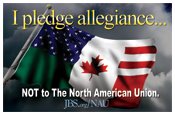
The Colombia FTA is part of the destructive cycle of other trade deals that have sacrificed more then they have gained. It would allow for the further domination of U.S. trade policies by multinational corporations, and the surrender of more sovereignty. It is another move for more central economic and political governance. This is also taking place with the continued integration of Canada , the U.S. , and Mexico into a North American Union. The Colombia FTA is essentially taking the Security and Prosperity Partnership structure to Latin America , and will be used as a stepping stone to the FTAA and the creation of a Pan-American Union.

Thursday, April 24, 2008

Start Stockpiling...................Really


Wall Street Warns Americans To Begin Stockpiling Food
Darryl MasonYour New Reality Thursday, April 24, 2008
The New York Times recently told its more wealthy readers to consider buying a rural cottage, or even log cabin, to ride out the water and food riots that militarised police forces are preparing and training for, and now Wall Street recommends its readers to begin stockpiling rice and cereals, not only to fend off hunger but as an investment opportunity :
Food prices are already rising here much faster than the returns you are likely to get from keeping your money in a bank or money-market fund. And there are very good reasons to believe prices on the shelves are about to start rising a lot faster.
"Load up the pantry," says Manu Daftary, one of Wall Street's top investors and the manager of the Quaker Strategic Growth mutual fund. "I think prices are going higher. People are too complacent. They think it isn't going to happen here. But I don't know how the food companies can absorb higher costs."
The latest data show cereal prices rising by more than 8% a year. Both flour and rice are up more than 13%. Milk, cheese, bananas and even peanut butter: They're all up by more than 10%. Eggs have rocketed up 30% in a year. Ground beef prices are up 4.8% and chicken by 5.4%.
You can't easily stock up on perishables like eggs or milk. But other products will keep. Among them: Dried pasta, rice, cereals, and cans of everything from tuna fish to fruit and vegetables. The kicker: You should also save money by buying them in bulk.
If this seems a stretch, ponder this: The emerging bull market in agricultural products is following in the footsteps of oil. A few years ago, many Americans hoped $2 gas was a temporary spike. Now it's the rosy memory of a bygone age.

The readers of the Wall Street Journal now know it's time to get busy stockpiling. For good reasons. Shortages of rice and other essentials are now being reported in American cities :
Many parts of America, long considered the breadbasket of the world, are now confronting a once unthinkable phenomenon : Major retailers in New York, in areas of New England, and on the West Coast are limiting purchases of flour, rice, and cooking oil as demand outstrips supply. There are also anecdotal reports that some consumers are hoarding grain stocks.
At a Costco Warehouse in Mountain View, Calif., yesterday, shoppers grew frustrated and occasionally uttered expletives as they searched in vain for the large sacks of rice they usually buy.
"Where's the rice?" an engineer from Palo Alto, Calif., Yajun Liu, said. "You should be able to buy something like rice. This is ridiculous."
"There have been so many stories about worldwide shortages that it encourages people to stock up. What most people don't realize is that supply chains have changed, so inventories are very short," Mr.Rawles , a former Army intelligence officer, said. "Even if people increased their purchasing by 20%, all the store shelves would be wiped out."
An anonymous high-tech professional writing on an investment Web site, Seeking Alpha, said he recently bought 10 50-pound bags of rice..."I am concerned that when the news of rice shortage spreads, there will be panic buying and the shelves will be empty in no time. I do not intend to cause a panic, and I am not speculating on rice to make profit. I am just hoarding some for my own consumption," he wrote.The presidential Bush family's favourite newspaper, the Washington Times, notes the rapidly growing chaos and panic in American food industries, and the demented greed of Wall Street :
Farmers and food executives appealed fruitlessly to federal officials yesterday for regulatory steps to limit speculative buying that is helping to drive food prices higher. Meanwhile, some Americans are stocking up on staples such as rice, flour and oil in anticipation of high prices and shortages spreading from overseas.Community Futures Trading Commission (CFTC)....regulators said high prices are mostly the result of soaring world demand for grains combined with high fuel prices and drought-induced shortages in many countries.Costco and other grocery stores in California reported a run on rice, which has forced them to set limits on how many sacks of rice each customer can buy. Filipinos in Canada are scooping up all the rice they can find and shipping it to relatives in the Philippines, which is suffering a severe shortage that is leaving many people hungry.While farmers here and abroad generally are benefiting from the high prices, even they have been burned by a tidal wave of investors and speculators pouring into the futures markets for corn, wheat, rice and other commodities and who are driving up prices in a way that makes it difficult for farmers to run their businesses.U.S. wheat stocks are at the lowest levels in 60 years because worldwide consumption of wheat has exceeded production in six of the past eight years, said U.S. Agriculture Department chief economist GeraldBange . Adding to tight supplies was the back-to-back failure of two years of wheat crops caused by drought in Australia, a major wheat exporter, he said.In addition, the diversion of one-third of the U.S. corn crop into making ethanol for vehicles has increased prices for corn and other staples such as soybeans and cotton as more acreage is set aside for ethanol production.The upswing in prices has been exaggerated by the massive influx of investors and speculators seeking to profit from rising prices for corn, wheat, oil, gold and other commodities. Big Wall Street firms and hedge funds have taken huge positions in futures markets that once were dominated by relatively small operators such as farmers and grain-elevator owners.Oil speculation helped drive the price of a barrel beyond $100, and now 'food speculators' are going to do the same for the food you need to buy to feed your family. And the government doesn't want to stop it happening.Maybe they're hoping Monsanto with save the day, and bellies, of Americans with GM crops, but the 'miracle' of GM crops is turning out to be little more than clever marketing. Monsanto now admits their genetically modified crops do not actually produce higher yields of rice and grains. More food from less acreage is something they aspire to achieve, not something they can actually do yet.Food prices will stay high simply because oil prices will never drop below $100 again. It will only ever increase, drop back a few dollars, then increase again. We're already being softened up by oil cartels and governments to expect $200 a barrel prices within the next few years.When oil hits $150 a barrel, trucking and freight companies will start projecting big losses, and will reconsider whether it pays to service longer, less profitable routes to smaller urban population pockets. The sort of places that need nearly everything trucked in, but produce little to truck back out again. When the delivery trucks slow, or cease altogether, most supermarkets will be emptied of food within a few days.Soaring food prices, and food shortages, are impacting across the world.In Japan, people are trying to cope with the savage shock of shortages of staple foods, stunning rises in the price of rice and emptying supermarket shelves :
"I went to another supermarket, and then another, and there was no butter at those either. Everywhere I went there were notices saying Japan has run out of butter. I couldn't believe it.."
Japan's acute butter shortage, which has confounded bakeries, restaurants and now families across the country, is the latest unforeseen result of the global agricultural commodities crisis.
A sharp increase in the cost of imported cattle feed and a decline in milk imports, both of which are typically provided in large part by Australia, have prevented dairy farmers from keeping pace with demand.
While soaring food prices have triggered rioting among the starving millions of the third world, in wealthy Japan they have forced a pampered population to contemplate the shocking possibility of a long-term — perhaps permanent — reduction in the quality and quantity of its food.The wealthy can only afford to buy the food that the poor cannot while that food is still available. When supplies run out, they too must either go without, grow their own or pay absurd prices for what was, only last year, so cheap.How bad could global food shortages ultimately get? The lives of many hundreds of millions who have never known hunger before are threatened.Will we be reduced to the pitiful state of Haitians, who have been driven by food shortages and extreme hunger to start eating the earth beneath their feet?
...the one business booming amid all the gloom is the selling of patties made of mud, oil and sugar...
“It’s salty and it has butter and you don’t know you’re eating dirt,” said Olwich Louis Jeune, 24, who has taken to eating them more often in recent months. “It makes your stomach quiet down.”The age of cheap and plentiful food, at least from supermarkets, is clearly over.All governments need to encourage backyard, and balcony, food gardens. Houses that will never sell and are decaying can be bulldozed to make way for community farms. There are at least two or three dozen villages in England returning to thispre-20th century method of feeding the people and bringing the community together. For city dwellers, however, even those with balcony gardens crowded with carrots, tomatoes, herbs, salad greens and citrus trees, the food staples like milk, cooking oil, butter and wheat, however, will continue to grow only more expensive.The psychological impact for most Americans of seeing food riots in their towns and cities will be immense, and destructive.