U.S.D. R.I.P.
"The call for more money to fix the financial markets comes just as global inflation is beginning to cause real mischief...”
EVEN IN DEATH, it seems you're no longer safe from the iniquities of inflation.
In Cheshire, England, a man has just been charged with stealing 400 bronze memorial plaques from his local crematorium. Bronze is 90% copper, and thanks to the price of copper quadrupling inside four years, the melt value of those RIPs now stands above 145,000 pounds — some $290,000 at today's exchange rate.
Outside the Garden of Remembrance, beware the evils of inflation at dinnertime, too. Fishmongers in Thailand have been disguising meat from the deadly, and therefore worthless, puffer fish as salmon, reports the Associated Press, killing 15 people in the last three years.
Health and safety officials in Beijing, in the meantime, just raided a "recycled" chopsticks factory. It has been selling up to 100,000 pairs of used disposable bamboo chopsticks per day, without using any kind of disinfectant first.
In the United States, "My wife came back from Wal-Mart," writes a reader of my Whiskey & Gunpowder colleague Mike Shedlock's Global Economic Analysis, "complaining about her favorite major brand chicken breast patties going from 15 per pack about a year ago to 12 this winter to 10 per package at the same price recently."
Also here at Whiskey, Fred Sheehan notes the same trend — the trend of $1 buying less stuff with each day that passes. General Mills, the giant U.S. food maker behind Lucky Charms and Cheerios, warned back in March that "input costs" were due to rise. Now the Minneapolis Star Tribune reports, "Customers will actually see lower prices per box, but the cereal boxes will be smaller, so the effect is a price increase of a few percent."
This kind of creeping inflation — route No. 1 to giving you less stuff in return for each dollar, pound, euro, or yen that you spend — is nothing new, of course. On the shelves of the candy store just next-door to our offices here at BullionVault in London, the king-size Mars Bar ain't what it used to be. It ain't even what the standard Mars Bar used to be, either.
"Among the things money can't buy is what it used to," as Max Kauffman, the comedian, joked in the 1950s. But U.S. consumers have since lost their sense of humor. The dollar has dropped another 86% of its purchasing power since then.
So where next for the flight to safety? Here in the United Kingdom, and despite the pound sterling breaking back above $2 already this week, the cost of living has risen 30 times over since 1945.
Put another way, the pound — strongest of the world's five major currencies in 2007 — now buys only 3.3% of the "stuff" that it bought at the end of the World War II. With the U.K. money supply still growing by 13% year over year, the trade-off between quantity and quality has only become clearer.
Less stuff per pound or dollar is as plain a definition of inflation as you'll ever find. It works when prices rise — the common-or-garden use of the word — and it also works when rising prices are hidden by shrinking the size of what money buys.
In the inflation-crazed '70s, corporations "discovered that they could increase profits and expand market share by degrading their product, advertising relentlessly, packaging it in a different form, and raising its unit price," reports David Hackett Fisher in The Great Wave, his grand history of price revolutions across the last eight centuries. But less stuff per dollar wasn't just a corporate strategy. It became a necessity as input prices rose across manufacturing, home building, transport, and, most crucially, the consumer goods sector.
David Slawson, a U.S. economist, made a study of this "competitive inflation" in the price of chocolate bars. They rose sevenfold between the late 1950s-1983 in a series of small 5 cent increments. "Each increase was disguised by making the bar larger at the same time," he found, "the size of the bar having been gradually decreased since the time of the last price rise."
Fast-forward 25 years, and what price a midmorning Snickers as summer '07 drips through the guttering? The spot market in cocoa has taken a tumble so far this month, after forecasts of an oversized surplus in the 2007-2008 season. But the price of drinking a cup of tea in England rose by 5.5% in the year to July, according to the official government data.
At the sillier end of the hot beverages market, rising prices have finally forced me to swap my favorite cup of overpriced foam for an inferior bucket of what passes for coffee. The government's statisticians might call this "substitution" — and as I'm now getting more liquid for less money, they might call the net result a drop in my cost of living, too!
But mud-flavored water — like secondhand chopsticks, unwashed and resold — does not mean the value of the cash in my wallet has risen.
"Governments are often tempted to answer the cry for more purchasing power by simply creating more money," Jerry L. Jordan — a central banker, of all people — wrote in a recent issue of the Federal Reserve Bank of St. Louis Review. "But in so doing, the opposite effect is achieved — the purchasing power of money is actually reduced."
"The result," Jordan continues, "is inflation: a rise in the number of dollars required to purchase a given standard of living."
Put another way, the current crisis in world investment markets will only increase the quantity of money — not its quality — even if fresh central bank lending somehow manages to bail out the world's biggest investment banks. (Bailing out U.S. homeowners, whether through a dramatic return to the "emergency" interest rates of 2003 or by creating new money — out of thin air — to refinance their mortgage debt, will do just the same.)
One defense that cash savers and hard-put investors might choose is gold bullion. No one's credit-backed promise, and impossible to create at will, gold remains as far from today's mountain of complex financial junk as an investor can get.
Thursday, August 30, 2007


Way To Go, H2O

Be a Smart Investor, Own Water
By Chris MayerAugust 23, 2007
It’s no surprise to you that we have been seeing one of the most volatile markets of this century. It should also be no surprise to you that it takes sound investments to actually make money in times like these. I’d like to share with you one way to navigate around the falling share prices of late.
In the rising tide of market volatility, the sinking level of worldwide water supply provides us with a fundamentally sound investment theme. Simply put, water is precious, especially when you don't have it.
The New York City pipe explosion last month gave us a sneak preview of what the problems here in the U.S. are. Pipes that stretch across the entire U.S. like are ready to burst like the one on 41st and Lexington did. And, to my surprise, people still haven’t put it together. Water companies are still trading for unbelievably low prices.
The water theme has many facets. There are water pipemakers and filtration companies, irrigation equipment, water pumps and more. The facet I want to focus on here is just the basic resource itself — owning actual water — because the investment backdrop for a rising water price looks pretty good from here.
The Financial Times recently highlighted the salient population-based facts. Take a look at this chart:
The chart shows how water use has grown faster than population growth. In fact, annual world water use rose six-fold — more than double the rate of population growth. What does it mean? The FT opines, "One unavoidable consequence will be that the price of water will rise substantially."
I would agree. When you study where population growth is greatest, you come to find out that it is in areas where water is most scarce. Look at the U.S., for example. The two fastest-growing populations in the country are those of Nevada and Arizona. Projections from the U.S. Census Bureau show that shouldn't change anytime soon.
The American West is already a dry and arid place. This past spring was the sixth driest on record. In some states — such as Georgia, Alabama, Tennessee and Mississippi — it was the driest spring in 113 years. Drought conditions persist into summer in many parts of the country. About two-thirds of the Southwest is in some form of drought.
Wildfires have devoured hundreds of thousands of acres of valuable timberland. (A recent fire in the Lake Tahoe basin was the worst in half a century.) Crop losses start to add up. And now drought threatens the Midwest, the heart of the ethanol boom and home to record levels of corn acreage. It should only get drier as the years roll by. No matter what you believe about what's causing this pretty little blue and green planet of ours to warm, it is nonetheless warming. And everyone seems to agree that certain places will get drier and hotter.
As the Financial Times noted: "By the year 2070, Stockholm and Oslo will have 'moved' in terms of weather to central Spain, while Mediterranean resorts will suffer conditions comparable to Saharan Africa today." Likewise, the already arid American West will get even drier and hotter. The year 2070 is a long way off, of course. I like to think of myself as a long-term investor, but I ain't that long term! Still, these trends provide a powerful backdrop for rising water prices.
Right now, there are some absurd anomalies in water markets around the world, because governments provide, or heavily regulate, most of the water consumers use. So you have situations in which water costs 90% more in Barcelona than in Valencia (which is farther down the Spanish coast), even though water is far scarcer in Valencia than Barcelona. And you have absurdities such as those that occur in California. Farmers consume 80% of California's water.
California's infamous alfalfa growers drink up 25% of the state's water. However, because of government subsidies, they pay between $2-20 per acre-foot for water — that's only about 10% of the water's full economic cost. There is little incentive to cut water use when rates are this low. [An acre-foot is basically what it takes to flood a plain of one acre to a depth of one foot. One acre-foot can supply enough water for one family of four for a whole year.]
In Europe, the government still provides two-thirds of the water supply. In America, it's 85%. In Asia, it's 95%. Water has been too cheap for too long. And years of government ownership have, not surprisingly, led to neglect of these systems.
In the U.K., "where the water sector is mainly privately owned," the FT says, "and prices probably reflect costs more accurately, prices are the third highest in the world — 66% above those in the U.S." We'll pay more for our water one way or another, or we won't have it.
In certain Western states, you can see how much people pay for water by looking at contracts between the owner of water rights and utilities (and other end-users). The price per acre-foot is tens of thousands of dollars in some places.
The price of water has nowhere to go but up.
It’s no surprise to you that we have been seeing one of the most volatile markets of this century. It should also be no surprise to you that it takes sound investments to actually make money in times like these. I’d like to share with you one way to navigate around the falling share prices of late.
In the rising tide of market volatility, the sinking level of worldwide water supply provides us with a fundamentally sound investment theme. Simply put, water is precious, especially when you don't have it.
The New York City pipe explosion last month gave us a sneak preview of what the problems here in the U.S. are. Pipes that stretch across the entire U.S. like are ready to burst like the one on 41st and Lexington did. And, to my surprise, people still haven’t put it together. Water companies are still trading for unbelievably low prices.
The water theme has many facets. There are water pipemakers and filtration companies, irrigation equipment, water pumps and more. The facet I want to focus on here is just the basic resource itself — owning actual water — because the investment backdrop for a rising water price looks pretty good from here.
The Financial Times recently highlighted the salient population-based facts. Take a look at this chart:
The chart shows how water use has grown faster than population growth. In fact, annual world water use rose six-fold — more than double the rate of population growth. What does it mean? The FT opines, "One unavoidable consequence will be that the price of water will rise substantially."
I would agree. When you study where population growth is greatest, you come to find out that it is in areas where water is most scarce. Look at the U.S., for example. The two fastest-growing populations in the country are those of Nevada and Arizona. Projections from the U.S. Census Bureau show that shouldn't change anytime soon.
The American West is already a dry and arid place. This past spring was the sixth driest on record. In some states — such as Georgia, Alabama, Tennessee and Mississippi — it was the driest spring in 113 years. Drought conditions persist into summer in many parts of the country. About two-thirds of the Southwest is in some form of drought.
Wildfires have devoured hundreds of thousands of acres of valuable timberland. (A recent fire in the Lake Tahoe basin was the worst in half a century.) Crop losses start to add up. And now drought threatens the Midwest, the heart of the ethanol boom and home to record levels of corn acreage. It should only get drier as the years roll by. No matter what you believe about what's causing this pretty little blue and green planet of ours to warm, it is nonetheless warming. And everyone seems to agree that certain places will get drier and hotter.
As the Financial Times noted: "By the year 2070, Stockholm and Oslo will have 'moved' in terms of weather to central Spain, while Mediterranean resorts will suffer conditions comparable to Saharan Africa today." Likewise, the already arid American West will get even drier and hotter. The year 2070 is a long way off, of course. I like to think of myself as a long-term investor, but I ain't that long term! Still, these trends provide a powerful backdrop for rising water prices.
Right now, there are some absurd anomalies in water markets around the world, because governments provide, or heavily regulate, most of the water consumers use. So you have situations in which water costs 90% more in Barcelona than in Valencia (which is farther down the Spanish coast), even though water is far scarcer in Valencia than Barcelona. And you have absurdities such as those that occur in California. Farmers consume 80% of California's water.
California's infamous alfalfa growers drink up 25% of the state's water. However, because of government subsidies, they pay between $2-20 per acre-foot for water — that's only about 10% of the water's full economic cost. There is little incentive to cut water use when rates are this low. [An acre-foot is basically what it takes to flood a plain of one acre to a depth of one foot. One acre-foot can supply enough water for one family of four for a whole year.]
In Europe, the government still provides two-thirds of the water supply. In America, it's 85%. In Asia, it's 95%. Water has been too cheap for too long. And years of government ownership have, not surprisingly, led to neglect of these systems.
In the U.K., "where the water sector is mainly privately owned," the FT says, "and prices probably reflect costs more accurately, prices are the third highest in the world — 66% above those in the U.S." We'll pay more for our water one way or another, or we won't have it.
In certain Western states, you can see how much people pay for water by looking at contracts between the owner of water rights and utilities (and other end-users). The price per acre-foot is tens of thousands of dollars in some places.
The price of water has nowhere to go but up.
Gold Is All You Really Need To Know

What You Probably Didn’t Know About the U.S. Dollar and Gold
The collapse of the “strong dollar policy” of that period formed one of the major premises of my case for gold at the time. However, by early 2005, as the currency reached my original target and began bouncing off its long-term lows, I recommended that clients no longer bet against the dollar, because I felt that the dollar would level off. Still, I wrote, gold prices were going to make their biggest move yet. As subsequent events proved, I had that one right.
Now, the gold story is this: The value of money is in danger of dropping precipitously again, and it is increasingly likely that the world monetary system will have another brush with hyperinflation akin to what occurred in the 1970s, except this time, worse.
The evidence supporting this thesis is devastating, yet this story is scarcely factored into gold values, let alone financial markets. That is, we have seen a rush to gold when the foreign exchange value of the U.S. dollar has crumbled, whenever some geopolitical boiling point has been reached, when other commodities have left the station, because the Chinese and Indian economies were heating up, and so on. But there has yet to be a significant enough deterioration of confidence in central banking institutions, or the quasi-fiat money they produce, to herald the kind of buying in which a person is “anxious to swap his money against ‘real’ goods, no matter whether he needs them or not, no matter how much money he has to pay for them,” according to Ludwig von Mises.
The evidence suggests we are headed there, but it also suggests that the most spectacular part of the bull market in gold must still lie ahead of us.
But the most interesting part about these “spectacular” moves in gold, where the market’s spotlight focuses entirely on the gold story (the greatest story never told), is the behavior of the currency markets.
What Most Investors Don’t Know About Gold and the U.S. Dollar
The biggest moves in the gold price occur when the foreign exchange value of the U.S. dollar is stable.
Did you get that? It may initially sound counterintuitive, but after reading this article, it shouldn’t.
Consider first the fact that the largest moves in gold's free-trading history occurred in four brief periods each lasting two-three years: 1973-1975, 1978-1980, 1985-1987, and 2005-? We know that the first two of these occurred during bull markets in gold, the third one in a bear market rally, and the last one we believe to be a bull market move, which can hardly be considered arguable at this point. As a matter of fact, the two former periods and the last (current) one have something important in common — they saw the lowest (inverse) correlations with the currency. That is, they occurred when the U.S. dollar had reached some level of relative stability following a two-three year collapse in its foreign exchange rate.
Since we are still in the midst of the final period, I used the current gold and dollar price for the table, while measuring all the other periods from trough to peak.
But if we take the high in gold prices last year as our peak, the gain in gold was actually 70%, and the U.S. dollar lost just 2% in this period — instead of the 51% and 0% originally in the table — hence making it more substantial than the bear market rally of 1985-1987, when the U.S. dollar dropped more precipitously…and nothing yet suggests those trends have ended.
Since its 1971 fix, the price of gold is up some 1,750%, or 18.5-fold.
Everyone will notice the general inverse relationship between the dollar and the gold price that can be seen in the chart, but it is not a well-known fact that the gains in the price of gold that occurred in the top three bull market moves alone (shaded regions in the above data series), where exchange rates were most stable, explain nearly two-thirds of this whole move in gold prices — more than $400 of the gain from $35 to $650 — while the U.S. dollar’s foreign exchange rate fell less than 5% net.
If we apply the 1970s model to the current move that started in 2005, we would suggest that it could end in late 2007 with a run in gold prices to somewhere between $900-1,200, and the dollar might well be only a few points from where it is today when it all blows over. Both of the instances of dollar stability in the ’70s saw the most spectacular gains in the gold price, and by all counts, the same factors are at play today. Investors were surely just as surprised by it then as they will be today.
There are a lot of strong arguments for why the dollar should continue to new lows. For instance:
It is no longer an intrinsically viable reserve currency
China may buy fewer dollars
The size of the U.S. trade deficit still suggests that it is cheaper to import goods than produce in U.S.
The trend in interest rate differentials probably favors the foreign currencies in the medium term.
But these arguments may already be factored in the medium-term (three-18 months) currency outlook, and attention should perhaps be drawn to the overlooked bullish arguments favoring the U.S. dollar.
For some of these arguments have potency, yet are least considered.
Here are two very important arguments for this time horizon:
Money supply inflation by international central banks has exceeded the Fed’s for four years
Risk premiums have more upside adjustment in foreign currencies than in the U.S. dollar
Don’t worry if you don’t understand these things.
The main point of this article is to illustrate the historical precedent behind a potentially bullish gold price explosion, regardless of whether the U.S. dollar makes new lows or not.
The historical fact is that gold’s biggest moves occur when the U.S. dollar is relatively stable.
Now you know what few people do.
The collapse of the “strong dollar policy” of that period formed one of the major premises of my case for gold at the time. However, by early 2005, as the currency reached my original target and began bouncing off its long-term lows, I recommended that clients no longer bet against the dollar, because I felt that the dollar would level off. Still, I wrote, gold prices were going to make their biggest move yet. As subsequent events proved, I had that one right.
Now, the gold story is this: The value of money is in danger of dropping precipitously again, and it is increasingly likely that the world monetary system will have another brush with hyperinflation akin to what occurred in the 1970s, except this time, worse.
The evidence supporting this thesis is devastating, yet this story is scarcely factored into gold values, let alone financial markets. That is, we have seen a rush to gold when the foreign exchange value of the U.S. dollar has crumbled, whenever some geopolitical boiling point has been reached, when other commodities have left the station, because the Chinese and Indian economies were heating up, and so on. But there has yet to be a significant enough deterioration of confidence in central banking institutions, or the quasi-fiat money they produce, to herald the kind of buying in which a person is “anxious to swap his money against ‘real’ goods, no matter whether he needs them or not, no matter how much money he has to pay for them,” according to Ludwig von Mises.
The evidence suggests we are headed there, but it also suggests that the most spectacular part of the bull market in gold must still lie ahead of us.
But the most interesting part about these “spectacular” moves in gold, where the market’s spotlight focuses entirely on the gold story (the greatest story never told), is the behavior of the currency markets.
What Most Investors Don’t Know About Gold and the U.S. Dollar
The biggest moves in the gold price occur when the foreign exchange value of the U.S. dollar is stable.
Did you get that? It may initially sound counterintuitive, but after reading this article, it shouldn’t.
Consider first the fact that the largest moves in gold's free-trading history occurred in four brief periods each lasting two-three years: 1973-1975, 1978-1980, 1985-1987, and 2005-? We know that the first two of these occurred during bull markets in gold, the third one in a bear market rally, and the last one we believe to be a bull market move, which can hardly be considered arguable at this point. As a matter of fact, the two former periods and the last (current) one have something important in common — they saw the lowest (inverse) correlations with the currency. That is, they occurred when the U.S. dollar had reached some level of relative stability following a two-three year collapse in its foreign exchange rate.
Since we are still in the midst of the final period, I used the current gold and dollar price for the table, while measuring all the other periods from trough to peak.
But if we take the high in gold prices last year as our peak, the gain in gold was actually 70%, and the U.S. dollar lost just 2% in this period — instead of the 51% and 0% originally in the table — hence making it more substantial than the bear market rally of 1985-1987, when the U.S. dollar dropped more precipitously…and nothing yet suggests those trends have ended.
Since its 1971 fix, the price of gold is up some 1,750%, or 18.5-fold.
Everyone will notice the general inverse relationship between the dollar and the gold price that can be seen in the chart, but it is not a well-known fact that the gains in the price of gold that occurred in the top three bull market moves alone (shaded regions in the above data series), where exchange rates were most stable, explain nearly two-thirds of this whole move in gold prices — more than $400 of the gain from $35 to $650 — while the U.S. dollar’s foreign exchange rate fell less than 5% net.
If we apply the 1970s model to the current move that started in 2005, we would suggest that it could end in late 2007 with a run in gold prices to somewhere between $900-1,200, and the dollar might well be only a few points from where it is today when it all blows over. Both of the instances of dollar stability in the ’70s saw the most spectacular gains in the gold price, and by all counts, the same factors are at play today. Investors were surely just as surprised by it then as they will be today.
There are a lot of strong arguments for why the dollar should continue to new lows. For instance:
It is no longer an intrinsically viable reserve currency
China may buy fewer dollars
The size of the U.S. trade deficit still suggests that it is cheaper to import goods than produce in U.S.
The trend in interest rate differentials probably favors the foreign currencies in the medium term.
But these arguments may already be factored in the medium-term (three-18 months) currency outlook, and attention should perhaps be drawn to the overlooked bullish arguments favoring the U.S. dollar.
For some of these arguments have potency, yet are least considered.
Here are two very important arguments for this time horizon:
Money supply inflation by international central banks has exceeded the Fed’s for four years
Risk premiums have more upside adjustment in foreign currencies than in the U.S. dollar
Don’t worry if you don’t understand these things.
The main point of this article is to illustrate the historical precedent behind a potentially bullish gold price explosion, regardless of whether the U.S. dollar makes new lows or not.
The historical fact is that gold’s biggest moves occur when the U.S. dollar is relatively stable.
Now you know what few people do.
Agriculture........It's All Agriculture

The Next Great Black Blizzard Is on Its Way
By Chris MayerAugust 30, 2007
A darkness blacker than night is how it was often described. At least one could pierce the black veil of night. Not so with this kind of darkness. It was opaque. People were afraid. It was only midmorning. They had never seen anything like it.
If you ventured outside into the cold and biting wind, sand would get in your nose and mouth and ears. You would hurry back inside and cough up black. While inside, people soaked sheets and towels. They would try to stuff them around windowsills and doorframes. But it didn't help much. Choking dust still filtered in. It spread out in little ripples on the floor and seeped through windowsills.
It was November 11, 1933 — Armistice Day, South Dakota.
When it was finally over, families would stumble out of their farmhouses and peer out at a new surrealist landscape. The fields were gone. The trees were no more. Just mounds of sand and eddies of dust swirling in the light autumn breeze. There were no roads. No tractors or machinery, no fences. All of it laid buried in sand. As one observer said, “The roofs of sheds stuck out through drifts deeper than a man is tall.”
The great Black Blizzard of 1933 destroyed acres of farmland stretching from the Texas Panhandle all through the Great Plains and clear to the Canadian border. The following day, the skies darkened over Chicago. A steady stream of filth fell on the city like snow. Even people as far east as Albany, New York could see the menacing dark clouds roll their way across the horizon. That winter, red snow fell softly on New England.
Yet 1933 was “only a prelude to disaster.” as Frederick Lewis Allen wrote in his panorama of the 1930s, Since Yesterday. In 1934 and 1935, the dust storms destroyed thousands and thousands of acres of farmland. The lives of more than half a million Americans changed forever. Many hit the road, forced to wander like refugees in their own land. Most headed west, looking for a new start.
The Dust Bowl was a seminal event in American history. Unlike a natural disaster such as a hurricane, “There was a long story of human error behind it,” as Allen wrote. After World War I, there was a great demand for wheat. Mechanized farming also became common. Farmers tore up the sod that covered the plains and farms expanded. Production soared.
The Great Plains was a region of high winds and light rainfall. Yet the 1920s were pretty forgiving in terms of drought. There were warnings, though, such as stories of topsoil blowing in Kansas after a stretch of dry, hot weather. But in the 1930s, we had some real droughts in these places. The combination of drought and desiccated farmland would create the epic Dust Bowl. “Retribution for the very human error of breaking the sod of the Plains had come in full measure,” Allen wrote.
I recently spent some time looking over pictures of the aftermath of these blizzards. They are incredible and simply hard to believe. Yet I see how something like this could happen again. Except this time, it will be bigger. And it will happen in China. But don't think it won't affect what happens in America. Plumes of dust emanating from northern China have already hit the U.S. mainland.
As Lester Brown, author of Outgrowing the Earth, explains: “With little vegetation remaining in parts of northern and western China, the strong winds of late winter and early spring can remove literally millions of tons of topsoil in a single day — soil that can take centuries to replace.” These dust storms are so strong that they can peel the paint off cars. They often force the closure of schools, airports and stores — even in places as far away as South Korea and Japan.
As with the Great Plains, northern China is dry and farmed intensely. Already, China's farmland is turning to desert at an alarming rate. Estimates peg the loss at more than 900 square miles per year. And Chinese farmers already struggle to meet the demands of the Chinese people.
There is limited arable land in northern China. So the Chinese rely more on fertilizers to boost yield. Currently, fertilizer use in China is more than three times the global average.
China's ability to produce the fertilizers it needs — in particular, potassium and phosphate — is limited. As a result, China is one of the largest importers of these fertilizers. This is one of the reasons companies (especially small caps that fill this niche market) like UAP Holding Corp. (NASDAQ: UAPH) thrive today.
So you have chunks of Chinese farmland turning into desert every year. You've got limited water resources in a dry region. Already you've got dust storms that kick up plumes of dust that travel thousands of miles. All of this is reminiscent of the U.S. in the 1930s.
We all have a stake in what happens in China. If China relied on the rest of the world for even 20% of its grain needs, there would be an incredible strain on the world's grain producers.
Many of the challenges China faces exist in the world at large already. Grain production per person is falling worldwide. So is cropland acreage per person. We are also approaching the limits of what fertilizers can do in terms of boosting crop yields. Plus, strong demand for biofuels — like ethanol — now competes with food demand.
By some estimates, we'll need to produce about 136 million tons of grain in 2007 to prevent grain stocks from falling again (they fell in 2006). Yet annual increases in grain production have averaged only about 20 million tons since 2000. That gives you something of a snapshot of the hurdle in front of us.
The investment conclusion from all this seems to be that we are in a long bull market for grains. Expect the prices of corn and wheat to keep rising. Expect the price of meat to rise. It also seems that fertilizer producers should continue to do well. Other ancillary ideas also come to mind — shippers of dry goods (i.e., grains) and manufacturers of farm equipment.
The potential for another 1930s-style Dust Bowl only adds to the power and durability of these trends.
A darkness blacker than night is how it was often described. At least one could pierce the black veil of night. Not so with this kind of darkness. It was opaque. People were afraid. It was only midmorning. They had never seen anything like it.
If you ventured outside into the cold and biting wind, sand would get in your nose and mouth and ears. You would hurry back inside and cough up black. While inside, people soaked sheets and towels. They would try to stuff them around windowsills and doorframes. But it didn't help much. Choking dust still filtered in. It spread out in little ripples on the floor and seeped through windowsills.
It was November 11, 1933 — Armistice Day, South Dakota.
When it was finally over, families would stumble out of their farmhouses and peer out at a new surrealist landscape. The fields were gone. The trees were no more. Just mounds of sand and eddies of dust swirling in the light autumn breeze. There were no roads. No tractors or machinery, no fences. All of it laid buried in sand. As one observer said, “The roofs of sheds stuck out through drifts deeper than a man is tall.”
The great Black Blizzard of 1933 destroyed acres of farmland stretching from the Texas Panhandle all through the Great Plains and clear to the Canadian border. The following day, the skies darkened over Chicago. A steady stream of filth fell on the city like snow. Even people as far east as Albany, New York could see the menacing dark clouds roll their way across the horizon. That winter, red snow fell softly on New England.
Yet 1933 was “only a prelude to disaster.” as Frederick Lewis Allen wrote in his panorama of the 1930s, Since Yesterday. In 1934 and 1935, the dust storms destroyed thousands and thousands of acres of farmland. The lives of more than half a million Americans changed forever. Many hit the road, forced to wander like refugees in their own land. Most headed west, looking for a new start.
The Dust Bowl was a seminal event in American history. Unlike a natural disaster such as a hurricane, “There was a long story of human error behind it,” as Allen wrote. After World War I, there was a great demand for wheat. Mechanized farming also became common. Farmers tore up the sod that covered the plains and farms expanded. Production soared.
The Great Plains was a region of high winds and light rainfall. Yet the 1920s were pretty forgiving in terms of drought. There were warnings, though, such as stories of topsoil blowing in Kansas after a stretch of dry, hot weather. But in the 1930s, we had some real droughts in these places. The combination of drought and desiccated farmland would create the epic Dust Bowl. “Retribution for the very human error of breaking the sod of the Plains had come in full measure,” Allen wrote.
I recently spent some time looking over pictures of the aftermath of these blizzards. They are incredible and simply hard to believe. Yet I see how something like this could happen again. Except this time, it will be bigger. And it will happen in China. But don't think it won't affect what happens in America. Plumes of dust emanating from northern China have already hit the U.S. mainland.
As Lester Brown, author of Outgrowing the Earth, explains: “With little vegetation remaining in parts of northern and western China, the strong winds of late winter and early spring can remove literally millions of tons of topsoil in a single day — soil that can take centuries to replace.” These dust storms are so strong that they can peel the paint off cars. They often force the closure of schools, airports and stores — even in places as far away as South Korea and Japan.
As with the Great Plains, northern China is dry and farmed intensely. Already, China's farmland is turning to desert at an alarming rate. Estimates peg the loss at more than 900 square miles per year. And Chinese farmers already struggle to meet the demands of the Chinese people.
There is limited arable land in northern China. So the Chinese rely more on fertilizers to boost yield. Currently, fertilizer use in China is more than three times the global average.
China's ability to produce the fertilizers it needs — in particular, potassium and phosphate — is limited. As a result, China is one of the largest importers of these fertilizers. This is one of the reasons companies (especially small caps that fill this niche market) like UAP Holding Corp. (NASDAQ: UAPH) thrive today.
So you have chunks of Chinese farmland turning into desert every year. You've got limited water resources in a dry region. Already you've got dust storms that kick up plumes of dust that travel thousands of miles. All of this is reminiscent of the U.S. in the 1930s.
We all have a stake in what happens in China. If China relied on the rest of the world for even 20% of its grain needs, there would be an incredible strain on the world's grain producers.
Many of the challenges China faces exist in the world at large already. Grain production per person is falling worldwide. So is cropland acreage per person. We are also approaching the limits of what fertilizers can do in terms of boosting crop yields. Plus, strong demand for biofuels — like ethanol — now competes with food demand.
By some estimates, we'll need to produce about 136 million tons of grain in 2007 to prevent grain stocks from falling again (they fell in 2006). Yet annual increases in grain production have averaged only about 20 million tons since 2000. That gives you something of a snapshot of the hurdle in front of us.
The investment conclusion from all this seems to be that we are in a long bull market for grains. Expect the prices of corn and wheat to keep rising. Expect the price of meat to rise. It also seems that fertilizer producers should continue to do well. Other ancillary ideas also come to mind — shippers of dry goods (i.e., grains) and manufacturers of farm equipment.
The potential for another 1930s-style Dust Bowl only adds to the power and durability of these trends.
Funny, This Stuff Was Never In My History Books.........

How Britain put Nazis' top men to work
Stewart PayneLondon TelegraphThursday Aug 30, 2007
German scientists and technicians were abducted at the end of the Second World War and made to work in Britain as part of a secret programme to plunder the defeated nation's trade secrets and intellectual assets, declassified government documents have revealed.
An elite British Army unit captured hundreds of Germans in possession of Nazi scientific and technical know-how and transported them across the Channel to work in government ministries and private companies.
Others were forced to travel to Britain, where they were interviewed by commercial rivals and detained if they did not reveal trade secrets.
The unit, known as T-Force, was lightly armed and highly mobile.
Following the D-Day landings it was tasked with seizing anything of scientific or military value.
The purpose was two-fold. Initially the scramble to uncover Nazi military secrets in the dying days of the war was seen as helpful in ending the conflict in the Far East and a method by which Britain could benefit from German knowledge to give it a commercial edge as it rebuilt its war-ravaged economy.
As the Cold War developed, it was also part of a campaign to prevent the Soviet Union from benefiting from Nazi scientific and industrial assets.
The Foreign Office papers, marked "top secret" and discovered at the National Archives at Kew, show that, in addition to those Germans believed to have volunteered to work in Britain, hundreds more were rounded up and transported to the UK against their will.
The documents concede that methods used resembled those of the Gestapo, Nazi Germany's secret police.
A memo written by a civil servant working with the British military in Germany in August 1946 explained the procedure. "Usually an NCO arrives without notice at the house or office of the German and warns that he will be required.
He does not give him any details of the reasons, nor does he present his credentials.
"Some time later the German is seized (often in the middle of the night) and removed under guard."
"This procedure savours very much of the Gestapo methods and, quite apart from causing great and unnecessary inconvenience to the individual and to the industry employing him, it is bound to create feelings of alarm and insecurity."
The abductions were carried out in the British-controlled zone of post-war Germany on the orders of two organisations.
One, the British Intelligence Objectives Sub-Committee (Bios) was made up of armed forces and Whitehall representatives, and was answerable to the Cabinet.
The other was the Field Information Agency (Technical), or Fiat, a joint Anglo-American military intelligence unit that earmarked scientists for "enforced evacuation" from US and French zones, and from Berlin.
Both had offices in London from where investigators would be sent to Germany, looking for human resources as well as machinery that could be shipped back to Britain. Representatives from leading companies such as ICI, BSA Tools, and Courtaulds were included in the teams.
After the war, T-Force was formed into the Enemy Personnel Exploitation Section, which escorted Bios and Fiat investigators, and took away the scientists and technicians identified as being in possession of knowledge useful to the UK.
After interrogation, which could last for months, they were either released or put to work in Britain. Those who worked were paid 15 shillings (75p) a week.
The files suggest that up to 1,500 scientists and technicians were identified for removal to the UK "whether they are willing or not".
All the occupying powers used various methods to loot Germany of its scientific and technical know-how. By 1947 there was concern that this was impeding Germany's reconstruction, and the programmes were stopped.
The policy of forcing scientists to work in the UK changed to offering them contracts, with many taking up work with British aerospace and armaments companies.
Stewart PayneLondon TelegraphThursday Aug 30, 2007
German scientists and technicians were abducted at the end of the Second World War and made to work in Britain as part of a secret programme to plunder the defeated nation's trade secrets and intellectual assets, declassified government documents have revealed.
An elite British Army unit captured hundreds of Germans in possession of Nazi scientific and technical know-how and transported them across the Channel to work in government ministries and private companies.
Others were forced to travel to Britain, where they were interviewed by commercial rivals and detained if they did not reveal trade secrets.
The unit, known as T-Force, was lightly armed and highly mobile.
Following the D-Day landings it was tasked with seizing anything of scientific or military value.
The purpose was two-fold. Initially the scramble to uncover Nazi military secrets in the dying days of the war was seen as helpful in ending the conflict in the Far East and a method by which Britain could benefit from German knowledge to give it a commercial edge as it rebuilt its war-ravaged economy.
As the Cold War developed, it was also part of a campaign to prevent the Soviet Union from benefiting from Nazi scientific and industrial assets.
The Foreign Office papers, marked "top secret" and discovered at the National Archives at Kew, show that, in addition to those Germans believed to have volunteered to work in Britain, hundreds more were rounded up and transported to the UK against their will.
The documents concede that methods used resembled those of the Gestapo, Nazi Germany's secret police.
A memo written by a civil servant working with the British military in Germany in August 1946 explained the procedure. "Usually an NCO arrives without notice at the house or office of the German and warns that he will be required.
He does not give him any details of the reasons, nor does he present his credentials.
"Some time later the German is seized (often in the middle of the night) and removed under guard."
"This procedure savours very much of the Gestapo methods and, quite apart from causing great and unnecessary inconvenience to the individual and to the industry employing him, it is bound to create feelings of alarm and insecurity."
The abductions were carried out in the British-controlled zone of post-war Germany on the orders of two organisations.
One, the British Intelligence Objectives Sub-Committee (Bios) was made up of armed forces and Whitehall representatives, and was answerable to the Cabinet.
The other was the Field Information Agency (Technical), or Fiat, a joint Anglo-American military intelligence unit that earmarked scientists for "enforced evacuation" from US and French zones, and from Berlin.
Both had offices in London from where investigators would be sent to Germany, looking for human resources as well as machinery that could be shipped back to Britain. Representatives from leading companies such as ICI, BSA Tools, and Courtaulds were included in the teams.
After the war, T-Force was formed into the Enemy Personnel Exploitation Section, which escorted Bios and Fiat investigators, and took away the scientists and technicians identified as being in possession of knowledge useful to the UK.
After interrogation, which could last for months, they were either released or put to work in Britain. Those who worked were paid 15 shillings (75p) a week.
The files suggest that up to 1,500 scientists and technicians were identified for removal to the UK "whether they are willing or not".
All the occupying powers used various methods to loot Germany of its scientific and technical know-how. By 1947 there was concern that this was impeding Germany's reconstruction, and the programmes were stopped.
The policy of forcing scientists to work in the UK changed to offering them contracts, with many taking up work with British aerospace and armaments companies.
Oh Boy! More Fireworks!
The next war?
Arnaud De Borchgrave
UPIThursday Aug 30, 2007
After a brief interruption of his New Hampshire vacation to meet President Bush in the family compound at Kennebunkport, Maine, French President Nicolas Sarkozy came away convinced his U.S. counterpart is serious about bombing Iran's secret nuclear facilities. That's the reading as it filtered back to Europe's foreign ministries:Addressing the annual meeting of France's ambassadors to 188 countries, Sarkozy said either Iran lives up to its international obligations and relinquishes its nuclear ambitions or it will be bombed into compliance.
Sarkozy also made clear he did not agree with the Iranian-bomb-or-bombing-of-Iran position, which reflects the pledge Bush made to his loyalists and endorsed by GOP presidential candidate Sen. John McCain and independent Sen. Joe Lieberman.
But Sarkozy recognized unless Iran's theocrats stop enriching uranium to weapons-grade levels under International Atomic Energy Agency inspection, we will all be "faced with an alternative that I call catastrophic."
(Article continues below)
A ranking Swiss official, speaking privately, said, "Anyone with a modicum of experience in the Middle East knows that any bombing of Iran would touch off at the very least regional instability and what could be an unmitigated disaster for Western interests."
Leaks about the Bush administration's plan to brand Iran's 125,000-strong Revolutionary Guards a global terrorist organization are widely interpreted as a major step on the escalator to military action.
Belatedly, Saudi Arabia, the world's largest oil producer, has signed a contract with Lockheed Martin for the training of 35,000 elite guards to be assigned to the protection of the kingdom's widely scattered oil installations.
With 25 percent of the world's oil reserves, Riyadh has earmarked $5 billion to train and field what will be a high-tech force ASAP. Eighteen months ago the desert kingdom was jolted by an al-Qaida terrorist squad that managed to penetrate the first two layers of defenses at Abqaiq, the nerve center of the entire oil infrastructure.
Iranian President Mahmoud Ahmadinejad has now stated publicly his country holds the key to the conditions of a U.S. withdrawal from Iraq. Prime Minister Nouri al-Maliki, much criticized by the United States for his lack of leadership and deserted by half his Cabinet, is much praised in Tehran, where he has gone twice in 11 months to confer with Iranian leaders. Ahmadinejad also says Iran is ready to fill the power vacuum in Iraq following a U.S. withdrawal.
"The political power of the occupiers is collapsing rapidly," he said, "and soon we will see a huge power vacuum in the region." The United States is not alone in trying to prove Ahmadinejad's geopolitical weather forecast wrong.
Saudi Arabia and its Gulf Cooperation Council allies in the Gulf, Egypt and Jordan are terrified at the idea of Iraq falling under Iranian domination. Hoping to head off a U.S.-Iran military confrontation, European countries are still pinning their hopes on major Iranian concessions at the IAEA in Vienna. Iran is back to cooperating with the IAEA -- but only one comma or semicolon at a time.
The three EU countries acting as U.S. surrogates on nuclear matters with Iran and IAEA chief Mohamed ElBaradei detect progress where the United States sees only stalling. Iran is still resisting short-notice inspections of sites that are not officially declared nuclear facilities and where secret nuclear work is believed to be taking place.
Tehran's only objective at the IAEA and the U.N. Security Council is to head off further economic sanctions by its major EU trading partners -- thus, the mantra that its only interest in nuclear matters is as an alternative source of energy in a country already awash in oil taxes credulity.
Both the Bush administration and Israel are painstakingly fashioning a casus belli with Iran. For Israel, the training and weapons support Iran furnishes Hezbollah in Lebanon (now with more rockets of all kinds than it had before the 2006 war when it fired 4,000 into Israel) and Hamas in Gaza (now equipped with Katyusha rockets and a range of 10.6 miles), coupled with Ahmadinejad's existential threats against the Jewish state, are sufficient evidence to justify airstrikes against Iran's nuclear facilities.
And for the White House, there is daily evidence of Iran's Revolutionary Guards meddling in Iraq, from improvised explosive devices made in Iran to behind-the-scenes dominance in the affairs of the oil-rich south.
Arnaud De Borchgrave
UPIThursday Aug 30, 2007
After a brief interruption of his New Hampshire vacation to meet President Bush in the family compound at Kennebunkport, Maine, French President Nicolas Sarkozy came away convinced his U.S. counterpart is serious about bombing Iran's secret nuclear facilities. That's the reading as it filtered back to Europe's foreign ministries:Addressing the annual meeting of France's ambassadors to 188 countries, Sarkozy said either Iran lives up to its international obligations and relinquishes its nuclear ambitions or it will be bombed into compliance.
Sarkozy also made clear he did not agree with the Iranian-bomb-or-bombing-of-Iran position, which reflects the pledge Bush made to his loyalists and endorsed by GOP presidential candidate Sen. John McCain and independent Sen. Joe Lieberman.
But Sarkozy recognized unless Iran's theocrats stop enriching uranium to weapons-grade levels under International Atomic Energy Agency inspection, we will all be "faced with an alternative that I call catastrophic."
(Article continues below)
A ranking Swiss official, speaking privately, said, "Anyone with a modicum of experience in the Middle East knows that any bombing of Iran would touch off at the very least regional instability and what could be an unmitigated disaster for Western interests."
Leaks about the Bush administration's plan to brand Iran's 125,000-strong Revolutionary Guards a global terrorist organization are widely interpreted as a major step on the escalator to military action.
Belatedly, Saudi Arabia, the world's largest oil producer, has signed a contract with Lockheed Martin for the training of 35,000 elite guards to be assigned to the protection of the kingdom's widely scattered oil installations.
With 25 percent of the world's oil reserves, Riyadh has earmarked $5 billion to train and field what will be a high-tech force ASAP. Eighteen months ago the desert kingdom was jolted by an al-Qaida terrorist squad that managed to penetrate the first two layers of defenses at Abqaiq, the nerve center of the entire oil infrastructure.
Iranian President Mahmoud Ahmadinejad has now stated publicly his country holds the key to the conditions of a U.S. withdrawal from Iraq. Prime Minister Nouri al-Maliki, much criticized by the United States for his lack of leadership and deserted by half his Cabinet, is much praised in Tehran, where he has gone twice in 11 months to confer with Iranian leaders. Ahmadinejad also says Iran is ready to fill the power vacuum in Iraq following a U.S. withdrawal.
"The political power of the occupiers is collapsing rapidly," he said, "and soon we will see a huge power vacuum in the region." The United States is not alone in trying to prove Ahmadinejad's geopolitical weather forecast wrong.
Saudi Arabia and its Gulf Cooperation Council allies in the Gulf, Egypt and Jordan are terrified at the idea of Iraq falling under Iranian domination. Hoping to head off a U.S.-Iran military confrontation, European countries are still pinning their hopes on major Iranian concessions at the IAEA in Vienna. Iran is back to cooperating with the IAEA -- but only one comma or semicolon at a time.
The three EU countries acting as U.S. surrogates on nuclear matters with Iran and IAEA chief Mohamed ElBaradei detect progress where the United States sees only stalling. Iran is still resisting short-notice inspections of sites that are not officially declared nuclear facilities and where secret nuclear work is believed to be taking place.
Tehran's only objective at the IAEA and the U.N. Security Council is to head off further economic sanctions by its major EU trading partners -- thus, the mantra that its only interest in nuclear matters is as an alternative source of energy in a country already awash in oil taxes credulity.
Both the Bush administration and Israel are painstakingly fashioning a casus belli with Iran. For Israel, the training and weapons support Iran furnishes Hezbollah in Lebanon (now with more rockets of all kinds than it had before the 2006 war when it fired 4,000 into Israel) and Hamas in Gaza (now equipped with Katyusha rockets and a range of 10.6 miles), coupled with Ahmadinejad's existential threats against the Jewish state, are sufficient evidence to justify airstrikes against Iran's nuclear facilities.
And for the White House, there is daily evidence of Iran's Revolutionary Guards meddling in Iraq, from improvised explosive devices made in Iran to behind-the-scenes dominance in the affairs of the oil-rich south.
It's A Test, Right?

Russian Far East naval exercises no threat to neighbors - Pacific Fleet
RIA NovostiThursday Aug 30, 2007
Naval exercises being held off Russia's Far East coast are defense-oriented and pose no threat to any neighboring Asian state, a Navy official said Thursday.
The weeklong exercises, which began Wednesday, are being conducted by the Primorye flotilla of the Pacific Fleet in the Russian sector of the Sea of Japan. The maneuvers involve over 20 surface ships, submarines and supply vessels, as well as about a dozen aircraft.
Captain 1st rank Roman Martov, the head of the Pacific Fleet press center, said these are scheduled combat exercises of diversified forces.
"These exercises will become the longest and most comprehensive maneuvers ever held in south Primorye waters," said Martov.
Besides missile and gunnery firing, and torpedo attacks, the exercises will feature missile interceptions by two large Anti-Submarine Warfare ships, the Admiral Panteleyev and Admiral Tributs [NATO codename Udaloy I].
RIA NovostiThursday Aug 30, 2007
Naval exercises being held off Russia's Far East coast are defense-oriented and pose no threat to any neighboring Asian state, a Navy official said Thursday.
The weeklong exercises, which began Wednesday, are being conducted by the Primorye flotilla of the Pacific Fleet in the Russian sector of the Sea of Japan. The maneuvers involve over 20 surface ships, submarines and supply vessels, as well as about a dozen aircraft.
Captain 1st rank Roman Martov, the head of the Pacific Fleet press center, said these are scheduled combat exercises of diversified forces.
"These exercises will become the longest and most comprehensive maneuvers ever held in south Primorye waters," said Martov.
Besides missile and gunnery firing, and torpedo attacks, the exercises will feature missile interceptions by two large Anti-Submarine Warfare ships, the Admiral Panteleyev and Admiral Tributs [NATO codename Udaloy I].
Wednesday, August 29, 2007
Bye Bye Gonzales! Oh and FUCK YOU!
So Long Mr. Gonzales, and Don't Let the Door Hit You on the Way Out!
For what they may be worth, these are my thoughts on the announced resignation of U.S. Attorney General Gonzales.
During the Gonzales tenure, I have been highly critical of many of his decisions and actions that I and many others believe repeatedly have violated the laws and Constitution of the United States.
I agree with Timothy Lynch, director of the libertarian Cato Institute's Project on Criminal Justice, who also has been one of Gonzales's longtime critics. He noted the resignation as welcome news for two reasons.
First, Gonzales has given the President terribly wrong legal advice on a range of constitutional and legal issues, from habeas corpus to military tribunals to the PATRIOT Act. Second, Gonzales has relayed a pattern of misleading statements on a host of issues to Congress, the courts, and the public.
In "Gonzales Must Go," an op-ed written in May, Lynch said: "Truth be told, Gonzales's tenure is more scandalous even than the mess he created by firing eight federal prosecutors. ...Even outside of the context of the war against al-Qaeda, Alberto Gonzales has been an embarrassment. In area after area - from habeas corpus to separation of powers to executive responsibility - he has sought to strip out the limits that the Constitution places on presidential power. His fiasco regarding the firing of federal prosecutors is a petty offense when compared to the legal advice that he has conveyed to the President. The real scandal is his disregard for constitutional principles." (You can read his full views yourself by clicking here .)
What also needs to be said is that while Gonzales himself can and should be faulted, the responsibility for his actions and for the repeated violations of the Constitution must be attributed to President Bush, who nominated him and who has acquiesced in these acts and events.
We can only hope that whoever succeeds Gonzales, the United States Department of Justice and the government as a whole will return to the rule of law from which this administration has deviated in ways unprecedented in our nation's history.
For what they may be worth, these are my thoughts on the announced resignation of U.S. Attorney General Gonzales.
During the Gonzales tenure, I have been highly critical of many of his decisions and actions that I and many others believe repeatedly have violated the laws and Constitution of the United States.
I agree with Timothy Lynch, director of the libertarian Cato Institute's Project on Criminal Justice, who also has been one of Gonzales's longtime critics. He noted the resignation as welcome news for two reasons.
First, Gonzales has given the President terribly wrong legal advice on a range of constitutional and legal issues, from habeas corpus to military tribunals to the PATRIOT Act. Second, Gonzales has relayed a pattern of misleading statements on a host of issues to Congress, the courts, and the public.
In "Gonzales Must Go," an op-ed written in May, Lynch said: "Truth be told, Gonzales's tenure is more scandalous even than the mess he created by firing eight federal prosecutors. ...Even outside of the context of the war against al-Qaeda, Alberto Gonzales has been an embarrassment. In area after area - from habeas corpus to separation of powers to executive responsibility - he has sought to strip out the limits that the Constitution places on presidential power. His fiasco regarding the firing of federal prosecutors is a petty offense when compared to the legal advice that he has conveyed to the President. The real scandal is his disregard for constitutional principles." (You can read his full views yourself by clicking here .)
What also needs to be said is that while Gonzales himself can and should be faulted, the responsibility for his actions and for the repeated violations of the Constitution must be attributed to President Bush, who nominated him and who has acquiesced in these acts and events.
We can only hope that whoever succeeds Gonzales, the United States Department of Justice and the government as a whole will return to the rule of law from which this administration has deviated in ways unprecedented in our nation's history.
The Canadian Side Of The NAU Superhighway


The Reality of Canadian Planning for the NAFTA Superhighway
By Larry Greenley
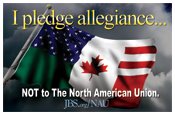
On August 21 both the "Three Amigos" at the SPP Summit in Montebello and a FoxNews panel laughed off any notions of the reality of the North American Union and the NAFTA Superhighway.
Follow this link to the original source: "'Special Report' Panel on Low Approval Ratings for Democratic Congress; 'North American Union'"
COMMENTARY:
At a press conference at the SPP Summit on August 21, the "Three Amigos" laughed off any notion that a North American Union and a NAFTA Superhighway are being planned and developed (transcript and video). Later the same day a FoxNews panel laughed off the same ideas with one of the panelists comparing concern over a North American Union with belief that Elvis is still alive (transcript; video).
One of the FoxNews panelists, Juan Williams, went so far as to say: "In fact, that map that you showed ... there is some reality to the highway from Mexico going up through Texas into Oklahoma. But there is no reality to those red veins at the northern part, there is just no reality to it yet." Comparison of the FoxNews map with a more detailed NAFTA Superhighway map from the John Birch Society (also on pp. 24-25 of this 5 MB pdf) shows that one of those northern "red veins" scoffed at by Williams goes through Toronto, Ottawa, Montreal, and Quebec, Canada's prime NAFTA trade corridor.
Remember that no one is saying that the NAFTA Superhighway is already constructed, or that most of it is under construction. Rather, what many individuals and organizations, such as the John Birch Society, are saying is that the NAFTA Superhighway is being planned by government agencies and non-governmental organizations in the U.S., Mexico, and Canada with some construction already occurring in Texas on the Trans-Texas Corridor.
So let's see if there is any evidence that the Canadian portion of the NAFTA Superhighway is being planned. Well, here's one very interesting document, "Embracing the Future: The Atlantic Gateway and Canada's Trade Corridor," a study prepared last year for the Asia Pacific Foundation of Canada. It states:
Since the Canada-US Free Trade Agreement was signed with the US, later expanded to become NAFTA, Canadians have reoriented their trade links away from a national focus (east-west) to a North American focus (north-south).... As globalization proceeds, not as an offset to US-Canada trade or NAFTA enlargement and integration, but as a close complimentary advantage, Canada must adjust its thinking and design transportation strategies accordingly....
Notice that this study is saying that NAFTA has led Canadians to a new focus on North American north-south trade, which requires Canada to adjust its thinking and design transportation strategies in accordance with NAFTA enlargement and integration.
Next, consider that on July 30 this year the governments of Canada, Ontario, and Quebec announced the signing of a Memorandum of Understanding (MOU) on the development of the Ontario-Quebec Continental Gateway and Trade Corridor. The official press release stated:
Canada's New Government has developed a National Policy Framework for Strategic Gateways and Corridors to advance the competitiveness of the Canadian economy in the rapidly changing field of global commerce.... Future federal gateway and corridor strategies will be guided by this framework, focused on transportation systems of road, rail, marine and air infrastructure of national significance to international commerce.
This planned Ontario-Quebec Continental Gateway, which corresponds to the northeastern "red vein" in the Canadian portion of the FoxNews NAFTA Superhighway map, mimics closely the integrated highway and railroad structure of the Trans-Texas Corridor, the widely acknowledged first segment of the NAFTA Superhighway in the U.S.
An article in MIT's Technology Review magazine, for June 30, 2006, provides in-depth insight as to how the Spanish company Cintra has become a leading player in superhighway toll road projects in both Canada and the U.S. It turns out that in 1999 Cintra, working in conjunction with Australia's Macquarie Bank, won a 99-year contract to operate Toronto's Highway 407 toll road, now already built and operating in 2007, which just so happens to run along Canada's premier NAFTA trade corridor.
Next, according to one commentator, "They've used the success of this very risky venture as a horse to ride through the U.S...." First, the Cintra combine bagged a 99-year deal to operate the Chicago Skyway in 2004, then a 75-year deal to operate the Indiana Toll Road. More recently and more notoriously, Cintra is partnering with the state of Texas for the development and operation of the Trans-Texas Corridor toll roads, the pioneering segment of the NAFTA Superhighway in the U.S.
The nervous laughter of the "Three Amigos" and FoxNews notwithstanding, planning for the northeastern "red vein" Canadian segment of the NAFTA Superhighway is very real indeed.
By Larry Greenley
On August 21 both the "Three Amigos" at the SPP Summit in Montebello and a FoxNews panel laughed off any notions of the reality of the North American Union and the NAFTA Superhighway.
Follow this link to the original source: "'Special Report' Panel on Low Approval Ratings for Democratic Congress; 'North American Union'"
COMMENTARY:
At a press conference at the SPP Summit on August 21, the "Three Amigos" laughed off any notion that a North American Union and a NAFTA Superhighway are being planned and developed (transcript and video). Later the same day a FoxNews panel laughed off the same ideas with one of the panelists comparing concern over a North American Union with belief that Elvis is still alive (transcript; video).
One of the FoxNews panelists, Juan Williams, went so far as to say: "In fact, that map that you showed ... there is some reality to the highway from Mexico going up through Texas into Oklahoma. But there is no reality to those red veins at the northern part, there is just no reality to it yet." Comparison of the FoxNews map with a more detailed NAFTA Superhighway map from the John Birch Society (also on pp. 24-25 of this 5 MB pdf) shows that one of those northern "red veins" scoffed at by Williams goes through Toronto, Ottawa, Montreal, and Quebec, Canada's prime NAFTA trade corridor.
Remember that no one is saying that the NAFTA Superhighway is already constructed, or that most of it is under construction. Rather, what many individuals and organizations, such as the John Birch Society, are saying is that the NAFTA Superhighway is being planned by government agencies and non-governmental organizations in the U.S., Mexico, and Canada with some construction already occurring in Texas on the Trans-Texas Corridor.
So let's see if there is any evidence that the Canadian portion of the NAFTA Superhighway is being planned. Well, here's one very interesting document, "Embracing the Future: The Atlantic Gateway and Canada's Trade Corridor," a study prepared last year for the Asia Pacific Foundation of Canada. It states:
Since the Canada-US Free Trade Agreement was signed with the US, later expanded to become NAFTA, Canadians have reoriented their trade links away from a national focus (east-west) to a North American focus (north-south).... As globalization proceeds, not as an offset to US-Canada trade or NAFTA enlargement and integration, but as a close complimentary advantage, Canada must adjust its thinking and design transportation strategies accordingly....
Notice that this study is saying that NAFTA has led Canadians to a new focus on North American north-south trade, which requires Canada to adjust its thinking and design transportation strategies in accordance with NAFTA enlargement and integration.
Next, consider that on July 30 this year the governments of Canada, Ontario, and Quebec announced the signing of a Memorandum of Understanding (MOU) on the development of the Ontario-Quebec Continental Gateway and Trade Corridor. The official press release stated:
Canada's New Government has developed a National Policy Framework for Strategic Gateways and Corridors to advance the competitiveness of the Canadian economy in the rapidly changing field of global commerce.... Future federal gateway and corridor strategies will be guided by this framework, focused on transportation systems of road, rail, marine and air infrastructure of national significance to international commerce.
This planned Ontario-Quebec Continental Gateway, which corresponds to the northeastern "red vein" in the Canadian portion of the FoxNews NAFTA Superhighway map, mimics closely the integrated highway and railroad structure of the Trans-Texas Corridor, the widely acknowledged first segment of the NAFTA Superhighway in the U.S.
An article in MIT's Technology Review magazine, for June 30, 2006, provides in-depth insight as to how the Spanish company Cintra has become a leading player in superhighway toll road projects in both Canada and the U.S. It turns out that in 1999 Cintra, working in conjunction with Australia's Macquarie Bank, won a 99-year contract to operate Toronto's Highway 407 toll road, now already built and operating in 2007, which just so happens to run along Canada's premier NAFTA trade corridor.
Next, according to one commentator, "They've used the success of this very risky venture as a horse to ride through the U.S...." First, the Cintra combine bagged a 99-year deal to operate the Chicago Skyway in 2004, then a 75-year deal to operate the Indiana Toll Road. More recently and more notoriously, Cintra is partnering with the state of Texas for the development and operation of the Trans-Texas Corridor toll roads, the pioneering segment of the NAFTA Superhighway in the U.S.
The nervous laughter of the "Three Amigos" and FoxNews notwithstanding, planning for the northeastern "red vein" Canadian segment of the NAFTA Superhighway is very real indeed.
FreedomFest 2007 The BIG Debate 4of7 Doug Casey
Please, please look up the other installments of this debate on YouTube.com Every intelligent American should be required to view these great minds in intelligent debate.
Doug Casey: The End of the World As You Know It
Fantastic speech by Doug Casey discussing the issues of the world and America. Watch and learn, the man is a genius of epic strength!
One Choice: Ron Paul

Conservative Republicans Have Only One Choice in 2008
Chuck BaldwinLew Rockwell.comWednesday Aug 29, 2007
Let's cut to the chase: conservative Republicans have only one choice for President in 2008: Congressman Ron Paul of Texas. Unlike the GOP frontrunners, Paul is the real deal.
No real conservative could support Rudy Giuliani, Mitt Romney, John McCain, Fred Thompson, or Newt Gingrich. When it comes to historic conservative principles, each of these men is as phony as a three-dollar bill. That they are now attempting to cast themselves as conservatives is more than laughable: it is downright hilarious.
For an ongoing review of the major presidential aspirants, I invite readers to visit this web page often.
The more that conservatives (and the rest of America) learn about the GOP's "top tier" candidates, the more they will dislike them. This fact does not bode well for the GOP in the 2008 general election should one of these five men obtain the nomination. Plus, G.W. Bush has forever wasted the antiquated "lesser of two evils" philosophy. As they say here in the south, "That dog won't hunt." Not anymore.
On the whole, Duncan Hunter and Tom Tancredo are head and shoulders above the aforementioned "top tier" candidates, especially on the very important illegal immigration issue. They are also opposed to so-called "free trade" agreements, and they are both pro-Second Amendment. This is a plus. Hunter supports preemptive war, however, and he voted for both the Patriot Act and the Military Commissions Act, which disqualifies him for President, in my judgment. I confess to liking Tom Tancredo. He strikes me as an honest man and was a bulldog in fighting Bush's amnesty for illegal aliens proposal. However, he also voted for the Patriot Act and Military Commissions Act. Mike Huckabee and Sam Brownback are strong on the life issue, but they are dismal on immigration and Big Brother issues. All that said, it is Ron Paul alone who contains the "whole package."
He has a twenty-year record as a conservative congressman that is virtually unblemished. Unlike the vast majority of congressmen and senators in Washington, D.C., Paul consistently honors his oath of office to support, protect, and defend the Constitution of the United States. That, all by itself, should be worth a conservative's support.
In fact, Ron Paul has voted against so many unconstitutional bills offered by both Democrats and Republicans that he is known on Capitol Hill as "Dr. No." This moniker comes from both his "no" votes and the fact that Paul is a former medical doctor, an OB/GYN physician who has delivered more than four thousand babies.
If one wants a true photograph of how a congressman or senator votes on conservative, constitutional issues, the best place to look is the Freedom Index in the New American Magazine. Ron Paul almost always ranks as the most conservative congressman from either chamber or either party. His current ranking is 100%, which is a score that few congressmen or senators, except Ron Paul, ever achieve. And Paul does it routinely.
See the Freedom Index here.
Ron Paul's commitment to the sanctity of human life goes beyond rhetoric. He is the man who sponsored H.R. 776, entitled the "Sanctity of Life Act of 2005." Had it passed, H.R. 776 would have recognized the personhood of all unborn babies by declaring that "human life shall be deemed to exist from conception." The bill also recognized the authority of each State to protect the lives of unborn children. In addition, H.R. 776 would have removed abortion from the jurisdiction of the Supreme Court, thereby nullifying the Roe v. Wade decision, and would have denied funding for abortion providers. In plain language, H.R. 776 would have ended abortion on demand. (It is more than interesting to me that none of the Religious Right's pet politicians, including George W. Bush, even bothered to support Paul's pro-life bill.)
In addition to being willing to stop the illegal alien invasion, Ron Paul is one of only a handful of congressmen that dares speak out against the emerging North American Union, NAFTA superhighway, and the Security and Prosperity Partnership agreement, all of which are being promoted by the White House in concert with the Council on Foreign Relations (CFR).
Another critical issue in next year's election is the gun issue (it is always a critical issue where freedom is concerned). On this issue, Ron Paul stands atop the field. Because Paul truly supports the Constitution, he truly supports "the right of the people to keep and bear arms." Period. Should Ron Paul become President, gun owners would have the best friend they ever had.
For a comprehensive review of the presidential contenders' records on the Second Amendment, go here.
Regarding the war in Iraq and other foreign policy issues, Paul is a traditional conservative of the order of George Washington and Robert Taft. Not ignorant of military matters (he is an Air Force veteran), Paul subscribes to a historical American approach of no entanglements with foreign nations. In fact, in the area of foreign policy, Ron Paul stands alone as a traditional, constitutional, American statesman.
Unlike his neocon counterparts, Ron Paul believes in an independent America. He believes that it is not America's responsibility to police the world. He believes America's political leaders are duty-bound to protect the interests of the United States, not the interests of internationalists. Accordingly, he opposed the unprovoked and preemptive invasion of Iraq. Time has certainly vindicated Dr. Paul's principled position.
In fact, those conservatives who have followed President Bush's preemptive war doctrine are the ones who have abandoned historical conservative principles. Before G.W. Bush changed the landscape, conservatives, especially Christian conservatives, mostly subscribed to Augustine's "just war" theory regarding accepted protocols for the conduct of war. Today, however, many professing conservatives have foolishly followed Bush's "preemptive war" theory, which, before now, was practiced mostly by pagan emperors. Not so with Ron Paul. As a Christian, he still subscribes to "just war."
Of course, Ron Paul believes in protecting America from terrorists. He authored H.R. 3076, the September 11 Marque and Reprisal Act of 2001. According to Paul, "A letter of marque and reprisal is a constitutional tool specifically designed to give the president the authority to respond with appropriate force to those non-state actors who wage war against the United States while limiting his authority to only those responsible for the atrocities of that day. Such a limited authorization is consistent with the doctrine of just war and the practical aim of keeping Americans safe while minimizing the costs in blood and treasure of waging such an operation."
If the United States government had listened to Ron Paul, we would not have lost nearly 3,500 American soldiers and Marines, spent over $1 trillion, and gotten bogged down in an endless civil war from which there is no equitable extraction. Furthermore, had we listened to Dr. Paul, Osama bin Laden would no doubt be dead, as would most of his al-Qaeda operatives, and we would be less vulnerable to future terrorist attacks, instead of being more vulnerable, which is the case today.
And speaking of Christianity, Ron Paul's testimony is clear. He has publicly acknowledged Jesus Christ as his personal Savior. And for Paul, this is not political posturing, it is a genuine personal commitment. This is easily demonstrated by the fact that he does not wear his Christianity on his sleeve, as do so many politicians (of both parties).
Just recently, Ron Paul said these words, "I have never been one who is comfortable talking about my faith in the political arena. In fact, the pandering that typically occurs in the election season I find to be distasteful. But for those who have asked, I freely confess that Jesus Christ is my personal Savior, and that I seek His guidance in all that I do. I know, as you do, that our freedoms come not from man, but from God. My record of public service reflects my reverence for the Natural Rights with which we have been endowed by a loving Creator."
Could conservative Christians ask for a testimony that is any clearer?
Should Ron Paul win the Republican nomination, he would almost certainly win the general election. His constitutional, common-sense ideals would be attractive to such a broad range of voters, I dare say that he would win a landslide victory, no matter who the Democrats nominated. Conservatives, independents, libertarians, union members, and even some liberals (mostly those who oppose the war in Iraq and Bush's Big Brother schemes) would support Ron Paul. The challenge is winning the Republican nomination.
Face it: the big money interests, the Chamber of Commerce crowd, the international bankers and GOP hierarchy will never support Dr. Paul. He is too honest, too ethical, too constitutional, and too independent for their liking. Therefore, the only chance Ron Paul has of winning the Republican nomination is for every Christian, every conservative, and every constitutionalist within the GOP to get behind him.
Conservative Republicans have only one choice for President in 2008: Ron Paul.
Chuck BaldwinLew Rockwell.comWednesday Aug 29, 2007
Let's cut to the chase: conservative Republicans have only one choice for President in 2008: Congressman Ron Paul of Texas. Unlike the GOP frontrunners, Paul is the real deal.
No real conservative could support Rudy Giuliani, Mitt Romney, John McCain, Fred Thompson, or Newt Gingrich. When it comes to historic conservative principles, each of these men is as phony as a three-dollar bill. That they are now attempting to cast themselves as conservatives is more than laughable: it is downright hilarious.
For an ongoing review of the major presidential aspirants, I invite readers to visit this web page often.
The more that conservatives (and the rest of America) learn about the GOP's "top tier" candidates, the more they will dislike them. This fact does not bode well for the GOP in the 2008 general election should one of these five men obtain the nomination. Plus, G.W. Bush has forever wasted the antiquated "lesser of two evils" philosophy. As they say here in the south, "That dog won't hunt." Not anymore.
On the whole, Duncan Hunter and Tom Tancredo are head and shoulders above the aforementioned "top tier" candidates, especially on the very important illegal immigration issue. They are also opposed to so-called "free trade" agreements, and they are both pro-Second Amendment. This is a plus. Hunter supports preemptive war, however, and he voted for both the Patriot Act and the Military Commissions Act, which disqualifies him for President, in my judgment. I confess to liking Tom Tancredo. He strikes me as an honest man and was a bulldog in fighting Bush's amnesty for illegal aliens proposal. However, he also voted for the Patriot Act and Military Commissions Act. Mike Huckabee and Sam Brownback are strong on the life issue, but they are dismal on immigration and Big Brother issues. All that said, it is Ron Paul alone who contains the "whole package."
He has a twenty-year record as a conservative congressman that is virtually unblemished. Unlike the vast majority of congressmen and senators in Washington, D.C., Paul consistently honors his oath of office to support, protect, and defend the Constitution of the United States. That, all by itself, should be worth a conservative's support.
In fact, Ron Paul has voted against so many unconstitutional bills offered by both Democrats and Republicans that he is known on Capitol Hill as "Dr. No." This moniker comes from both his "no" votes and the fact that Paul is a former medical doctor, an OB/GYN physician who has delivered more than four thousand babies.
If one wants a true photograph of how a congressman or senator votes on conservative, constitutional issues, the best place to look is the Freedom Index in the New American Magazine. Ron Paul almost always ranks as the most conservative congressman from either chamber or either party. His current ranking is 100%, which is a score that few congressmen or senators, except Ron Paul, ever achieve. And Paul does it routinely.
See the Freedom Index here.
Ron Paul's commitment to the sanctity of human life goes beyond rhetoric. He is the man who sponsored H.R. 776, entitled the "Sanctity of Life Act of 2005." Had it passed, H.R. 776 would have recognized the personhood of all unborn babies by declaring that "human life shall be deemed to exist from conception." The bill also recognized the authority of each State to protect the lives of unborn children. In addition, H.R. 776 would have removed abortion from the jurisdiction of the Supreme Court, thereby nullifying the Roe v. Wade decision, and would have denied funding for abortion providers. In plain language, H.R. 776 would have ended abortion on demand. (It is more than interesting to me that none of the Religious Right's pet politicians, including George W. Bush, even bothered to support Paul's pro-life bill.)
In addition to being willing to stop the illegal alien invasion, Ron Paul is one of only a handful of congressmen that dares speak out against the emerging North American Union, NAFTA superhighway, and the Security and Prosperity Partnership agreement, all of which are being promoted by the White House in concert with the Council on Foreign Relations (CFR).
Another critical issue in next year's election is the gun issue (it is always a critical issue where freedom is concerned). On this issue, Ron Paul stands atop the field. Because Paul truly supports the Constitution, he truly supports "the right of the people to keep and bear arms." Period. Should Ron Paul become President, gun owners would have the best friend they ever had.
For a comprehensive review of the presidential contenders' records on the Second Amendment, go here.
Regarding the war in Iraq and other foreign policy issues, Paul is a traditional conservative of the order of George Washington and Robert Taft. Not ignorant of military matters (he is an Air Force veteran), Paul subscribes to a historical American approach of no entanglements with foreign nations. In fact, in the area of foreign policy, Ron Paul stands alone as a traditional, constitutional, American statesman.
Unlike his neocon counterparts, Ron Paul believes in an independent America. He believes that it is not America's responsibility to police the world. He believes America's political leaders are duty-bound to protect the interests of the United States, not the interests of internationalists. Accordingly, he opposed the unprovoked and preemptive invasion of Iraq. Time has certainly vindicated Dr. Paul's principled position.
In fact, those conservatives who have followed President Bush's preemptive war doctrine are the ones who have abandoned historical conservative principles. Before G.W. Bush changed the landscape, conservatives, especially Christian conservatives, mostly subscribed to Augustine's "just war" theory regarding accepted protocols for the conduct of war. Today, however, many professing conservatives have foolishly followed Bush's "preemptive war" theory, which, before now, was practiced mostly by pagan emperors. Not so with Ron Paul. As a Christian, he still subscribes to "just war."
Of course, Ron Paul believes in protecting America from terrorists. He authored H.R. 3076, the September 11 Marque and Reprisal Act of 2001. According to Paul, "A letter of marque and reprisal is a constitutional tool specifically designed to give the president the authority to respond with appropriate force to those non-state actors who wage war against the United States while limiting his authority to only those responsible for the atrocities of that day. Such a limited authorization is consistent with the doctrine of just war and the practical aim of keeping Americans safe while minimizing the costs in blood and treasure of waging such an operation."
If the United States government had listened to Ron Paul, we would not have lost nearly 3,500 American soldiers and Marines, spent over $1 trillion, and gotten bogged down in an endless civil war from which there is no equitable extraction. Furthermore, had we listened to Dr. Paul, Osama bin Laden would no doubt be dead, as would most of his al-Qaeda operatives, and we would be less vulnerable to future terrorist attacks, instead of being more vulnerable, which is the case today.
And speaking of Christianity, Ron Paul's testimony is clear. He has publicly acknowledged Jesus Christ as his personal Savior. And for Paul, this is not political posturing, it is a genuine personal commitment. This is easily demonstrated by the fact that he does not wear his Christianity on his sleeve, as do so many politicians (of both parties).
Just recently, Ron Paul said these words, "I have never been one who is comfortable talking about my faith in the political arena. In fact, the pandering that typically occurs in the election season I find to be distasteful. But for those who have asked, I freely confess that Jesus Christ is my personal Savior, and that I seek His guidance in all that I do. I know, as you do, that our freedoms come not from man, but from God. My record of public service reflects my reverence for the Natural Rights with which we have been endowed by a loving Creator."
Could conservative Christians ask for a testimony that is any clearer?
Should Ron Paul win the Republican nomination, he would almost certainly win the general election. His constitutional, common-sense ideals would be attractive to such a broad range of voters, I dare say that he would win a landslide victory, no matter who the Democrats nominated. Conservatives, independents, libertarians, union members, and even some liberals (mostly those who oppose the war in Iraq and Bush's Big Brother schemes) would support Ron Paul. The challenge is winning the Republican nomination.
Face it: the big money interests, the Chamber of Commerce crowd, the international bankers and GOP hierarchy will never support Dr. Paul. He is too honest, too ethical, too constitutional, and too independent for their liking. Therefore, the only chance Ron Paul has of winning the Republican nomination is for every Christian, every conservative, and every constitutionalist within the GOP to get behind him.
Conservative Republicans have only one choice for President in 2008: Ron Paul.
Like Everything Associated With The SPP, Criminal Acts Abound

Bush administration's SPP-linked North American Competitiveness Council is criminal under Federal Anti-Trust Law
The Canadian
Tuesday Aug 28, 2007
The Bush Administration's North American Competitiveness Council (NACC) appears to be in profound criminal violation of U.S. Anti-Trust Law (as well as, for example Competition Law in Canada). The NACC could be viewed to be the largest ever criminal conspiracy against the marketplace in United States (as well as in Canada). The NACC, is a grab to seize control over the human and natural resources of North America, that is designed to subvert vital consumer rights which are associated with the affirmation of a fair and competitive marketplace.
It is apparent that the name "Competitiveness", was a clever attempt to disguise the substantive violation by this entity, of U.S. law that is designed to protect the American people from attempts by large corporations to engage in organized criminal "collaborations" for commercial profit. The NACC, is substantively an anti-competitive alliance of the largest corporations in Canada, the U.S., and Mexico. This alliance, through "Public-Private Partnerships", is seeking to "carve up" Canada, the U.S., and Mexico, into regionally controlled monopolies linked to SPP "stakeholders", affirmed by a system of government preferentialism/favouritism. A more accurate name for NACC would indeed be the "North American Anti-Competitiveness Council".
In the NACC, affiliated Big Business interests provide support to the corrupted politicians who are "stakeholders" in the SPP. This includes, for example, funnelling lots of money from wealthy donors to political campaigns which secretively endorse the SPP, to providing media coverage aimed at protecting SPP-related interests. Politicians in the U.S. (and Canada), that expect to be get the funding and other support during re-election, are required to pass laws, and engage in other activities which support corporate commercial profiteering interests.
In return, the corporate executives who are stakeholders in the NACC, expect that the politicians will make sure that SPP-linked corporations, will be awarded government contracts via Public-Private Partnerships (PPPs). Indeed PPPs help enable NACC corporate members to avoid the "hassle" of the competitive bidding process. Tom DeWeese, President of the American Policy Centers exposed, PPPs as the creation of private monopolies, against a free marketplace.
The Sherman Antitrust Act (Sherman Act[1], July 2, 1890, ch. 647, 26 Stat. 209, 15 U.S.C. § 1-7), was the first U.S. government action to limit monopolies, and forms the intellectual legal basis of modern U.S. antitrust laws. The Sherman Act provides: "Every contract, combination in the form of trust or otherwise, or conspiracy, in restraint of trade or commerce among the several States, or with foreign nations, is declared to be illegal". The Act also provides: "Every person who shall monopolize, or attempt to monopolize, or combine or conspire with any other person or persons, to monopolize any part of the trade or commerce among the several States, or with foreign nations, shall be deemed guilty of a felony ..." The Act put responsibility upon government attorneys and district courts to pursue and investigate trusts, companies and organizations suspected of violating the Act.
Critically acclaimed author Jerome Corsi says, about the Bush administration's SPP related initiative, "The White House press release references no U.S. law or treaty under which the NACC was organized."
That is because the NACC operates essentially, a criminal conspiracy under U.S. law. The NACC is analogous to a bunch of bank robbers being able to perpetrate a bank robbery, right in front of a group of police, who turn a blind eye to it, while waiting for their "cut" of the money.
NACC, changes the role of government, from representing the people to ensure that laws are being upheld on labour rights to environmental rights, into government as a colluding partner with Big Business interests.
The Bush Administration, through its apparent Executive government sabotage of U.S. Anti-Trust laws, appears to seek with the support of "politician stakeholders", to convert America from "free enterprise", to an economy where executive interests connected with the NACC will be able to pillage America, along with Canada and Mexico.
The NACC, which is a Bush Administration White House initiative under the Security and Prosperity Partnership (SPP), is creating collusive trade relationships and monopolies under the misnomer of "PPPs", involving Big Business interests "across state lines" and with "foreign nations". This clearly appears to be in criminal violation of U.S. Anti-Trust Law. Furthermore, the attempt by the Bush administration to circumvent U.S. Congressional oversight could be interpreted as an attempt to wilfully pursue a criminal conspiracy as defined by U.S. anti-trust law, and that would be an abuse of the Office of President.
The NACC is an official tri-national working group of the SPP. It was "officially" created at the second summit of the SPP in Cancún, Mexico, in March 2006. However, under U.S. trade law, as well as Congressional approval requirements under U.S. constitutional law, the NACC profoundly operates outside the boundaries of legality.
The SPP currently operates as a clandestine agreement between U.S. President Bush, Prime Minister Stephen Harper, and the President of Mexico, with 30 other trans-national Big Business interests in Canada, the U.S. and Mexico, to work towards a "North American Union." (NAU). The SPP is implementing a process to create the NAU by 2010, and it is itself an anti-democratic process, that is in accompanying violation of both U.S. and Canadian constitutional law.
The Canadian
Tuesday Aug 28, 2007
The Bush Administration's North American Competitiveness Council (NACC) appears to be in profound criminal violation of U.S. Anti-Trust Law (as well as, for example Competition Law in Canada). The NACC could be viewed to be the largest ever criminal conspiracy against the marketplace in United States (as well as in Canada). The NACC, is a grab to seize control over the human and natural resources of North America, that is designed to subvert vital consumer rights which are associated with the affirmation of a fair and competitive marketplace.
It is apparent that the name "Competitiveness", was a clever attempt to disguise the substantive violation by this entity, of U.S. law that is designed to protect the American people from attempts by large corporations to engage in organized criminal "collaborations" for commercial profit. The NACC, is substantively an anti-competitive alliance of the largest corporations in Canada, the U.S., and Mexico. This alliance, through "Public-Private Partnerships", is seeking to "carve up" Canada, the U.S., and Mexico, into regionally controlled monopolies linked to SPP "stakeholders", affirmed by a system of government preferentialism/favouritism. A more accurate name for NACC would indeed be the "North American Anti-Competitiveness Council".
In the NACC, affiliated Big Business interests provide support to the corrupted politicians who are "stakeholders" in the SPP. This includes, for example, funnelling lots of money from wealthy donors to political campaigns which secretively endorse the SPP, to providing media coverage aimed at protecting SPP-related interests. Politicians in the U.S. (and Canada), that expect to be get the funding and other support during re-election, are required to pass laws, and engage in other activities which support corporate commercial profiteering interests.
In return, the corporate executives who are stakeholders in the NACC, expect that the politicians will make sure that SPP-linked corporations, will be awarded government contracts via Public-Private Partnerships (PPPs). Indeed PPPs help enable NACC corporate members to avoid the "hassle" of the competitive bidding process. Tom DeWeese, President of the American Policy Centers exposed, PPPs as the creation of private monopolies, against a free marketplace.
The Sherman Antitrust Act (Sherman Act[1], July 2, 1890, ch. 647, 26 Stat. 209, 15 U.S.C. § 1-7), was the first U.S. government action to limit monopolies, and forms the intellectual legal basis of modern U.S. antitrust laws. The Sherman Act provides: "Every contract, combination in the form of trust or otherwise, or conspiracy, in restraint of trade or commerce among the several States, or with foreign nations, is declared to be illegal". The Act also provides: "Every person who shall monopolize, or attempt to monopolize, or combine or conspire with any other person or persons, to monopolize any part of the trade or commerce among the several States, or with foreign nations, shall be deemed guilty of a felony ..." The Act put responsibility upon government attorneys and district courts to pursue and investigate trusts, companies and organizations suspected of violating the Act.
Critically acclaimed author Jerome Corsi says, about the Bush administration's SPP related initiative, "The White House press release references no U.S. law or treaty under which the NACC was organized."
That is because the NACC operates essentially, a criminal conspiracy under U.S. law. The NACC is analogous to a bunch of bank robbers being able to perpetrate a bank robbery, right in front of a group of police, who turn a blind eye to it, while waiting for their "cut" of the money.
NACC, changes the role of government, from representing the people to ensure that laws are being upheld on labour rights to environmental rights, into government as a colluding partner with Big Business interests.
The Bush Administration, through its apparent Executive government sabotage of U.S. Anti-Trust laws, appears to seek with the support of "politician stakeholders", to convert America from "free enterprise", to an economy where executive interests connected with the NACC will be able to pillage America, along with Canada and Mexico.
The NACC, which is a Bush Administration White House initiative under the Security and Prosperity Partnership (SPP), is creating collusive trade relationships and monopolies under the misnomer of "PPPs", involving Big Business interests "across state lines" and with "foreign nations". This clearly appears to be in criminal violation of U.S. Anti-Trust Law. Furthermore, the attempt by the Bush administration to circumvent U.S. Congressional oversight could be interpreted as an attempt to wilfully pursue a criminal conspiracy as defined by U.S. anti-trust law, and that would be an abuse of the Office of President.
The NACC is an official tri-national working group of the SPP. It was "officially" created at the second summit of the SPP in Cancún, Mexico, in March 2006. However, under U.S. trade law, as well as Congressional approval requirements under U.S. constitutional law, the NACC profoundly operates outside the boundaries of legality.
The SPP currently operates as a clandestine agreement between U.S. President Bush, Prime Minister Stephen Harper, and the President of Mexico, with 30 other trans-national Big Business interests in Canada, the U.S. and Mexico, to work towards a "North American Union." (NAU). The SPP is implementing a process to create the NAU by 2010, and it is itself an anti-democratic process, that is in accompanying violation of both U.S. and Canadian constitutional law.
Yeah, The UN Can Really Help

PREMEDITATED MERGER
U.S. under U.N. law in health emergency
Bush's SPP power grab sets stage for military to manage flu threats
Posted: August 28, 200711:15 p.m. Eastern
By Jerome R. Corsi
© 2000 WorldNetDaily.com-->© 2007 WorldNetDaily.com
David Nabarro is new U.N. system influenza coordinatorThe Security and Prosperity Partnership of North America summit in Canada released a plan that establishes U.N. law along with regulations by the World Trade Organization and World Health Organization as supreme over U.S. law during a pandemic and sets the stage for militarizing the management of continental health emergencies.
The "North American Plan for Avian & Pandemic Influenza" was finalized at the SPP summit last week in Montebello, Quebec.
At the same time, the U.S. Northern Command, or NORTHCOM, has created a webpage dedicated to avian flu and has been running exercises in preparation for the possible use of U.S. military forces in a continental domestic emergency involving avian flu or pandemic influenza.
With virtually no media attention, in 2005 President Bush shifted U.S. policy on avian flu and pandemic influenza, placing the country under international guidelines not specifically determined by domestic agencies.
The policy shift was formalized Sept. 14, 2005, when Bush announced a new International Partnership on Avian and Pandemic Influenza to a High-Level Plenary Meeting of the U.N. General Assembly, in New York.
(Story continues below)
The new International Partnership on Avian and Pandemic Influenza was designed to supersede an earlier November 2005 Homeland Security report that called for a U.S. national strategy that would be coordinated by the Departments of Homeland Security, Health and Agriculture.
The 2005 plan, operative until Bush announced the International Partnership on Avian and Pandemic Influenza, directed the State Department to work with the WHO and U.N., but it does not mention that international health controls are to be considered controlling over relevant U.S. statutes or authorities.
Under the International Partnership on Avian and Pandemic Influenza, Bush agreed the U.S. would work through the U.N. system influenza coordinator to develop a continental emergency response plan operating through authorities under the WTO, North American Free Trade Agreement and the U.N. Food and Agriculture Organization.
WND could find no evidence the Bush administration presented the Influenza Partnership plan to Congress for oversight or approval.
The SPP plan for avian and pandemic influenza announced at the Canadian summit last week embraces the international control principles Bush first announced to the U.N. in his 2005 International Partnership on Avian and Pandemic Influenza declaration.
The SPP plan gives primacy for avian and pandemic influenza management to plans developed by the WHO, WTO, U.N. and NAFTA directives – not decisions made by U.S. agencies.
The U.N.-WHO-WTO-NAFTA plan advanced by SPP features a prominent role for the U.N. system influenza coordinator as a central international director in the case of a North American avian flu or pandemic influenza outbreak.
In Sept. 2005, Dr. David Nabarro was appointed the first U.N. system influenza coordinator, a position which also places him as a senior policy adviser to the U.N. director-general.
Nabarro joined the WHO in 1999 and was appointed WHO executive director of sustainable development and health environments in July 2002.
In a Sept. 29, 2005, press conference at the U.N., Nabarro made clear that his job was to prepare for the H5N1 virus, known as the avian flu.
Nabarro fueled the global fear that an epidemic was virtually inevitable.
In response to a question about the 1918-1919 flu pandemic that killed approximately 40 million people worldwide, Nabarro commented, "I am certain there will be another pandemic sometime."
Nabarro stressed at the press conference that he saw as inevitable a worldwide pandemic influenza coming soon that would kill millions.
He quantified the deaths he expected as follows: "I'm not, at the moment at liberty to give you a prediction on numbers, but I just want to stress, that, let's say, the range of deaths could be anything from 5 to 150 million."
In a March 8, 2006, U.N. press conference that was reported on a State Department website, Nabarro predicted an outbreak of the H5N1 virus would "reach the Americas within the next six to 12 months."
On Feb. 1, 2006, NORTHCOM hosted representatives of more than 40 international, federal and state agencies for "an exercise designed to provoke discussion and determine what governmental actions, including military support, would be necessary in the event of an influenza pandemic in the United States."
NORTHCOM and other governmental websites document the growing role the Bush administration plans for the U.S. military to be involved in continental domestic emergencies involving health, including avian flu and pandemic influenza.
NORTHCOM participated in a nationwide Joint Chiefs of Staff-directed exercise – code-named Exercise Ardent Sentry 06 – to rehearse cooperation between Department of Defense and local, state and federal agencies, as well as the Canadian government.
A pandemic influenza crisis was one of the four scenarios gamed in Exercise Ardent Sentry 06, involving a scenario of a plague in Mexico reaching across the border into Arizona and New Mexico.
As has been customary in SPP documents and declarations, the Montebello, Canada, announcement of the North American Plan for Avian & Pandemic Influenza acknowledges in passing the sovereignty of the three nations.
The announcement says, "The Plan is not intended to replace existing arrangements or agreements. As such, each country's laws are to be respected and this Plan is to be subordinate and complementary to domestic response plans, existing arrangements and bilateral or multilateral agreements."
Still, the SPP plan argues the risk from avian and pandemic influenza was so great to North America that the leaders of the three nations were compelled "to work collectively and with all levels of government, the private sector and among-non-governmental organizations to combat avian and pandemic influenza."
Moreover, the SPP plan openly acknowledges, "The WHO's international guidance formed much of the basis for the three countries' planning for North American preparedness and response."
WND previously reported NORTHCOM has been established with a command center at Peterson Air Force Base, tasked with using the U.S. military in continental domestic emergency situations.
WND also has reported President Bush signed in May two documents, National Security Presidential Directive-51 and Homeland Security Presidential Directive-20, which give the office of the president extraordinary powers to declare national emergencies and to assume near-dictatorial powers.
Following the Montebello summit last week, the SPP North American Plan for Avian & Pandemic Influenza was published on a made-over SPP homepage redesigned to feature agreements newly reached by trilateral bureaucratic working groups.
Posted: August 28, 200711:15 p.m. Eastern
By Jerome R. Corsi
© 2000 WorldNetDaily.com-->© 2007 WorldNetDaily.com
David Nabarro is new U.N. system influenza coordinatorThe Security and Prosperity Partnership of North America summit in Canada released a plan that establishes U.N. law along with regulations by the World Trade Organization and World Health Organization as supreme over U.S. law during a pandemic and sets the stage for militarizing the management of continental health emergencies.
The "North American Plan for Avian & Pandemic Influenza" was finalized at the SPP summit last week in Montebello, Quebec.
At the same time, the U.S. Northern Command, or NORTHCOM, has created a webpage dedicated to avian flu and has been running exercises in preparation for the possible use of U.S. military forces in a continental domestic emergency involving avian flu or pandemic influenza.
With virtually no media attention, in 2005 President Bush shifted U.S. policy on avian flu and pandemic influenza, placing the country under international guidelines not specifically determined by domestic agencies.
The policy shift was formalized Sept. 14, 2005, when Bush announced a new International Partnership on Avian and Pandemic Influenza to a High-Level Plenary Meeting of the U.N. General Assembly, in New York.
(Story continues below)
The new International Partnership on Avian and Pandemic Influenza was designed to supersede an earlier November 2005 Homeland Security report that called for a U.S. national strategy that would be coordinated by the Departments of Homeland Security, Health and Agriculture.
The 2005 plan, operative until Bush announced the International Partnership on Avian and Pandemic Influenza, directed the State Department to work with the WHO and U.N., but it does not mention that international health controls are to be considered controlling over relevant U.S. statutes or authorities.
Under the International Partnership on Avian and Pandemic Influenza, Bush agreed the U.S. would work through the U.N. system influenza coordinator to develop a continental emergency response plan operating through authorities under the WTO, North American Free Trade Agreement and the U.N. Food and Agriculture Organization.
WND could find no evidence the Bush administration presented the Influenza Partnership plan to Congress for oversight or approval.
The SPP plan for avian and pandemic influenza announced at the Canadian summit last week embraces the international control principles Bush first announced to the U.N. in his 2005 International Partnership on Avian and Pandemic Influenza declaration.
The SPP plan gives primacy for avian and pandemic influenza management to plans developed by the WHO, WTO, U.N. and NAFTA directives – not decisions made by U.S. agencies.
The U.N.-WHO-WTO-NAFTA plan advanced by SPP features a prominent role for the U.N. system influenza coordinator as a central international director in the case of a North American avian flu or pandemic influenza outbreak.
In Sept. 2005, Dr. David Nabarro was appointed the first U.N. system influenza coordinator, a position which also places him as a senior policy adviser to the U.N. director-general.
Nabarro joined the WHO in 1999 and was appointed WHO executive director of sustainable development and health environments in July 2002.
In a Sept. 29, 2005, press conference at the U.N., Nabarro made clear that his job was to prepare for the H5N1 virus, known as the avian flu.
Nabarro fueled the global fear that an epidemic was virtually inevitable.
In response to a question about the 1918-1919 flu pandemic that killed approximately 40 million people worldwide, Nabarro commented, "I am certain there will be another pandemic sometime."
Nabarro stressed at the press conference that he saw as inevitable a worldwide pandemic influenza coming soon that would kill millions.
He quantified the deaths he expected as follows: "I'm not, at the moment at liberty to give you a prediction on numbers, but I just want to stress, that, let's say, the range of deaths could be anything from 5 to 150 million."
In a March 8, 2006, U.N. press conference that was reported on a State Department website, Nabarro predicted an outbreak of the H5N1 virus would "reach the Americas within the next six to 12 months."
On Feb. 1, 2006, NORTHCOM hosted representatives of more than 40 international, federal and state agencies for "an exercise designed to provoke discussion and determine what governmental actions, including military support, would be necessary in the event of an influenza pandemic in the United States."
NORTHCOM and other governmental websites document the growing role the Bush administration plans for the U.S. military to be involved in continental domestic emergencies involving health, including avian flu and pandemic influenza.
NORTHCOM participated in a nationwide Joint Chiefs of Staff-directed exercise – code-named Exercise Ardent Sentry 06 – to rehearse cooperation between Department of Defense and local, state and federal agencies, as well as the Canadian government.
A pandemic influenza crisis was one of the four scenarios gamed in Exercise Ardent Sentry 06, involving a scenario of a plague in Mexico reaching across the border into Arizona and New Mexico.
As has been customary in SPP documents and declarations, the Montebello, Canada, announcement of the North American Plan for Avian & Pandemic Influenza acknowledges in passing the sovereignty of the three nations.
The announcement says, "The Plan is not intended to replace existing arrangements or agreements. As such, each country's laws are to be respected and this Plan is to be subordinate and complementary to domestic response plans, existing arrangements and bilateral or multilateral agreements."
Still, the SPP plan argues the risk from avian and pandemic influenza was so great to North America that the leaders of the three nations were compelled "to work collectively and with all levels of government, the private sector and among-non-governmental organizations to combat avian and pandemic influenza."
Moreover, the SPP plan openly acknowledges, "The WHO's international guidance formed much of the basis for the three countries' planning for North American preparedness and response."
WND previously reported NORTHCOM has been established with a command center at Peterson Air Force Base, tasked with using the U.S. military in continental domestic emergency situations.
WND also has reported President Bush signed in May two documents, National Security Presidential Directive-51 and Homeland Security Presidential Directive-20, which give the office of the president extraordinary powers to declare national emergencies and to assume near-dictatorial powers.
Following the Montebello summit last week, the SPP North American Plan for Avian & Pandemic Influenza was published on a made-over SPP homepage redesigned to feature agreements newly reached by trilateral bureaucratic working groups.
Tuesday, August 28, 2007
Nicely Said....................
"Laws are laws only because government can use coercion against anyone who violates them." -Sharon Harris
Bill Bonner With An Interesting Rant

Governments used to talk of providing ‘safety nets’ for citizens in trouble. That meant offering assistance to people on the margins of society. A man who lost his job would get unemployment compensation. One who was injured would get workman’s comp. Poor people were offered food stamps...and surplus food from government farm support programs.
Now, the feds offer a safety net for people with money – a kind of rich man’s Marxism – in the form of protection against financial losses.
On August 17th, U.S. stocks were selling at just 8.25% below their all-time high. Yet, the rich were already bellowing for a bailout. And along came the Fed with a cut in the discount rate. According to Fortune Magazine, the Fed also bent its rules to help two major banks – Citigroup (NYSE: C ) and Bank of America (NYSE: BAC ).
So great was investors’ confidence in these rescue efforts that it was soon back business as usual on Wall Street. Stocks seemed to be on the road to recovery last week – with another solid increase on Friday. The yield on the 30-year Treasury bond is back at 4.89%. Gold has returned to $677. The dollar is falling again.
We can now announce with confidence that ‘all is well.’
The logic of the safety net – whether used to catch a poor man or a rich one – is that whatever mess you’ve gotten yourself into, someone else pays for it. You forget to save money...you lose your job; bingo...someone else provides emergency assistance. During the ’70s and ’80s, Americans began to realize that providing unlimited assistance to the poor had its drawbacks; many people actually seemed to prefer a life of easy poverty to a life of hard work. Many were ‘hooked’ on public assistance, with several generations of welfare recipients in a single family. We recall, in the early ’80s, asking a young woman in the ghetto of Baltimore what she did for a living.
“I get a check,” was her reply.
Poor thing. She never knew the pleasure and pride of a job well done. She never enjoyed the boost to her confidence and self-esteem that minimum wage employment can give.
Later, the Reagan administration reformed the welfare system. We don’t know if it did any good or not; but people stopped getting so many checks...and stopped talking about it. Now what they are talking about is the safety nets for the rich – and everyone is in favor of them. So far, we’ve seen the central bank act with remarkable speed to help bankers, speculators and hedge fund managers. Stockholders have been given a boost too. And if the housing slump worsens, government will probably rush out some safety nets for homeowners.
Now, capitalists, proles, and the bourgeoisie all get checks. Is that progress...or what?
“The whole secret to the rental business is getting good tenants,” said a man sitting opposite us on Saturday night. The affair was a celebration of a neighbor’s 40th wedding anniversary. He invited about 100 people to dinner to mark the occasion.
“I was a car salesman,” continued our dinner companion. “Actually, I worked my way up so that I was in charge of marketing Renault cars in Toulouse. It was a good job. I loved it. And I was very good at it. So I won about a dozen trips. You know, incentive bonuses. On one of them I got a trip to Florida. What a great time! We went to Cape Canaveral...and toured around the whole state.
“But when I was 55, Renault decided to cut back its sales staff; so they offered me such a nice early retirement, I couldn’t refuse. And then, I began to buy up houses in the Toulouse area. It’s a great city...the center of research and the aeronautical industry in France. And the second biggest student population after Paris.
“I realized that you had to get good tenants. Otherwise, they damage your place...or they miss payments. All it takes is one missed payment per year and your revenue goes from plus to minus. Each month’s rent is 8% of annual revenue. So if you’re running at 8% positive yield and a renter misses a payment, your profit for the year is erased.
“Obviously, you try to build a few missed payments – and vacancies – into your figures. But if you can eliminate them...with no vacancies...and no problems from tenants...then you can operate more efficiently and more profitably...and you can acquire more property.
“So, all I did was to ask more questions. I want to see bank statements. I want guarantees. I want cancelled checks. I want tax returns. I check references. I always meet the people. And if I don’t like them, I don’t rent to them.
“It’s work...but I’m retired. I enjoy it. And it pays off...
“Well...it paid off so well that the French tax authorities came after me. They’re awful. I think they monitor my bank accounts, because they seem to know a lot more than they should. And they tax me so heavily that I wonder why I bother. Now, at my age, all I’m trying to do is to build up some wealth so I can pass it on to my children. But it’s very hard to do. They take so much away...
“I let my daughter live in one of my apartments, for example. They claimed that I would have to pay tax on the amount of money that the apartment should rent for. I told them to ‘drop dead.’ But of course, they always have the last word.
“I think France is headed for ruin. People with ambition...rich people...and young people...are all leaving the country. And I’d leave too if I were younger.”
Now, the feds offer a safety net for people with money – a kind of rich man’s Marxism – in the form of protection against financial losses.
On August 17th, U.S. stocks were selling at just 8.25% below their all-time high. Yet, the rich were already bellowing for a bailout. And along came the Fed with a cut in the discount rate. According to Fortune Magazine, the Fed also bent its rules to help two major banks – Citigroup (NYSE: C ) and Bank of America (NYSE: BAC ).
So great was investors’ confidence in these rescue efforts that it was soon back business as usual on Wall Street. Stocks seemed to be on the road to recovery last week – with another solid increase on Friday. The yield on the 30-year Treasury bond is back at 4.89%. Gold has returned to $677. The dollar is falling again.
We can now announce with confidence that ‘all is well.’
The logic of the safety net – whether used to catch a poor man or a rich one – is that whatever mess you’ve gotten yourself into, someone else pays for it. You forget to save money...you lose your job; bingo...someone else provides emergency assistance. During the ’70s and ’80s, Americans began to realize that providing unlimited assistance to the poor had its drawbacks; many people actually seemed to prefer a life of easy poverty to a life of hard work. Many were ‘hooked’ on public assistance, with several generations of welfare recipients in a single family. We recall, in the early ’80s, asking a young woman in the ghetto of Baltimore what she did for a living.
“I get a check,” was her reply.
Poor thing. She never knew the pleasure and pride of a job well done. She never enjoyed the boost to her confidence and self-esteem that minimum wage employment can give.
Later, the Reagan administration reformed the welfare system. We don’t know if it did any good or not; but people stopped getting so many checks...and stopped talking about it. Now what they are talking about is the safety nets for the rich – and everyone is in favor of them. So far, we’ve seen the central bank act with remarkable speed to help bankers, speculators and hedge fund managers. Stockholders have been given a boost too. And if the housing slump worsens, government will probably rush out some safety nets for homeowners.
Now, capitalists, proles, and the bourgeoisie all get checks. Is that progress...or what?
“The whole secret to the rental business is getting good tenants,” said a man sitting opposite us on Saturday night. The affair was a celebration of a neighbor’s 40th wedding anniversary. He invited about 100 people to dinner to mark the occasion.
“I was a car salesman,” continued our dinner companion. “Actually, I worked my way up so that I was in charge of marketing Renault cars in Toulouse. It was a good job. I loved it. And I was very good at it. So I won about a dozen trips. You know, incentive bonuses. On one of them I got a trip to Florida. What a great time! We went to Cape Canaveral...and toured around the whole state.
“But when I was 55, Renault decided to cut back its sales staff; so they offered me such a nice early retirement, I couldn’t refuse. And then, I began to buy up houses in the Toulouse area. It’s a great city...the center of research and the aeronautical industry in France. And the second biggest student population after Paris.
“I realized that you had to get good tenants. Otherwise, they damage your place...or they miss payments. All it takes is one missed payment per year and your revenue goes from plus to minus. Each month’s rent is 8% of annual revenue. So if you’re running at 8% positive yield and a renter misses a payment, your profit for the year is erased.
“Obviously, you try to build a few missed payments – and vacancies – into your figures. But if you can eliminate them...with no vacancies...and no problems from tenants...then you can operate more efficiently and more profitably...and you can acquire more property.
“So, all I did was to ask more questions. I want to see bank statements. I want guarantees. I want cancelled checks. I want tax returns. I check references. I always meet the people. And if I don’t like them, I don’t rent to them.
“It’s work...but I’m retired. I enjoy it. And it pays off...
“Well...it paid off so well that the French tax authorities came after me. They’re awful. I think they monitor my bank accounts, because they seem to know a lot more than they should. And they tax me so heavily that I wonder why I bother. Now, at my age, all I’m trying to do is to build up some wealth so I can pass it on to my children. But it’s very hard to do. They take so much away...
“I let my daughter live in one of my apartments, for example. They claimed that I would have to pay tax on the amount of money that the apartment should rent for. I told them to ‘drop dead.’ But of course, they always have the last word.
“I think France is headed for ruin. People with ambition...rich people...and young people...are all leaving the country. And I’d leave too if I were younger.”
The IRS Has A Lot To Say

Your Citizenship and the IRS
Tuesday, August 28, 2007
According to the IRS, a taxpayer can be "out of compliance" for any number of reasons: checking the wrong box, taking a disputed deduction, misinterpreting a regulation, etc. Tax experts cannot agree among themselves what actions are "in" or "out of" compliance. Indeed, the IRS code is the most compli-cated and convoluted tax legislation in the world. Do you have reason to believe that you are "out of com-pliance with the law" from either a civil or criminal standpoint? Most of us are not tax experts and, there-fore, few of us would presumably be able to determine whether or not we are "in compliance" anyway.
Nevertheless, let's take notice of four recent cases where non-filers were found to be innocent of charges brought against them by the IRS: (1) on June 27, 2005, former IRS special agent Joseph Banister, CPA was acquitted by a jury in U.S. District Court in Sacramento (Case No. S-04-435, E.D. Calif.) of charges surrounding conspiracy to defraud and assisting with the improper filing of income tax returns-note: Joe Banister does not file an income tax return, (2) on August 8, 2003, Federal Express pilot Vernice Kuglin was acquitted by a jury in U.S. District Court in Memphis for willful failure to file a tax return (Case No. 03-20111, W.D. Tenn.), (3) on July 9, 2007, Tom Cryer of Shreveport was found not guilty for "willful failure to file an income tax return" by a 12-0 jury decision in U.S. District Court (Case No. 06-C-2176, W.D. La.), and (4) on May 12, 2006, the U.S. Attorney filed an emergency motion in U.S. Dis-trict Court in Peoria to drop the charges of failure to file and tax evasion against Robert Lawrence-just three days before his trial was to start (Case No. 06-CR-10019, C.D. Ill.). Isn't it curious that important verdicts like these are not widely reported in the standard reporters like the Federal Reporter (F.2d)? Nevertheless, the news media has picked them up, as a simple Google search will show. Take a look!
One term of interest for non-filers is the meaning of "United States Citizen". Here are a couple of key questions that we might all ask ourselves: (a) "Do you know of a statute that requires that all United States citizens who earn an income must file an Income Tax Return with the IRS?" and (b) "How do you contemplate the term "United States Citizen" as used in the Internal Revenue Code?"
That term was a source of significant controversy, resulting in the U.S. Supreme Court ruling In Re the Slaughterhouse Cases (1872), 83 U.S. 36 (Wall.) and many similar rulings afterwards. The Four-teenth Amendment (1868) had granted-rather than recognized-rights to life, liberty and property to certain people, mainly blacks and perhaps Chinese Coolies, who while having been born in one of the several States were not citizens and had no fundamental rights. They had been slaves-the property of other men. On the other hand, while white Americans born prior to passage of that Amendment were con-sidered citizens merely as a matter of being born in one of the States. Black people were not. That legal doctrine was one of the more repugnant and widely-known aspects of the famous decision Dred Scott v. Sandford (1857), 60 U.S. 393. The Fourteenth Amendment did not confer or grant upon white Americans any new right of citizenship or any fundamental right. White people already held such rights "naturally". That Amendment conferred citizenship and rights on recently freed slaves.
Let us recall that such racial issues (which strike us as so repulsive today) were commonplace in caselaw during the eighteenth and nineteenth centuries. For instance, all southern states had myriad cases and decisions on how much "black blood" a man could have and yet still be considered "white" (usually one-sixteenth). Like it or not, such decisions form a part of southern heritage.
The regulations for the U.S. tax code refer to United States citizens and imply the meaning of the term as contemplated in the Fourteenth Amendment. For example, it is interesting to note that in trying to interpret who owes the income tax under Title 26, the Code of Federal Regulations 1.1-1(c) states: "Who is a citizen. Every person born or naturalized in the United States and subject to its jurisdiction is a citi-zen." Compare that statement to the Fourteenth Amendment to the U.S. Constitution: "All persons born or naturalized in the United States, and subject to the jurisdiction thereof, are citizens of the United States and of the State wherein they reside." Do you think it is fair to say that the CFR is effectively quoting (or at least paraphrasing) the Fourteenth Amendment in its definition of a citizen of the United States? Do you think that CFR 1.1-1(c) thus implies the meaning of that term as interpreted by the U.S. Supreme Court in The Slaughterhouse Cases-which ruling has never been overturned? Is it fair to say, therefore, that having a rudimentary understanding of citizenship is important for a primary understanding who must file a tax return?
Considerations of citizenship should give all of us some food for thought. And they might even change the way you file your taxes.
According to the IRS, a taxpayer can be "out of compliance" for any number of reasons: checking the wrong box, taking a disputed deduction, misinterpreting a regulation, etc. Tax experts cannot agree among themselves what actions are "in" or "out of" compliance. Indeed, the IRS code is the most compli-cated and convoluted tax legislation in the world. Do you have reason to believe that you are "out of com-pliance with the law" from either a civil or criminal standpoint? Most of us are not tax experts and, there-fore, few of us would presumably be able to determine whether or not we are "in compliance" anyway.
Nevertheless, let's take notice of four recent cases where non-filers were found to be innocent of charges brought against them by the IRS: (1) on June 27, 2005, former IRS special agent Joseph Banister, CPA was acquitted by a jury in U.S. District Court in Sacramento (Case No. S-04-435, E.D. Calif.) of charges surrounding conspiracy to defraud and assisting with the improper filing of income tax returns-note: Joe Banister does not file an income tax return, (2) on August 8, 2003, Federal Express pilot Vernice Kuglin was acquitted by a jury in U.S. District Court in Memphis for willful failure to file a tax return (Case No. 03-20111, W.D. Tenn.), (3) on July 9, 2007, Tom Cryer of Shreveport was found not guilty for "willful failure to file an income tax return" by a 12-0 jury decision in U.S. District Court (Case No. 06-C-2176, W.D. La.), and (4) on May 12, 2006, the U.S. Attorney filed an emergency motion in U.S. Dis-trict Court in Peoria to drop the charges of failure to file and tax evasion against Robert Lawrence-just three days before his trial was to start (Case No. 06-CR-10019, C.D. Ill.). Isn't it curious that important verdicts like these are not widely reported in the standard reporters like the Federal Reporter (F.2d)? Nevertheless, the news media has picked them up, as a simple Google search will show. Take a look!
One term of interest for non-filers is the meaning of "United States Citizen". Here are a couple of key questions that we might all ask ourselves: (a) "Do you know of a statute that requires that all United States citizens who earn an income must file an Income Tax Return with the IRS?" and (b) "How do you contemplate the term "United States Citizen" as used in the Internal Revenue Code?"
That term was a source of significant controversy, resulting in the U.S. Supreme Court ruling In Re the Slaughterhouse Cases (1872), 83 U.S. 36 (Wall.) and many similar rulings afterwards. The Four-teenth Amendment (1868) had granted-rather than recognized-rights to life, liberty and property to certain people, mainly blacks and perhaps Chinese Coolies, who while having been born in one of the several States were not citizens and had no fundamental rights. They had been slaves-the property of other men. On the other hand, while white Americans born prior to passage of that Amendment were con-sidered citizens merely as a matter of being born in one of the States. Black people were not. That legal doctrine was one of the more repugnant and widely-known aspects of the famous decision Dred Scott v. Sandford (1857), 60 U.S. 393. The Fourteenth Amendment did not confer or grant upon white Americans any new right of citizenship or any fundamental right. White people already held such rights "naturally". That Amendment conferred citizenship and rights on recently freed slaves.
Let us recall that such racial issues (which strike us as so repulsive today) were commonplace in caselaw during the eighteenth and nineteenth centuries. For instance, all southern states had myriad cases and decisions on how much "black blood" a man could have and yet still be considered "white" (usually one-sixteenth). Like it or not, such decisions form a part of southern heritage.
The regulations for the U.S. tax code refer to United States citizens and imply the meaning of the term as contemplated in the Fourteenth Amendment. For example, it is interesting to note that in trying to interpret who owes the income tax under Title 26, the Code of Federal Regulations 1.1-1(c) states: "Who is a citizen. Every person born or naturalized in the United States and subject to its jurisdiction is a citi-zen." Compare that statement to the Fourteenth Amendment to the U.S. Constitution: "All persons born or naturalized in the United States, and subject to the jurisdiction thereof, are citizens of the United States and of the State wherein they reside." Do you think it is fair to say that the CFR is effectively quoting (or at least paraphrasing) the Fourteenth Amendment in its definition of a citizen of the United States? Do you think that CFR 1.1-1(c) thus implies the meaning of that term as interpreted by the U.S. Supreme Court in The Slaughterhouse Cases-which ruling has never been overturned? Is it fair to say, therefore, that having a rudimentary understanding of citizenship is important for a primary understanding who must file a tax return?
Considerations of citizenship should give all of us some food for thought. And they might even change the way you file your taxes.
Sovereign? That's A Funny Name For Private Money.........

800 Pound Market Gorillas
Tuesday, August 28, 2007 - FreeMarketNews.com
As if the prevalence of hedge funds, automated computer trading "black boxes" wasn't' enough to deal death-blow from the blue to unwitting individual investors in today's marketplace, now comes another omnivore able to crush just about everything in its path – the "sovereign fund."
As if the prevalence of hedge funds, automated computer trading "black boxes" wasn't' enough to deal death-blow from the blue to unwitting individual investors in today's marketplace, now comes another omnivore able to crush just about everything in its path – the "sovereign fund."
Scotiamocatta.com, a member of Scotia Bank Group, in its June report discusses this concept, noting: "Another potentially dollar bearish development is the growing interest by governments to set up sovereign funds. So far, as mentioned above, dollar diversification has focused on a few central banks spreading their reserves across a basket of currencies, but the next wave of diversification is likely to focus on commodities and other alternative investments. As China's move to set up a $300b sovereign-wealth fund to diversify away from the dollar, other countries are following suit."...Some estimates reckon that by the end of 2007, the assets in these types of funds could reach $2.5 trillion dollars. This compares to the estimated 1.6 trillion dollars that hedge funds have under management. In addition, it is thought that these funds could grow by $450bn a year. David Galland, editor of Casey Research writes:"Not only can the new money-bags move markets, up or down, in a big way… but, as commented on in a recent edition of this column, the attempt to unload some of their cash for tangible assets can and already is causing some serious talk of protectionism. We mention this again here, because it is a powerful new force in the market and one to keep a very close eye on." Staff Reports - Free-Market News Network
Nicely Said.............

"I cannot find any authority in the Constitution for public charity. [It] would be contrary to the letter and the spirit of the Constitution and subversive to the whole theory upon which the Union of these States is founded." -Franklin Pierce
Reco From The Boys At AGORA.

Expensive Food, Cheap Stock
By Chris Mayer
China's last emperor, Pu Yi, loved his soybeans. They were a staple of the Manchurian diet in Northern China. In the 1930s, a forward-thinking Brazilian friend asked Pu Yi if he could take some soybeans back to Brazil. Pu Yi agreed. The beans eventually made their way to bustling Rio de Janeiro.
In Brazil's fertile soils, soybeans found a welcome new home. Over the ensuing decades, they would become one of Brazil's most important crops. Today, soybeans are Brazil's largest export.
So there are historical roots for the boom in trade between China and South America. Trade between the countries has really surged in recent years. For example, China gets about one-third of its food supply from South America - with a good chunk of that from Brazil's vast farmlands. It's a natural, too. Not just for China, but for the world.
In Brazil and Argentina, you have one of the few places left in the world where you can acquire large tracts of land in temperate climates with plenty of rainfall to support large-scale agriculture. Already, the two countries produce about one-third of the world's agricultural commodities. As China is the world's workshop and India its back office, so has South America become its breadbasket.
Brazil is already the world's largest producer of coffee, sugar cane, ethanol and fruit juice. It is also near the top in soybeans, beef, poultry and tobacco. Brazil's agricultural sector alone has grown at a 5%-plus clip since 1999. That's pretty good for such a big sector. Agriculture represents about 8% of the economy, employs one-quarter of its work force and supports some 8 million enterprises. Likewise, Argentina is also a leader in beef and grains - it is the largest consumer of beef on a per capita basis in the world. In beef production, Argentina is behind only Brazil and Australia. Argentina is big on soybeans, wheat, sorghum, rice and barley. Argentina also produces an abundance of fruits - lemons, apples, peaches, pears and more.
But - as hard as this may be to fathom - there is the potential for so much more. The rise in the living standards of hundreds of millions of people in China and India, the resulting shift in dietary habits and the global push for alternative fuels derived from agricultural products put South America in the catbird seat.
The agricultural markets are abuzz these days. The prices of corn, barley, soybeans, coffee and cocoa are all well above their averages over the past five years. Meat and poultry prices are also on the upswing. You can see it, too, in the behavior of the companies involved. Dannon recently announced it would boost prices for its dairy products. That follows on the heels of similar announcements by Nestlé, Unilever and Cadbury Schweppes, Kellogg's, General Mills and others.
As an investor, I think I'd like to own companies that make the stuff that everybody else wants to pay more for. So it's not hard to see why I should gaze at those lush farmlands in South America.
Historically, the productive capacity of this region is underdeveloped - despite its chart-topping production. Some 90% of Brazil's fertile and productive land has not yet been cultivated. Similarly, the United Nations' Food and Agriculture Organization estimates that farmers have cultivated only 3% of Argentina's fertile land. So there is lots of land to accumulate and turn into a top-notch farming operation.
Only in the last decade or so have producers in these countries applied cutting-edge technologies in managing their farms. The result has been a great expansion in crop yields. In today's markets, farmers in Argentina and Brazil are highly competitive in the global market for corn, wheat, soybean, sugar and other products. In fact, some of the success in Argentina and Brazil has come at the expense of American farmers - especially in the area of soybeans, for example.
Brazil and Argentina have something else of great value: water. Take a look at the chart, which shows that South America has about 26% of the world's water supply, but only 6% of the world's population. Asia, by contrast, has many more people to support with its water supply. Then again, this chart makes things look better than they are. Most of China's water supply is in the south, while most of its people live in the north.
In any case, Brazil alone holds 14% of the world's supply of fresh water. I remember, too, visiting a ranch in Argentina and having the owner proudly show me how water generously bubbles out of the ground from underground streams and then waters acres of crops. Quite a natural advantage.
Perhaps it goes without saying that the biggest risk down here is the populist and interventionist policies of governments. That is a risk one takes everywhere these days -even in America, and even in Canada (remember the income trust fiasco?). Political risk seems to be on the rise the globe over, something we should expect after a long period of fat years. People get complacent and take economic growth for granted.
While the political risks of South America bear watching, I believe the investment merits of owning farmland down here outweigh the political risks.
The best way to own South American farmland, short of hopping on a plane and bringing a bag full of money to a settlement table, is to buy shares of Cresud (CRESY:nasdaq).
Cresud is a big agricultural concern in Argentina. It has operations in beef cattle, grain and milk. It also has a large stake in the Argentine developer IRSA. And the real kicker - the thing that could make a mint for shareholders over the next few years - is its investment in BrasilAgro. BrasilAgro is what prompts me to write this update, as I believe that Cresud's investment in BrasilAgro could eventually exceed the size of Cresud's existing Argentine operations.
Cresud and some local investors started BrasilAgro in May 2006. The idea was to use Cresud's expertise and replicate its successful business model in Brazil. Since BrasilAgro's initial public offering, it has been busy acquiring farmland throughout Brazil. By April of this year, it had gone through about 40% of its IPO proceeds. Cresud owns about 10% of BrasilAgro.
When I was in Argentina earlier this year, I met with the management team at Cresud. I remember the team's excitement about the long-term prospects of BrasilAgro. It is easy in Brazil to acquire vast tracts of farmland. It is also relatively cheap. Finally, the business environment in Brazil is generally thought somewhat friendlier than in Argentina.
I expect the value of BrasilAgro to increase significantly in the years ahead. In the meantime, Cresud itself still looks cheap and has great trends behind it. Even the investment banking firms that are neutral on the shares still come up with a net asset value of $25 per share – 25% above the current quote. The downside on Cresud looks low here. I think the worst case is that a year from now, this stock still lingers around $20 per share. Basically, we ought to get our money back. But in the best case, you've got lots of potential catalysts for a move higher.
Cresud remains a buy.
China's last emperor, Pu Yi, loved his soybeans. They were a staple of the Manchurian diet in Northern China. In the 1930s, a forward-thinking Brazilian friend asked Pu Yi if he could take some soybeans back to Brazil. Pu Yi agreed. The beans eventually made their way to bustling Rio de Janeiro.
In Brazil's fertile soils, soybeans found a welcome new home. Over the ensuing decades, they would become one of Brazil's most important crops. Today, soybeans are Brazil's largest export.
So there are historical roots for the boom in trade between China and South America. Trade between the countries has really surged in recent years. For example, China gets about one-third of its food supply from South America - with a good chunk of that from Brazil's vast farmlands. It's a natural, too. Not just for China, but for the world.
In Brazil and Argentina, you have one of the few places left in the world where you can acquire large tracts of land in temperate climates with plenty of rainfall to support large-scale agriculture. Already, the two countries produce about one-third of the world's agricultural commodities. As China is the world's workshop and India its back office, so has South America become its breadbasket.
Brazil is already the world's largest producer of coffee, sugar cane, ethanol and fruit juice. It is also near the top in soybeans, beef, poultry and tobacco. Brazil's agricultural sector alone has grown at a 5%-plus clip since 1999. That's pretty good for such a big sector. Agriculture represents about 8% of the economy, employs one-quarter of its work force and supports some 8 million enterprises. Likewise, Argentina is also a leader in beef and grains - it is the largest consumer of beef on a per capita basis in the world. In beef production, Argentina is behind only Brazil and Australia. Argentina is big on soybeans, wheat, sorghum, rice and barley. Argentina also produces an abundance of fruits - lemons, apples, peaches, pears and more.
But - as hard as this may be to fathom - there is the potential for so much more. The rise in the living standards of hundreds of millions of people in China and India, the resulting shift in dietary habits and the global push for alternative fuels derived from agricultural products put South America in the catbird seat.
The agricultural markets are abuzz these days. The prices of corn, barley, soybeans, coffee and cocoa are all well above their averages over the past five years. Meat and poultry prices are also on the upswing. You can see it, too, in the behavior of the companies involved. Dannon recently announced it would boost prices for its dairy products. That follows on the heels of similar announcements by Nestlé, Unilever and Cadbury Schweppes, Kellogg's, General Mills and others.
As an investor, I think I'd like to own companies that make the stuff that everybody else wants to pay more for. So it's not hard to see why I should gaze at those lush farmlands in South America.
Historically, the productive capacity of this region is underdeveloped - despite its chart-topping production. Some 90% of Brazil's fertile and productive land has not yet been cultivated. Similarly, the United Nations' Food and Agriculture Organization estimates that farmers have cultivated only 3% of Argentina's fertile land. So there is lots of land to accumulate and turn into a top-notch farming operation.
Only in the last decade or so have producers in these countries applied cutting-edge technologies in managing their farms. The result has been a great expansion in crop yields. In today's markets, farmers in Argentina and Brazil are highly competitive in the global market for corn, wheat, soybean, sugar and other products. In fact, some of the success in Argentina and Brazil has come at the expense of American farmers - especially in the area of soybeans, for example.
Brazil and Argentina have something else of great value: water. Take a look at the chart, which shows that South America has about 26% of the world's water supply, but only 6% of the world's population. Asia, by contrast, has many more people to support with its water supply. Then again, this chart makes things look better than they are. Most of China's water supply is in the south, while most of its people live in the north.
In any case, Brazil alone holds 14% of the world's supply of fresh water. I remember, too, visiting a ranch in Argentina and having the owner proudly show me how water generously bubbles out of the ground from underground streams and then waters acres of crops. Quite a natural advantage.
Perhaps it goes without saying that the biggest risk down here is the populist and interventionist policies of governments. That is a risk one takes everywhere these days -even in America, and even in Canada (remember the income trust fiasco?). Political risk seems to be on the rise the globe over, something we should expect after a long period of fat years. People get complacent and take economic growth for granted.
While the political risks of South America bear watching, I believe the investment merits of owning farmland down here outweigh the political risks.
The best way to own South American farmland, short of hopping on a plane and bringing a bag full of money to a settlement table, is to buy shares of Cresud (CRESY:nasdaq).
Cresud is a big agricultural concern in Argentina. It has operations in beef cattle, grain and milk. It also has a large stake in the Argentine developer IRSA. And the real kicker - the thing that could make a mint for shareholders over the next few years - is its investment in BrasilAgro. BrasilAgro is what prompts me to write this update, as I believe that Cresud's investment in BrasilAgro could eventually exceed the size of Cresud's existing Argentine operations.
Cresud and some local investors started BrasilAgro in May 2006. The idea was to use Cresud's expertise and replicate its successful business model in Brazil. Since BrasilAgro's initial public offering, it has been busy acquiring farmland throughout Brazil. By April of this year, it had gone through about 40% of its IPO proceeds. Cresud owns about 10% of BrasilAgro.
When I was in Argentina earlier this year, I met with the management team at Cresud. I remember the team's excitement about the long-term prospects of BrasilAgro. It is easy in Brazil to acquire vast tracts of farmland. It is also relatively cheap. Finally, the business environment in Brazil is generally thought somewhat friendlier than in Argentina.
I expect the value of BrasilAgro to increase significantly in the years ahead. In the meantime, Cresud itself still looks cheap and has great trends behind it. Even the investment banking firms that are neutral on the shares still come up with a net asset value of $25 per share – 25% above the current quote. The downside on Cresud looks low here. I think the worst case is that a year from now, this stock still lingers around $20 per share. Basically, we ought to get our money back. But in the best case, you've got lots of potential catalysts for a move higher.
Cresud remains a buy.
Another Reason Mitt Romney Sucks

“There’s nothing wrong with not serving in the military… The irony is that the five Romney brothers are campaigning around Iowa in a bus emblazoned with the words “Five Brothers.” In Iowa, five brothers means the five Sullivan Brothers who died when the USS Juneau was sunk in World War II. The Romney campaign makes a flippant remark about his sons’ lack of military service at the same time it uses the epitome of a family’s military sacrifice.”
- Sioux City (Iowa) Journal
- Sioux City (Iowa) Journal
Subscribe to:
Posts (Atom)