Sunday, September 30, 2007

Canadian Dollar May Not Fly That High


The Soaring Canuck Buck Will Come Back to Earth

For the first time since 1976, the Canadian dollar is now trading at par-value versus its largest trading partner, the United States.
On Friday, the Canuck buck or loonie, closed at par-value vis-à-vis the U.S. dollar, meaning one Canadian dollar equaled one American dollar. The last time both currencies traded at par was in 1976. At the time, the secessionist Parti Quebecois was elected in Quebec and commodities prices were in the midst of a secular bull market.
And Canadians are definitely proud now that history is repeating itself.
The news media in Canada has taken the loonie's new flight by storm since last Friday. A newfound pride has erupted across a country which has been almost perpetually saddled with a weaker currency against its much larger American brother.
Since hitting a 125-year low in February 2002, the loonie has surged a cumulative 62% versus the sagging greenback. Meanwhile, the greenback is now in its sixth year of a secular bear market versus most foreign currencies and gold.
Watch the Loonie Fly
Canada Now a Petro-Currency
Since discovering bitumen or tar sands in Northern Alberta, Canada has become the world's second-largest source of untapped oil reserves after Saudi Arabia.
It's no surprise the Canadian dollar shadows the price of spot crude. On any given trading day, the loonie tracks the performance of West Texas intermediate crude oil, while the U.S. dollar is slammed by economic trends.
Indeed, Canada's energy exports have skyrocketed this decade amid declining global reserves and China's insatiable appetite for refined Canadian energy products and raw materials.
As a result, Canada's trade balance has been in a secular uptrend since 2002 while its fiscal performance has been the envy of international markets as tax receipts surge. Despite the country's enviable twin surpluses, both Liberal and Conservative governments have refused to meaningfully reduce the country's stifling tax burden, further bulging Canada's budget surpluses.
We Can Thank the Drowning Buck for the Flying Loonie
Since 2002, I've repeatedly predicted a par-value currency relationship between the world's two largest trading partners. Well, it's finally here.
The Canadian dollar has appreciated mainly because of a healthy balance sheet and booming commodities prices. But part of that currency gain can also be attributed to protracted U.S. dollar weakness. The American dollar has been in a virtual freefall over the last five years and has declined versus almost every currency in the world since 2002.
America's fiscal burden continues to drag down growth as a tirade of bearish developments encourages dollar-based selling. The ongoing mortgage-backed crisis, housing woes, the Iraq war and exorbitant budget and trade deficits are encouraging traders to dump the buck. Canada, on the other hand, has dramatically reduced its foreign debt over the last decade and continues to record trade surpluses almost every quarter.
But be careful. The soaring value of the Canadian dollar will exact a toll on Canada's economy - eventually.
Soaring Loonie Comes at a Price
A strong currency inhibits manufacturing exports as cheaper currencies in foreign markets compete to sell similar goods and services.
Canada does harbor a plethora of raw materials to feed and grow the world's emerging markets. But the country's non-commodity exports, including forestry, continue to bleed a slow death in 2007. The strong loonie is resulting in mounting manufacturing job losses, rising labor discontent and seriously damaging the country's export platforms in Ontario and Quebec.
So while Western Canada, loaded with natural resources, continues to benefit from the commodity bull market, the rest of the nation climbs deeper into a hole. The rest of the exporters are struggling with an expensive currency and the government's reluctance to cut tax rates. Business leaders have also increased the call to lower interest rates this year to suppress the loonie's value and alleviate manufacturing losses. Indeed, until the U.S. sub-prime crisis resurfaced in July, the Bank of Canada had been tightening or raising interest rates.
For now, Canada is enjoying a strong currency. It is the best-performing dollar-based unit in 2007. The Canuck buck is up 17% versus the U.S. dollar and even rising 8% versus the almighty euro.
But at some point over the next several months, I expect the loonie to finally head back to earth. I see a U.S. economic slowdown and easier Bank of Canada monetary policy clipping the loonie's wings. Never in Canada's history has it managed to defy a U.S. economic slowdown or recession.
The loonie has further to sail and will probably fetch a premium against the sagging greenback. But 12 months from now, I'll bet the Canadian dollar will buy less, not more, American dollars as the economy slows amid declining trade-flows between both markets.

Sobering Thoughts About A Failing America


America's New Religion

By James Kunstler
Okay, here's the big problem in America; we made this unfortunate set of choices to create the drive-in utopia, the happy-motoring utopia. America's oil consumption is the greatest misallocation of resources in the history of the world. We're not going to be able to continue this living arrangement and that makes it, by definition, the greatest misallocation of resources in the history of the world.
But we like things the way they are. So we will not change our behavior until conditions force us to change. We Americans have put so much of our resources, so much of our wealth, so much of our spirit into constructing and assembling this energy-intensive infrastructure for daily life, that we can't imagine letting go of it.
But get this; no combination of alternative fuels or systems for running them will allow us to run Walt Disney World, Wal-Mart, and the interstate highway system. We're not going to run those things on any combination of solar, wind, nuclear, bio-fuel, used French fried potato oil, dark matter, or all the other things that we're wishing for, or even a substantial fraction of it.
I'm not against alternative fuels or making investment in alternative systems. But what you need to know is we'll probably be disappointed in what they can actually do for us. They can do things for us, but not the things that we're wishing they can do for us. One of the main implications of "the long emergency," therefore, is that we're going to have to downscale everything we do. So the 3,000-mile Cesar salad will not be with us that much longer.
Let's talk about the thing that the American people really do believe: when you wish upon a star your dreams come true. This is what adults all over America believe. This is a nice thought for children, but it's not a good thing for adults to believe. So what we've got now in the US is a tremendous amount of delusional thinking, especially around the issues of energy, and especially around what we're going to do in the face of a probable energy crisis. And this delusional thinking is joined by a second idea – many people think that the leading religion in America is Evangelical Christianity, but it's not. The leading religion is the worship of unearned riches.
This religion has now become normative throughout America. But this is a bad religion. The reason that it's a bad idea to believe this is because it's based on the fundamental unreality that it's possible to get something for nothing. That's why it has been a very bad idea to promote legalized gambling all over America for the last 30 years. I am not an Evangelical; I'm not a Christian. I'm not a campaigner for social reform, but I believe that legalized gambling is one of the most pernicious things that we've done to ourselves in society in my lifetime. It promotes the idea that it's possible to get something for nothing. And when you join that idea with the idea that "when you wish upon a star your dreams come true," you get a really dysfunctional, delusional country, unable to conduct a coherent discussion about what's happening to us.
One of the reigning delusions is that energy and technology are the same things. If you run out of one, you just plug in the other. I had a very interesting experience about a year and a half ago. I was invited to give a talk at the Google headquarters, and I went down to the Silicon Valley, to the Google suburban office pod. The whole building was tricked-out like a kindergarten. They had the knock-hockey sets and the computer game consoles and the Lucite boxes with the gummy bears and the yogurt-covered pretzels. And you know, the impression I had was, "Wow! This is really a child-like kind of atmosphere!"
And then the Google employees came into the auditorium. These were Google millionaires: young people who had gotten in on the ground floor pretty early: engineers and executives, and had been paid in stock and stock options. And they had become millionaires by the age of 27 and they were dressed like skateboard rats. Their ass-crack was showing; they had the sideways cap on – dressed like nine-year-olds. And I gave my talk and they all got up afterwards for comments and questions. There were no questions whatsoever, just one uniform comment from 17 people, and the comment was, "Dude, we've got like technology." Subtext: you're an asshole.
That experience was very instructive for me because I began to understand a few things about where we are as a nation. What we've got at the highest level of American high-tech enterprise are people who believe that technology and energy are the same. (How much trouble does that tell you we're in?) And I think you can account for this ignorance in the following way: these are people who have become tremendously, personally, successful from moving little pixels around on a screen with a mouse. So they assume that that activity will solve all the problems of the world. But guess what? We're not going to change out the hardware on the $2.7 trillion dollar fleet of Boeings and Airbuses all around the world. We're not going to change them out to run on some other kind of energy. We're either going to run these things on liquid hydro-carbons or we're not going to run them at all.
This is the most important thing I've got to tell you today: the only conversation that's going on around America is how are we going to run the cars by other means than gasoline. That's across the whole political spectrum and from the lowest ranks of society to the highest. From the dumb people, the NASCAR morons, clear up to the Ivy League.
But we've got to have a conversation about a lot of other things besides how we're going to run the cars. We have to make other arrangements for living. We have to behave differently in the Western World, but particularly in North America. We're going to have to do farming differently; we're going to have to do commerce and trade differently; we're going to have to do schooling differently; we're going to have to learn to make some things in our own countries again.
The thing that Thomas Friedman calls globalism and regards as a permanent condition of life: guess what? It's not a permanent condition of life; it's a set of transient economic relations that exist because we have been living in a period of extraordinarily cheep and abundant energy and extraordinary relative peace between the great powers. And that's why we have globalism. When neither of these conditions obtain anymore, we will not have globalism and we will not have those trade relations any more.
One other thing; we're going to have to occupy the terrain of North America differently. Suburbia is going to fail. You can state that categorically: It's going to fail in terms of investment and it's going to fail in terms of utility.

Ted Butler On The Silver Markets


PUTTING THINGS INTO PERSPECTIVE
By Theodore Butler
Mid-September 2007
I am concerned that by explaining the silver manipulation in such detail, the real message to silver investors may not be getting through. Manipulation has created what I believe is the investment opportunity of a lifetime. If it were not for the fact that the price of silver has been manipulated, given the powerful supply/demand fundamentals, there is no way that it could, or would, be priced as cheaply as it is today, Simply put, the manipulation has caused the price of silver to be so low that it has created a rare gift.
Sure, the manipulation is an abomination to any free-market advocate, and we must continue to attempt to expose and terminate it. Like every manipulation in history, this silver manipulation must and will end. Artificial prices cannot be maintained indefinitely. But it would be a shame not to take full advantage of this by positioning oneself for the inevitable end of the silver manipulation.
The current investment opportunity in silver is rare precisely because the manipulation itself is a rarity. While there have been countless market manipulations throughout history, to my knowledge, they were all upside manipulations, where the price of something was artificially inflated. The current manipulation in silver is a rare downside manipulation.
Upside manipulations are more common because they are relatively simple to accomplish. All you have to do to create an upside manipulation is have the concentrated entity buy, and keep buying, enough of the item in question to drive the price sharply higher. Then they unload to new buyers who come in late. A short side manipulation is more complicated. It takes sophisticated short selling and uneconomic dumping of physical supplies.
In an upside manipulation, an ordinary investor can hope to participate by buying in the later stages of the price advance and then selling before the inevitable collapse in price. Or, if the outside investor is sophisticated and has deep pockets, he could go short and hope to profit from the price collapse. But both approaches to profiting from an upside manipulation are entirely dependent on luck and timing. Guess wrong on timing and you will lose big. This is rank speculation not tailored to securing your financial security.
But, the very rare downside price manipulation currently in force in silver offers outside investors the opportunity of a lifetime for a number of reasons. A downside manipulation creates a much lower price than would exist without the manipulation. Buying low means you can buy more at lower risk. Also, when a downside manipulation ends, it explodes upward. When manipulations end they end with a bang and a price movement opposite the direction of the manipulation.
But, there is a third aspect of the downside silver manipulation that creates a lifetime investment opportunity. Quite simply, it can be done easily by every type of investor. There is a simple and understandable way to participate, namely, buy real silver. There are no sophisticated strategies, critical timing decisions, high risk leverage or luck. It’s just common sense. Buy silver before the manipulation ends. Buy it now.
Sometimes, we make things more complicated than necessary. Admittedly, the downside silver manipulation is a complicated issue, although I have tried my best to explain it as simply as possible. Silver is much lower than it should be. Fortunately, how you can profit from this particular manipulation is as simple as can be. Don’t get fancy. Buy silver, put it away and go about life.
UPDATE
By Theodore Butler
In a surprisingly bullish development, the August 28 Commitment of Traders Report (COT) recorded a shocking further improvement in COMEX silver futures. I can’t over emphasize the bullish COT set up in silver. The fundamentals have never been better in silver, and the dramatic improvement in the COT creates a particularly attractive opportunity for buying silver.
The last time the COT was this good, four years ago, silver was priced around $4.50 an ounce. We have less available silver in the world than four years ago. We know that the remaining silver is held in stronger hands. We know the shorts are more concentrated than they were four years ago and are coming under increasing scrutiny. That makes them more vulnerable and sets the stage for an upside surprise. No one would turn down the chance to buy silver at $4.50 an ounce. In a very real sense silver is the equivalent to its $4.50 price tag of four years ago.
ACTIONS SPEAK LOUDEST
Theodore Butler
The key to ending the silver manipulation is to pressure either the Big 4 or the single big short to end their manipulative ways. This was the intent behind my private, turned public, campaign involving ScotiaMocatta. I believe that campaign is bearing fruit, both in action and words.
Scotiabank has responded to questions about there being a significant short in COMEX silver. To their credit, Scotiabank answered in a timely manner, unlike the CFTC or the NYMEX/COMEX. In addition, Scotiabank wrote that they unequivocally did not condone market or price manipulation. In the history of the world, no one ever has.
While Scotiabank did answer in a timely manner, they only answered two of the three questions posed to them. They answered that they thought it was proper for them to be speculating in silver and that they were reporting their risk profile, their Value at Risk (VaR), properly. While time may prove their assessment wrong, at least they answered directly. What they didn’t answer, of course, was the most important and specific question, namely, did they hold a significant short position in COMEX silver?
Instead, Scotiabank danced around this direct question, by saying that as a leading dealer in the world silver market, they were long and short at times, but were always mostly hedged. This response was no surprise to me, as this is exactly what I warned them about in my private letters to the CEO, Richard Waugh. I wrote him that offsets via derivative hedges away from the COMEX would not excuse manipulation via a concentrated short position on the COMEX.
This is an important concept to grasp. It is not legal to artificially depress the price of silver by shorting thousands of contracts on the world’s leading silver exchange, the COMEX, for the purpose of then buying silver and silver derivatives elsewhere. Because the COMEX silver price is the benchmark for how most silver is priced in the world, it is illegal to influence the price on the COMEX to get bargains elsewhere. This is not legitimate arbitrage, this is manipulation 101.
Of course, I can’t say this is what ScotiaMocatta has done, but the response from Scotiabank indicates it may be the case. They did not deny that they were the big short on the COMEX. They said, in essence, that if they were short on the COMEX, they were hedged. Scotiabank answered the only way that they could if they were short big on the COMEX. They wouldn’t lie and say they weren’t short if they were. It would be potentially catastrophic for a respected financial institution if it was later discovered they were untruthful.
Unlike the CFTC and the NYMEX/COMEX, who are the frontline regulators and must answer legitimate questions about issues as important as manipulation, I never expected any great revelations from Scotiabank’s response. So if I knew what they were going to say, then why the heck did I ask them directly about their short position and impose on you to ask them as well?
The answer is that it wasn’t about words, it was about actions. Our actions and their actions. It was about putting Scotiabank (and other silver commercials) on notice, in such a manner that it could not be denied. Thanks to you, that has been accomplished. Scotiabank can never say they weren’t warned.
As I had written previously, I strongly believe that the CEOs of the large financial firms whose metal departments may be involved in the silver manipulation were largely unaware of illegal activities in silver. Scotiabank was formerly in the unaware category, in my opinion, but not any longer. Now it becomes a case of what they do about it.
I think you have to put yourself in Mr. Waugh’s shoes. He is responsible for a highly respected and successful financial giant that employs over 58,000 people around the world, has over 12 million customers and earns over $1 billion each quarter. Metals trading is not a core component of the organization, yet has the potential of erupting into scandal and tarnishing a stellar 175 year-old reputation. Suddenly, serious questions are asked about a large short position in COMEX silver futures. What would you do if you were he?
As outsiders, all we can do is think about what is likely to occur and monitor possible changes in previous behavior. I think we may have been given a strong signal that change may be underway in the last two COT Reports. I find it hard to believe that the recent sharp sell-off and dramatic short covering in the big 4 category is unrelated to ScotiaMocatta and our recent contacts to its parent, Scotiabank. It just can’t be a coincidence that the largest two-week buyback of short position by the big 4 had nothing to do with the attention placed on Mocatta.
If I am correct, and the recent sell-off and concentrated short covering was related to the spotlight being shined on Mocatta, that could portend a sea change in the silver manipulation. We won’t know for sure until the next rally has commenced and we can observe if the concentrated short position increases or not. But I think there is a reasonably good chance that the big shorts have had enough of the attention being heaped upon them and will end their manipulative ways. This would have a profound impact on the price of silver.
(Editors Note: For the first time in years gold has outperformed silver over the short term. Why has the pattern changed now? Could it have anything to do with Ted Butler focusing the spotlight on Mocatta Metals? Since his private letters to the CEO of the Bank of Nova Scotia, who owns Mocatta, some strange things have happened. Silver was pounded down to $11.00 in a single day of trading. The Commitment of Traders Report (COT) looks more bullish than it has in decades, according to Ted Butler. Yet silver hasn’t reflected that fact. Gold ran while silver walked.)
(The previous essays were written by silver analyst Theodore Butler, an independent consultant. Investment Rarities does not necessarily endorse these views, which may or may not prove to be correct.)
E-MAIL TO SCOTIAMOCATTA
We have slightly condensed the following e-mail sent by a reader.
"Dear Mr. Waugh CEO of Scotia Mocatta:
Thank you for replying to Mr. Butler's letter. A reply is more than we generally get. I would like to point out to you an observation; you should not take comfort in the fact that the regulatory authorities have not seen fit to investigate you with regard to your silver market manipulation. Gov’t actions dealing with manipulation many times come after the blow up. It's called the blame game and the Gov’t never takes the blame. The authorities have a history of not implementing their regulatory responsibilities before the fact. They more often react after there is a melt down so when it is all over they look like they are on top of things. So where does this place you. In my estimation, it is very simple. You are the CEO of Scotia and to the extent manipulation blows up on your watch you have a big problem as a CEO. The simple solution for you is to do something about it now. You have been warned of the problem.
As a suggestion, get your legal staff to study the way the regulatory agencies implement the rules and regulations they are empowered to enforce. I think you will find that many times they do not implement to regulate but implement to punish. They often react after a problem becomes an event (subprime: what a joke when it comes to regulatory oversight). You become an easy target, and in the end you are the one that gets blamed. The Gov’t makes sure it’s the one that is the hero to the voters.
In conclusion, if you do not fear the eventual wrath of Gov’t regulators, then you are totally unaware of how the game is played.
Also, while you try to cover your shorts, may I suggest you do not participate in another nuke of the silver market like 08 16 07, as that was a criminal act of manipulation.
Thank you."
MONEY MANAGERS
By James R. Cook
I have some wealthy friends. They use brokerage firms and hedge funds to manage their money. They make no investment decisions themselves. It’s worked for them in the past and they’re not about to change. The other night one such fellow bragged to me that a hedge fund managing some of his money was up 20% last year.
Later, I thought about how I could ever convince these wealthy individuals to buy silver. Maybe it’s not possible. They pretty much buy the establishment story. The Federal government, the Federal Reserve and Wall Street all agree that inflation has been running about 2% a year. You would have to doubt that fact to buy silver. You would have to be convinced that covering the government deficits with new money and keeping interest rates artificially low would eventually debase the dollar. You would also have to suspect that stocks could someday be impacted negatively by monetary mismanagement.
Lou Rockwell of the Mises Institute puts in aptly. "The American economy may look good on the surface, but underneath the foundation is cracking. The debt is unsustainable. Savings are nearly nonexistent. Money supply creation is getting scary. The paper money economy can’t last and last. One senses that the slightest change could bring about massive wreckage."
Here’s why wealthy people should put 10% of their net worth into silver. Over two billion new people are in the hunt for products that use silver. For the first time, they have money and they are going to improve their living standards, come hell or high water. This roaring Niagara of demand will devour natural resources like a herd of hungry elephants in a shrub garden. Silver price rise could outdo any money manager’s stock picking ability.
Stocks can get clobbered. What’s worked for money managers can turn against them. Hedge fund investors are reported to be leaving these funds. The current mortgage and derivatives problem looks like a $30 trillion iceberg. According to newsletter author, Chris Laird, (using BIS estimates) "the actual leveraged amount is $600 trillion." As the Norwegians say in Minnesota, "Uff-da."
Laird goes on to say, "Right now, central banks are vigorously trying to stem a meltdown in the money markets, as corporate paper (short term money for banks and companies) has pretty much stopped rolling over. The lenders in that market are afraid if they roll the paper over, they will be stuck with loans to companies banks and institutions who are hiding huge derivates losses….A central bank can monetize some things, but it surely cannot monetize trillions and trillions of them over and over. If they do that, then the value of their own bonds collapse, and the currency devalues.….Given the fact that I don’t think Central banks can escape having to monetize more and more trillions worth of derivatives, the question arises ‘what will be the fate of major currencies?’…."
As monetary guru Jim Sinclair says about derivatives. "The problems cannot be fixed by any interest rate action. The problem will not even be fixed by a monetary inflation of unprecedented amounts."
These are circumstances that Austrian economists companies have always warned against. Paper money is inherently unstable. It has become worthless a thousand times over in a hundred different countries. More than ever paper money and paper assets are at risk. There isn’t one Wall Street money manager in a hundred that truly understands the risks. That’s why wealthy individuals solely invested with the establishment should change directions for 10% of their net worth. They should own silver because it’s one of the few things that can’t go bankrupt.
SILVER SAVANT
By James Cook
I’ve been in the gold and silver business for thirty-five years. I started out calling company presidents, trying to get an appointment to sell them silver. When I’d get a rare sale I’d deliver it myself, sometimes lugging bags of silver up two flights of stairs. Once I got a flat tire on the freeway with six bags of silver in my trunk. I changed that tire in a hurry. In 1973 I made a measly $3,000 selling silver and gold. I lived off my savings.
I read every economic treatise on sound money. I learned everything I could about gold and silver. Twenty-eight years later I met Ted Butler. At the time, I thought I knew everything there was to know about silver. In reality, I knew next to nothing about silver. I knew what the Silver Institute and the Silver Users said. I knew what the so-called silver analysts at the big Wall Street firms had to say. (They’re still saying the same dumb things today.)
Ted instructed me on how important the COMEX was in determining the price. Everything else was background noise. The London market, the Asian market and the after-hours market were essentially meaningless. When gold hit $700 the other day on the COMEX, I read where various newsletter writers and others were saying that people were pouring into gold because of economic concerns. Sorry. Trying to sell gold these days is like pulling teeth. I read that the Chinese and India were going to buy big quantities of gold. As if the Asians would put out a press release that they were going to be buying gold. Inscrutable indeed. It’s never what you hear it is that influences price. It’s big hedge funds, mining speculators and dealers on the COMEX.
In 1980, when silver soared to $50 an ounce, I made a lot of money melting down silverware. The Hunt brothers were primarily responsible for that dramatic price rise. When silver hit $50 an ounce, the big shorts of that period were in huge trouble. Rumors of major bankruptcies circulated. Somehow these dealers got the exchange to intervene on their behalf. The exchange ruled that you could no longer buy silver, you could only sell it. The shorts were back in the driver’s seat. Since you couldn’t buy, the price could only go down. Silver collapsed.
The authorities went after the Hunt brothers. I could never figure out why. Apparently their aggressive buying was deemed a manipulation. They had a few associates also buying. The amount of silver they were long is less than the amount held short today for the four or less big traders. Ted Butler has claimed this is a selective application of the law. You get treated differently if you are a commodities exchange member than an outsider. It appears the big silver shorts can impact the price at will. Supposedly they’re not suppose to be a market maker in what is an open outcry market. But, when prices head down, the entities with huge controlling positions only need refuse to buy, or lower their bids, and the price drops accordingly. That’s why concentration is illegal.
Let’s say you bought a futures contract for 5,000 ounces at $12.00. You put up $10,000 for one contract and the balance is financed. You buy another 5,000-ounce contract at $14.00. Silver rises to $15.00. You have a $20,000 profit. The price starts to slide on an overall drop in commodities. Soon silver is back to $12.00. You get a margin call and put up another $10,000. Now silver crashes to $11.00 where you have a stop loss order. You’re sold out. The buyer of your contracts is one of the big shorts. Now they have a $20,000 profit. They also have reduced their short position by buying your contracts back. This is how they profit and how they extricate themselves from an overly large short position. Precipitous drops like the recent plunge to $11.00 smell to high heaven. What kind of trading advantage do you have if you can influence the price?
Ted Butler has argued that the short position is concentrated, manipulative and illegal. He suggests it’s become too big to offset without a massive price spike. He has focused attention on so many different aspects of the silver market as to be a silver genius. Meanwhile, the establishment trots out the same old dreary silver expert to cover their butts and say what they want to hear. To think we used to listen to guys like this.
I’ve learned virtually everything I know about silver from Ted Butler. So has everybody else writing or talking about silver. There’s one difference. I give him all the credit in the world. Others will write a lengthy epistle about silver full of revelations that were first mentioned by Ted. Yet, that article will never acknowledge him. It’s amazing.
How’s the big paper caper in silver going to end? If the shorts cover, silver will skyrocket. Ted Butler is putting pressure on individual shorts once again. He did in once before with AIG. If a big short covers, it could be explosive. However, the ultimate answer is a physical shortage. Ted Butler says we’re close to that. Physical silver will eventually trump the paper market. When it does, I’m betting Mr. Butler is right when he says the silver price will overheat.

Jim Rogers Tells It Like It Is


“The clowns in Washington,” our friend Jim Rogers agrees, “have signaled to the world they don’t care about the U.S. dollar.” In an interview with Bloomberg, Rogers predicted another 15-year run in commodity prices. Rogers’ Quantum fund returned 4,200% between 1971-1980, and Rogers “retired” after working for about 10 years. He expects the environment we’re in today to return similar gains in commodities as back then.

GW Has Been More Spendthrift Than Friggin Clinton


“The Senate has given final approval to an $850 billion increase in the public debt,” reports DR blog -master Dave Gonigam. This hike marks the fifth since President Bush took office and will allow for a national debt of $9.8 trillion.
“Please allow a moment for that to sink in,” urges Dave. “The fifth such adjustment under President Bush… The man has been in office less than seven years. And in that time, the national debt has exploded by 65%. By what earthly standard is this man considered a ‘conservative?’”

Best Countries To Run A Business


Singapore is the “easiest” place in the world to conduct business, says a Doing Business 2008 report released this week. The report considered items such as employing workers, getting credit, licensing and taxes when compiling the list.
“Countries that have improved their performance in the rankings in past years have seen a parallel increase in equities performance,” says our international man of investing Christopher Hancock. “Egypt improved more than any other country -- rising to 126 from 165 last year. China overtook Russia among the fastest middle-income countries, rising 10 places, to 83.”
Our buddy Hugo Chavez is getting high marks this year, too. Venezuela fell from 164 to 172, the survey’s worst performing country. The World Bank reports that Venezuela is on track to pass the Democratic Republic of the Congo as the worst place in the world to conduct business next year. Bravo, mi hermano.

SOC Has Maintained This Was A Deliberate Act By The Central Banks


THE CREDIT CRUNCH THAT NEVER WAS, IS OVER

By Joan Veon

September 24, 2007 NewsWithViews.com
The ruse that has been played out in the stock, bond, and credit markets for the last two months is one of the biggest scams of the century, after the crash of the NASDAQ. At stake is the cementing together of a global economic structure that will not be able to be dismantled.
At the core of the trumped up credit crunch were a handful of international bankers that helped create a big enough deception which will ultimately lead to Congress exchanging our national regulatory laws for standardized international regulatory laws. Sadly, I have seen the pattern of creating a problem so you can solve it according to your hidden agenda, over and over again in the 27 years I have spent in the investment business. For those who think it is about a new low in the value of the dollar, they are wrong—the dollar has been dropping ever since the twin 1973 currency crises which sent then Assistant Treasury Secretary for International Monetary Affairs Paul Volcker around the world to hammer out a new regime for floating currencies (what a great way to transfer wealth and control countries: currencies). Every time the dollar drops, it is new and historic. For those who think the past two months was about the Rothschild’s cornering the global gold market, no way. They and the same core of international bankers that own the Bank of England, the Federal Reserve, and other major central banks control the value of gold. When central banks sell gold as they did in the late 90s, it is only title that changes, not the owners.
In the fall of 1983, my husband and I purchased our first home. Several months later he got a job in another city but we were straddled for 2 ½ years with a house we could not sell because interest rates climbed to 22% with mortgages as high as 14-16%. Years later, I found out that our Congress changed “old and outdated” banking laws to render to national and international bankers, one of the most major coups of the century! The law which Congress passed is called the Depositary Institutions Deregulation and Monetary Control Act (1980 Deregulation Act), which basically lifted all restrictions on U.S. banks as to the amount of interest they could pay or charge investors/creditors. At the time this was heralded as being “good” for America since banks would have to pay market rates on savings, which conveniently rose to 22% for a short period of time. That was not a bad short-term price to pay for banks being able to pay very low rates for savings and charge usurious rates for credit cards from 9 ½% to 35% with home equity lines of credit being tied to prime. The high interest rates were appreciated by the serfs who have ceased to remember their joy.
This globally trumped up liquidity and credit crunch was orchestrated by the key players: the international bankers: Goldman Sachs, Barclays, BNP Paribas, Bear Stearns, Citigroup, JP Morgan Chase, and Bank of America. They would not buy commercial paper from one another or lend to one another. Come on. This was reported as being shocking when in fact, it was the standard insiders game designed to facilitate major changes to U.S. regulations by scaring Congress and the rest of the country first. Once the Security and Exchange regulator has been folded into one agency—like Britain’s Financial Services Authority, instead of having separate regulators for commodities and derivatives, the world will go back to calm—for a little while. The next thing you are likely to hear is that the world needs a global financial regulator. But before that can happen, the national regulatory laws have to be harmonized to prepare the way.
The supporting players were the hedge funds and complex investment instruments. It is not Joe Average who can afford to invest in these animals. Hedged funds known as “Quants” attempt to profit from price inefficiencies identified through mathematical models. These send buy/sell signals on small variations in price between different securities (Financial Times-FT, 8/13/07). Most of the international bankers have quant funds. In fact while they were crying the blues over a 30% drop in August and external investors lost 20% of their investment, it was reported that Goldman Sachs made $300M last month from the rescue of one of their troubled hedge funds. They injected $2B of their own money while billionaire friends injected another $1B to save it (FT, 9/16/7, 6). The fund was up 15% before the Fed bailout! What great math!
The investment instruments are no doubt terribly complex. They are called derivatives ($400T in a world where the entire GDP is $40T), off-balance sheet structures known as conduits ($1,400B), and SIV’ or structured investment vehicles.
The pawns were those who took a sub-prime mortgage and bit the apple in the same way Eve did. According to Fed Chairman Ben Bernanke, “About 7.5 million first-lien subprime mortgages are now outstanding, accounting for 14% of all first-lien mortgages. So-called near-prime loans—loans to borrowers who typically have higher credit scores than subprime borrowers but have other higher-risk aspects—account for an additional 8 to 10 percent of mortgages” (speech 5/17/07). Six months ago, there were $1,300B of subprime loans or about 13% of all outstanding mortgages while the total residential mortgage market is more than $20,000B. In other words, the subprime market is a very small percentage of our total economy. In fact the losses from the Savings and Loan Crisis in the 1990s were much higher.
Regarding the mortgage market, it should be noted that the practice of banks selling mortgages they use to hold until maturity is over. In the 1980s when there was a mortgage default, it was the bank that took the hit. Now mortgages and loans of every type (auto, credit card, etc.) have been securitized (packaged into group of mortgages), then repackaged in a collateralized debt obligation bond (CDO) and sold to a hedge fund that bought it on leverage (David Hale, FT, 8/14/7, 11). The sophistication and complexity of how you sell mortgages has evolved since the 1980s. Bottom line is that the banks no longer carry mortgages or the risk—they basically act as conduits. It is the market—now the global market that carries the risk. The banks really are not concerned about the risk in the loans they make because all of them are now sold in the bond markets to pension funds, mutual funds, and others.
While there is much more that could be said about this whole trumped up charade of loss of liquidity, the bottom line is that the Federal Reserve could have solved this problem two months ago by lowering interest rates. They are the ones who create the business cycle and market highs and lows by the amount of money they inject into the banking system. Just like in the 1980s, interest rates could have come down at any time, but there was another agenda. Can the Fed solve the problem of the sub-prime mortgages, no. Congress will have to deal with the inequities.
At the international level, all of the international organizations: the Bank for International Settlements, the International Organization of Security Commissions, the Group of Seven finance ministers, and the Financial Stability Forum are talking about the need to have capital markets that are globally integrated since no one Central Bank could determine how to proceed. The U.S. is the only major country not to have all of their regulators under one roof (just like the British system which is used in many countries around the world). All countries need to adopt global accounting standards (the US is in the process of moving in that direction, there has been agreement between GAAP and the IASB) and countries must implement the BASEL II Capital Accords (which are new rules for international banks on how much they need to have in reserve for protection), the U.S. is in the process of implementing them. Then once these things are put in place, the world is ready for a global financial regulator!

Just days after the Fed reduced interest rates by ½ of 1%, it was announced that the Dubai Stock exchange will acquire just under 20% of the Nasdaq stock exchange and 28% of the London Stock Exchange while the Nasdaq purchases the Nordic stock exchange, OMX. Do we see the handwriting on the wall?

If the IMF is suppose to become a Global Central Bank, then perhaps the Financial Stability Forum is a forerunner of what might be suggested next month when the G7 reports on the problems of supposed credit crunch! All this drama just to integrate world markets and stock exchanges! The ruse is now global! People need to see beyond the lies, deceit, deception, and distortion so that they stop operating in fear and begin living in truth. Lastly, all of the volatility created allowed those in the know to make lots of extra money at the expense of those who sold low and those who lost their homes. Be prepared for more of these trumped up vignettes, they have been occurring from the beginning of time. This one is in our generation.

Bad Thoughts Are Now Illegal


Hate Bill Passes!
By Rev. Ted Pike
By a vote of 60 to 39 this morning, Sens. Kennedy and Smith’s hate crimes amendment was attached to the defense authorization act. After three days of virtual silence, several Republican senators spoke against the bill within the two hours of debate. Sen. Lindsey Graham briefly argued that, if passed, the President will veto the hate bill and arms bill together, jeopardizing timely support of our troops. Sen. Jeff Sessions contended that states are adequately dealing with hate crimes and that Kennedy’s amendment burdens the defense authorization bill. Senate majority leader Mitch McConnell, arriving after the debate, was allowed to very briefly state that a hate bill was irrelevant to an arms bill.
The real hero of the day was Sen. Orrin Hatch. Yesterday he stood alone among Republicans to publicly oppose the hate bill. But today he spoke three times with powerful, logical, legal, and constitutional reasons why the hate bill is redundant to state law enforcement, which adequately deals with all kinds of violent crime. He said that gender identity, as put forth in this legislation, is unclear. Its definition depends on the subjective perceptions of both the hate criminal and the victim. He offered his own amendment (which was later passed unanimously) calling for the federal government to authorize studies to determine if states are adequately enforcing hate crimes laws.
Remarkably, Sen. Byrd of West Virginia , habitual supporter of the hate bill, voted against it. If only one more pro-hate bill Senator, Democrat or Republican, had been persuaded, either by massive calling during the last week or by impassioned attack of the hate bill on the floor of the Senate, the hate bill would have been destroyed in this Congress. It would have to be resubmitted in the next Congress under the stigma of having been rejected six times. Yes, the President has promised to veto today’s hate bill victory. But at the same time, the hate bill, through passage now by both House and Senate, is energized and dignified as never before to be easily ratified in the next Congress, little more than a year from now.
Credit for hate bill victory must largely go to the repeated impassioned speeches by Sens. Kennedy and Smith, but leaders of the religious right and Republican senators are, by default, just as responsible. Since the defense appropriations act was introduced 16 days ago, opening the possibility of hate bill attachment, there has been an astonishing lack of consistent warning from leaders of the religious right. This has grown even more acute since Monday, with a virtual blackout of warning from all new right websites (See, Do New Right Leaders Want Hate Bill Passed? and Hate Bill Ready for a Vote). As a result, the millions of calls which might have been generated amounted to a relative trickle. Only at the last minute, yesterday, when it became virtually impossible to influence today’s Senate vote, did new right leaders send out calls to action.
Such dereliction of duty was reflected on the floor of the Senate this week by the silence of Senators well known to oppose hate laws. Day after day they ignored invitations to speak to the Senate against the hate bill.
Both new right leaders and Republican senators represent themselves as watchmen on the wall, guardians of our freedom. Yet God told the prophet Ezekiel that if, as such a watchman, he knew the enemy was coming and yet did not sound the alarm, he would lose his eternal soul (Ez. 33)
For the past several weeks, both Christian and Republican leaders have seen the enemy coming. Yet they did not sound the alarm in a timely and effective way. For this they will have to answer to their Creator. Meanwhile, all Americans now are very, very much closer to having to answer to the federal “thought police” for every idle word that is not politically correct.

Some Airplane REITS To Spice Up Your Portfolio


COME FLY WITH ME
We start with some of the bits of pending regulations focused on the airline industry. I live on airplanes, probably logging more miles than most US pilots. I understand all too well the troubles facing the airline industry.
I’ve sat on the tarmac at JFK, and I know what it’s like to try to get off the ground from O’Hare. I often pray, “Please, just let number 17 go this time.”
And I never know when or if my American Airlines shuttle between Reagan National and LaGuardia will ever leave.
I'm not alone. Passengers around the country are fed up and are asking for help. And politicos are starting to pay attention.
New regulations are in the works, meaning we may soon see some fixes--but not ones that will help the industry and the market. Pending revisions include the reduction of landing and takeoff slots at airports--among them O’Hare and JFK--with airlines negotiating to cut back flights.
This sounds like a win-win for all--on the surface. But it's not. It's merely a band-aid that makes for nice headlines, but similar moves have been made before, with no real impact.
We've had voluntary flight cutbacks before. What happens is that the big carriers agree to cut flights, only to have the local airport reassign those slots to some discount carrier. American Airlines and its peers get the shaft, passengers still suffer delays, and the whole mess continues.
We need a market approach to the airline business. Airlines should bid for landing and takeoff slots by number and time. The carriers will then be able to accomplish a few major, free-market fixes.

First, the carriers will price flights appropriately. Smaller carriers giving away seats won't be able to compete with business-focused carriers for key times that serve regular travelers. Fares will reflect this. Leisure travelers with flexible schedules will choose flights in the lower-stressed mid-morning and mid-afternoon time frames; early morning and late-afternoon peak periods will be reserved for full-price flights of major carriers.
Second, regional jets--the bane of frequent fliers--will become uneconomic for major airports. They'll still be fine for serving smaller airports. Competition and bidding for landing slots at secondary airports will be cheaper. Carriers will use larger planes, making each flight count, especially during peak periods.
Each airport will have an approved number of slots determined under modest weather conditions. And we'll have planes focused on key markets, with larger planes fitting into major markets.
Smaller airports that feed larger ones in the hub-and-spoke system will find that they can compete for leisure travelers and for those traveling to connect. They'll either choose off-peak landing times at the big airports or pay up to travel during peak periods.
Airlines will then have the economic power to work with prices under true supply and demand conditions. And to those of you muttering that air travel is part of the public service, it isn't. It's private. Only the airspace and airports are in the public purview.
Think of it as a gasoline tax for controlling road traffic. Raise gasoline taxes enough and we'll be able to fully fund a better road system. Drivers and shippers would then make free-market decisions, which should ease congestion because price will become a more significant factor. Let’s kill the sprawl and focus on less driving and more efficient use of land and transportation resources.
But neither of these policies will play out, not amid the already heady 2008 election season. We have the airline market we're stuck with, so we might as well make some cash from it.
I’ve been on the hunt for the best means to profit from air traffic, not just in the US but around the world. And the way to wealth isn’t through airlines, as the Iceland-based private equity group FL GROEP is learning.
Own the planes themselves.
We know airlines need more planes, and new aircraft need to be more fuel efficient. If rational approaches to limiting landing and takeoff slots emerge, bigger planes will be even more in vogue.
But if you walked into a showroom in Seattle or Amsterdam and asked about delivery times for new passenger or cargo fleets, the answer would be termed in years.
If you own planes, you own the market.
There are three leaders in this market, and each is structured as a publicly traded partnership (PTP). They’re all headquartered or registered (for tax reasons) in Ireland. Think of them as REITs for airplanes.
They own planes that get leased out on long-term contracts. All they have to do is service their debt, pay management and the rest is profit--with the bulk going to us in the form of nice, fat dividend checks.
Two have been in the market for almost a year now, AIRCASTLE (NYSE: AYG) and GENESIS LEASE (NYSE: GLS). As of this week, BABCOCK & BROWN AIR (NYSE: FLY) has joined them.
Babcock & Brown Air is the offspring of Australia-based BABCOCK & BROWN (OTC: BBNLF, Australia: BNB), the same bank in Sydney that, like it's crosstown peer MACQUARIE BANK (Australia: MBL, OTC: MQBKY), is getting on board great businesses and packaging them up to trade on their own. And all the spinoffs pay piles of cash to investors.
For some strange reason, market observers don’t take the time to look at these airplane REITs. The result: They're trading as cheap as the tarmac they land on. But we've already been collecting huge cash flows from the first two, and Babcock & Brown Air shouldn't be any different. The dividend yield should fall somewhere in the mid- to upper 8 percent range. (Yahoo Finance won't show a dividend yield because the company just went public.)
Read the filings, then come fly with me. The cash will flow faster than the $2 bottles of water rolling down the aisle in coach.
Perhaps more of us will soon be able to afford to fly first class.

Those GATA Boys Are Tenacious


Citigroup acknowledges central bank scheme to suppress gold
Submitted by cpowell on Fri, 2007-09-28 04:23. Section:
11:20p ET Thursday, September 27, 2007
Dear Friend of GATA and Gold:
A major New York investment house, Citigroup, this week acknowledged that central banks have been colluding to suppress the price of gold.
The acknowledgement came in a long report on the prospects for the metals and mining industry, "Gold: Riding the Reflationary Rescue." It was written by Citigroup analysts John H. Hill and Graham Wark, who, in a section titled "Central Banks: Capitulating on Gold?," write:
"Official sales ran hot in 2007, offset by rapid de-hedging. Gold undoubtedly faced headwinds this year from resurgent central bank selling, which was clearly timed to cap the gold price. Our sense is that central banks have been forced to choose between global recession or sacrificing control of gold, and have chosen the perceived lesser of two evils. This reflationary dynamic also seems to be playing out in oil markets."
GATA welcomes Citigroup to the camp of the conspiracy nuts, where the central bank scheme against gold has been documented for nine years.
You can read Citigroup's acknowledgement of the central bank scheme to suppress gold on Page 7 here:
http://www.gata.org/files/CitigroupGoldReport092107.pdf
CHRIS POWELL, Secretary/TreasurerGold Anti-Trust Action Committee Inc.

Ron Paul vs. the Neocon Cowards


Let’s say it straight out: Virtually every architect and supporter of today’s neo-con-game of endless war is a coward.
Why? Because anyone who advocates a policy of military invasion, yet studiously avoids joining the soldiers on the battlefield, is, by definition, a coward.
What kind of a person believes that a cause is worth (someone else) dying for, yet not only refuses to face the "enemy," but remains, at all times, in the cool shadow of security? I’ll tell you what kind – a coward.
What kind of a person can’t wait to send America’s youth to die in Iraq for a series of absurd, constantly evolving fabrications, yet finds it more prudent to receive lobbyists than to fire a rifle? I’ll tell you what kind – a raw coward.
We’ve all heard the deranged platitudes: "Sorry I can’t join ya over there...but I’ll be stayin’ here, representin’ ya, makin’ sure the homeland is secure, and that the economy stays on track. Believe me, I’m gonna be doin’ everything I can to keep you and your buddies well-supplied – with everything you need for victory. So...God’s speed. We’ll all be thinkin’ about ya. And prayin’ for ya. You’re all just fabulous!"
(Article continues below)
Another classic: "I’ve already served my country in the military. I’ve done my duty. Now, someone else can do his. I’m entitled to voice my support for this war. But, right now, I’m just too old to return to battle! And too busy with my job!"
And my all-time favorite? "Well...I haven’t really had any military training. I think it’s best to leave the actual fighting to professionals."
How much training does it take to blow a hole in an eight-year-old girl?
So...soccer mom, construction worker, US Senator, software engineer, grade school teacher, Vice-President of the United States, young, old...whatever you are. You think defeating worldwide "terrorism" is a life-or-death issue for America? Then put your courage where your mouth is.
Join-up, or shut-up.
Just look around. And listen. Listen to all of America’s neo-conned, warriors-in-theory. Their numbers are legion. They’re in Congress. They’re in the White House. They’re wearing the black robes of justice. They’re walking the streets of America, safely preaching genocide. What do they all have in common?
There’s never a doubt, and never a scratch. Cowards, each and every one.
I hereby issue a challenge: I challenge any supporter of our current Middle East blood fest to tell me exactly why he is still here – and not over there.
Do you hear a sudden eerie silence? Of course you do. It’s the silence of cowards.
Have you noticed how the rationale for war these days is becoming less and less important? At this very moment, we are committing mass-extermination in Iraq – for no discernable reason whatsoever.
Except for one – profit.
When our nation’s very existence rests in the balance (as the "War on Terror" drum-beaters repeatedly claim), precisely why is any kind of profit-taking permitted? Why isn’t the military-industrial complex offering its materials and services at cost?
This is a question the cowards would rather not answer, because answering it would reveal the truth: If you take the profit out of war...there is no war. Today’s cowardly patriotism resides only within the perimeter of profit – and safety.
And there’s also a corollary, just for cowards: If you require those calling loudest for war to fire the first shot, the guns remain silent.
Our "War on Terror" has absolutely nothing to do with "terrorists." It has absolutely nothing to do with preventing another 9/11. (The proof? The neo-cowards’ refusal to secure our wide-open borders, due to their love affair with slave labor.) It has nothing to do with a "Clash of Civilizations."
It has everything to do with making money. Lots and lots of money. (And let’s never forget: There’s oil in them-thar hills!)
And it has to do with a new type of "failure." Just as cowardice is now the new bravery, today, failure has also been rebranded. It’s now called "success."
The more American soldiers who die, the longer that innocent blood is spilled, the longer the cycle of destruction and rebuilding, in other words, the longer the horror – the bigger the profit. A normal person believes that he is witnessing chaos in Iraq. Not at all. Success is everywhere in sight.
Of course, it’s a coward’s success. And a coward’s profit.
With every gut-shot Iraqi child, limp in a grieving parent’s arms, we see a bullet that is sold. And a profit that is made. With every suffering, limbless soldier, the military-industrial complex sees a reason to persist. And finds more profits to be made. With every tank that’s ripped-apart, with every screaming, dying civilian, the White House imagines a "surge" that is working. And sees a profit for a friend.
A government that endorses mass murder for profit, and calls it war, deserves no latitude. It deserves a cage.
And so do we, if we stand by in passive assent. Every American deserves what he tolerates. The time for tolerance is over.
There’s only one candidate for President of the United States in 2008 who has the depth of understanding, and the character, necessary to place meaningful restraints upon our profit-centered system of cowardly warmongering – Ron Paul.
Positions of Dr. Paul’s that would help achieve this objective include:
Getting rid of the Federal Reserve, which functions as the financial enabler of war, as well as its head-coach.
Forcing politicians in favor of war to make a formal declaration of war, as specified in the Constitution.
To which I would add:
Patriotism requires that the profit-motive be put-aside in time of war. Therefore, financially profiting from a soldier’s courage, and, possibly, from the sacrifice of a soldier’s life, should be forbidden by law.
By law, every elected representative espousing war must either personally ship-off to battle, or, send a close family member in his stead.
The Ron Paul Revolution is, among other things, a revolution to reclaim our original American spirit, a spirit mangled, at least since the time of Lincoln, by the passive acceptance, and tacit encouragement, of state-sponsored mass-murder for profit.
With God’s help, it is a revolution that will come to pass.

Ron Paul Knows What's Good For This Country


America According to Ron Paul
Dana GabrielStop Lying.caSaturday September 29, 2007
It is exciting to chronicle the Ron Paul revolution of hope, liberty, and freedom. You can never accurately gage how far any grassroots movement will go, but his campaign shows no signs of slowing down anytime soon. Although he has taken on the mantle of leader, it is our actions that have brought success. He continues to perform well in debates and in interviews, and this quarters campaign contribution numbers are expected to be good, which will even further distance him from the bottom pack candidates and give him a better chance at becoming president. We have all witnessed the chuckles, snickers, the taunting, the ridicule, the misrepresentation, and the outright disrespect that some have directed his way. He is focused, refuses to engage in sandbox politics, and continues to put his heart, soul, and body on the line because he sincerely wants to make this country better. He isn't an establishment type, and unlike other politicians, he doesn't wish to further control our lives. America according to Ron Paul would be a safer, freer, more independent, and more liked nation around the world.
Ron Paul understands the importance of the constitution and national sovereignty. He believes that they are obstacles to the global elite, and that both are threatened by continued U.S. membership in the United Nations. He views the UN as an undemocratic body that serves as a forum for anti-Americanism, and doesn't wish to see our armed forces under its control. He said, “We should stop worrying about the UN and simply walk away from it by withdrawing our membership and our money. We should demand a return to real national sovereignty, and respect other nations by rejecting our failed interventionist foreign policy.” The United Nations is the necessary mechanism in place for a world government that wishes to control all aspects of our lives. Ron Paul stated, “The choice is very clear: we either follow the constitution or submit to UN global governance.”
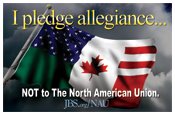
It is isn't only the UN that we are ceding more and more sovereignty to. Other unelected and unaccountable organizations like the WTO are also a real threat. Ron Paul said, “the WTO is the third leg of the globalists' plan for a one-world, centrally-managed economic system.” First of all, we don't need a treaty to have trade, and both NAFTA and CAFTA are not about free or fair trade but represent government-managed agreements. Ron Paul is a co-sponsor of resolutions stating that Congress should not engage in the construction of a NAFTA Superhighway or any other agreement that promotes or advances the concept of a NAU. He said, “Any movement toward a North American Union diminishes the ability of average Americans to influence the laws under which they must live.”
Ron Paul advocates a humble foreign policy and believes that we should not entangle ourselves in the affairs of other nations. He said, “We can continue to fund and fight no-win police actions around the globe, or we can refocus on securing America and bring the troops home.” That means bringing the troops back from Iraq, which he has always viewed as an unconstitutional war in the first place. He wishes to secure our own borders and coastlines and enforce visa rules and is against any sort of amnesty. Ron Paul understands that there is a fine line in becoming a protectionist and isolationist and stated, “Let us have a strong America, conducting open trade, travel, communication, and diplomacy with other nations.”
Many people hear that Ron Paul wants to the end income tax and eliminate the IRS, they like the idea but can't understand how this could possibly be done. He believes that income tax isn't necessary to pay for government services, and by cutting spending overtime it could be eliminated. He said, “Few people know that every penny of the income tax is used to service federal debt.” He went on to say, “If we stop incurring debt, we can quickly end the IRS.” A limited constitutional government with low taxes, one that doesn't interfere in the business of other nations, sounds good to me. Ron Paul has always been on the front lines fighting for our privacy, freedoms, and liberties. Whether it be his opposition to the Patriot Act or the National ID Act, he understands the importance of a free society and recognizes that the biggest threat to it is the government itself. One of the great things about Ron Paul is that it doesn't matter if you find a quote or statement he made yesterday, two months, or five years ago-his principles and philosophy have remained consistent and true to the constitution.
Many in the patriot movement have known for quite sometime that Ron Paul represents what is right with America. It has taken others a little longer to catchup with his message, and I pray that more will wake-up. It is impossible to ever agree with everything someone says or does, but I am convinced that the changes that he would bring about can and will save this country. America and the world would be a much safer and freer place with him as president. If another attack on a country like Iran or Syria doesn't take place before the 2008 elections, his presidency might be one of the only things that could prevent such a strike and further escalation in the Middle East. We all know that just because one man becomes president, things will not automatically change for the better overnight. Improvements will have to be done gradually, but they will not require us making sacrifices at the expense of our freedoms or the constitution. He is the right man to lead us back on the road to recovery and respectability, not only in our own eyes, but in the eyes of all those around the world. Ron Paul's campaign continues to win over the hearts and minds of the people with his simple message of freedom for America.

The NAU Doesn't Want Uncle Sam Around


Something The US Should Consider


Japan Set to Privatize Postal System
Saturday, September 29, 2007

TOKYO — Tiny Shirogane post office in a quiet Tokyo neighborhood, with just three clerks and one ATM, might seem far removed from the world of global finance.
But when Japan Post is privatized on Monday, the Shirogane office will become part of the world's biggest commercial bank _ with assets of $3.03 trillion _ in a move intended to inject competition into Japan's banking sector.
"Our customers will soon experience the merits of privatization," Yoshifumi Nishikawa, president of Japan Post, said Friday. "They will see a better quality of services, or new products _ in short, more convenience."
The massive changeover is the result of 2005 reforms instituted by then-Prime Minister Junichiro Koizumi, a former post and telecommunications minister who championed the issue in his landslide victory in parliamentary elections that year.
Much more is at stake than just stamps and letter deliveries: Japan Post operates a bank with over 400 million accounts. Its 24,500 offices nationwide act as sales agents for insurance and investment products.
For millions of rural Japanese, the post office is their only bank, and the system's ubiquitousness has made it a symbol of a benevolent government ready to cater to every citizen's needs.
"The post office is such a basic necessity," said Kazuko Nishina, 36, an accounting clerk, who was withdrawing cash from her savings account at the Shirogane post office.
"I'm still not sure what's going to happen with privatization, but I hope there aren't any surprises for ordinary customers," she said.
Changing such an entrenched system has been tough. When Koizumi pushed through the reforms, critics warned privatization would reduce services, especially to the countryside.
Even lawmakers within his own ruling party vilified the reforms as another attack by modern times on an orderly, secure society.
But Koizumi argued that the government guarantee on postal savings had encouraged generations of Japanese to park their money in the low-interest accounts, creating a stagnant pool of savings and diverting funds away from more productive investments like stocks and mutual funds.
Experts have also said that postal funds have been used to finance pointless government-backed public works _ bridges to nowhere, redundant roads _ and to purchase government bonds, contributing to a public debt now over 160 percent of Japan's gross domestic product.
"These reforms were necessary in terms of making more efficient use of funds," formerly being diverted to useless public works projects, said Kentaro Kogi, banking analyst at Macquarie Securities.
Privatization could also help foreign banks and investment companies scoop up new clients, with the huge savings pool up for grabs at a time when more Japanese turning to stocks and mutual funds.
That means big money for both domestic and foreign banks, as well as insurance companies.
"We can expect the changes to be a plus for stock markets, against the general backdrop of a trend toward more diverse investments," Kogi said.
The entity privatized on Monday will eclipse Citigroup, with assets of $2.22 trillion, as the world's largest commercial bank. Third will be Japan's Mitsubishi UFJ Financial Group, with $1.67 trillion.
Under the 10-year privatization plan, Japan Post will on Monday be broken into four separate businesses, initially held under a government-controlled holding company: An insurance company, savings bank, mail courier and post office management company.
The companies are set to be made independent by 2017, and aim to list on stock markets. The new bank has said it hopes to improve returns on its savings by starting mortgage and credit card businesses, and lending to small companies.
Still, uncertainties remain.
Some say that far from encouraging open competition, Japan Post will be allowed to encroach on rivals by introducing new investment services and new insurance products before a more level playing field is created.
Another issue is whether foreign firms will have equal footing to sell investment products through the newly privatized bank. So far, they have been granted only a minor role, with Goldman Sachs Asset Management the only foreign firm chosen from a dozen that applied to sell their funds.
Meanwhile, some analysts say the mammoth organization _ largely lacking expertise in more sophisticated investments _ could struggle to stay profitable. That raises the risk the bank could start selling off its huge government bond holdings, causing a hike in yield and ultimately adding to the government's debt payments.
"The concept of postal privatization is good. It will inject competition into the banking sector and raise the overall quality of financial institutions, and would encourage more risk-taking behavior and revitalize the economy," said Junsuke Senoguchi, a banking analyst at Lehman Brothers Japan.
"But, depending on how privatization plays out, the move could ultimately damage public finances," Senoguchi said. "That's probably not what the government intended."

Giv'in It All To The U.N.


Law of Sea Treaty on Senate fast-track

Bush administration pushing for ratification in next 3 weeks

WASHINGTON – For the second time in three years, the Bush administration is putting on a major effort for Senate ratification of the United Nations' Law of the Sea Treaty, a wide-ranging measure critics say will grant the U.N. control of 70 percent of the planet under its oceans.
With Democrats in nearly unanimous agreement with the treaty and the Bush administration behind it, it will be up to a handful of determined Republican senators to derail it from getting a two-thirds vote in the upper house.
The treaty is currently under review by the Senate Foreign Relations Committee and could be approved by the entire Senate in the next three weeks, before popular opposition has a chance to grow.
This is not the first time LOST has come up, of course. International negotiators drafted it in 1982 in an attempt to establish a comprehensive legal regime for international management of the seas and their resources. President Ronald Reagan, however, refused to sign LOST because he realized that the treaty doesn't serve U.S. interests.
In 1994, however, President Clinton signed a revised version of the treaty and forwarded it to the Senate. The record shows the Senate was not convinced the 1994 changes corrected the problems, and it has deferred action on the treaty ever since.
The Heritage Foundation warns the treaty would have unintended consequences for U.S. interests – including a threat to sovereignty.
The conservative think tank says "bureaucracies established by multilateral treaties often lack the transparency and accountability necessary to ensure that they are untainted by corruption, mismanagement or inappropriate claims of authority. The LOST bureaucracy is called the International Seabed Authority Secretariat, which has a strong incentive to enhance its own authority at the expense of state sovereignty."
"For example, this treaty would impose taxes on U.S. companies engaged in extracting resources from the ocean floor," write Heritage fellows Baker Spring and Brett D. Schaefer. "This would give the treaty's secretariat an independent revenue stream that would remove a key check on its authority. After all, once a bureaucracy has its own source of funding, it needs answer only to itself."
"The United States should be wary of joining sweeping multilateral treaties negotiated under the auspices of the United Nations," say Spring and Schaefer of Heritage. "Specifically, the benefit to U.S. national interests should be indisputable and clearly outweigh the predictable negative consequences of ratification."
(Story continues below)
Other critics fear the treaty will be used as a back-door to implement policies against global warming without any accountability to the American people. Parts of the treaty, they say, mandate international regulation of U.S. economic and industrial activities on land. With that in mind, critics of the treaty believe so-called greenhouse gases could be viewed as ocean pollutants.
In the Senate Foreign Relations Committee hearing last week, Bush administration officials were repeatedly embarrassed by tough questioning from Sen. David Vitter, R-La., who is leading the opposition to ratification.
For instance, Deputy Secretary of State John Negroponte testified the U.N. body established by the treaty has "no jurisdiction over marine pollution disputes involving land-based sources."
"Why is there a section entitled pollution from land-based sources?" questioned Vitter.
Vitter also questioned who decides what is considered military activity under the treaty.
"We will decide that. We consider that within our sovereign prerogative," said Negroponte.
"Where does the treaty say that we decide that and an arbitral body does not decide that?" questioned Vitter.
Deputy Secretary of Defense Gordon England answered: "My understanding – and I'll ask my lawyer behind me – that that's in the treaty that we make that determination and that's not subject to review by anyone else."
"It's not in the treaty because I point to Article 298 1b where it simply says disputes concerning military activities are not subject to dispute resolution," explained Vitter. "But it doesn't say who decides what is and what is not a military activity."
England conceded the point.
"We say it is up to us, but nobody else in the world says it is up to us," Said Vitter said.
Sen. Jim DeMint, R-S.C., said the United States had special military and commercial interests as the globe's only superpower, interests that the treaty did not take into account. He said many of the concerns over loss of national sovereignty that surfaced in the recent debate over immigration reform were surfacing once again in the Law of the Sea debate.
"This is not a good time to be bringing something like this before the American people," he said.
The battle over the Law of the Sea Treaty first began 25 years ago, eventually being torpedoed by President Reagan. It resurfaced in 2004 under the sponsorship of Sen. Richard Lugar, R-Ind., and was successfully defeated by then Senate Majority Leader Bill Frist, R-Tenn.
President Bush announced his intention to seek reintroduction of LOST for ratification to a small group of trusted Republican grass-roots organizers last week – an announcement that was met with horror and scorn.
Eagle Forum leader Phyllis Schlafly, Center for Security Policy President Frank Gaffney, Leadership Institute President Morton Blackwell, Free Congress Foundation founder Paul Weyrich and leaders of the Heritage Foundation were quick to denounce the idea in forceful terms, calling on their members to begin lobbying the White House immediately.
LOST has long had the support of environmental groups such as the Natural Resources Defense Council.
It would establish rules governing the uses of the of the world's oceans – treating waters more than 200 nautical miles off coasts as the purview of a new international U.N. bureaucracy, the International Seabed Authority
The ISA would have the authority to set production controls for ocean mining, drilling and fishing, regulate ocean exploration, issue permits and settle disputes in its own new "court."
Companies seeking to mine or fish would be required to apply for a permit, paying a royalty fee
Critics also point out the new U.N. agency would have the right to compete directly with private companies in those profit-making activities.
The U.S. would have only one vote of 140 – and no veto power as it has on the U.N. Security Council.
The Bush administration claims the initiative for reintroduction of the treaty comes from the military, which likes the 12-mile territorial limits it places on national claims to waters. Yet, critics point out international law already protects non-aggressive passage, including non-wartime activities of military ships.
One of the main authors of LOST not only admired Karl Marx but was an ardent advocate of the Marxist-oriented New International Economic Order. Elisabeth Mann Borgese, a socialist who ran the World Federalists of Canada, played a critical role in crafting and promoting LOST, as WND reported in 2005.
Borgese was hailed by her U.N. supporters as the "Mother of the Oceans" or "First Lady of the Oceans." She died in 2002.
The youngest daughter of the German novelist Thomas Mann, Borgese openly favored world government, wrote for the left-wing The Nation magazine and was a member of a "Committee to Frame a World Constitution." She served as director of the International Center for Ocean Development and chairman of the International Oceans Institute at Dalhousie University in Canada.
The U.N. Environment Program, UNEP, has said Borgese recognized the oceans as "a possible test-bed for ideas she had developed concerning a common global constitution."
Borgese received UNEP's "Environment Prize" in 1987 and was credited with organizing the conferences that "served to lay the foundation" for the United Nations Convention of the Law of the Sea, according to Dalhousie University, which houses her archives.
In a 1995 speech, pro-U.N. Democratic Sen. Claiborne Pell said Borgese's ideas were "embodied in the negotiated texts of the Law of the Sea Convention."
Her ideas included recognizing the oceans as the "common heritage of mankind" and creating an International Seabed Authority to charge U.S. and foreign companies for the right to mine the ocean floor.
In a January 1999 speech, Borgese declared, "The world ocean has been, and is, so to speak, our great laboratory for the making of a new world order."
In an article titled, "The New International Economic Order and the Law of the Sea," she argued that the pact could "reinforce" the goals of the NIEO by giving Third World countries a role in managing access to the oceans.
In a 1997 interview, Canadian Broadcasting Corporation broadcaster Philip Coulter asked Borgese about the collapse of Soviet-style communism and the triumph of the "elites."
Borgese replied "there is a strong counter-trend. It's not called socialism, but it's called sustainable development, which calls ... for the eradication of poverty. There is that trend and that is the trend that I am working on."
The concept of "sustainable development," considered a euphemism for socialism or communism, has been embraced in various pronouncements by the U.N. and even the U.S. government.
In her book, "The Oceanic Circle: Governing the Seas as a Global Resource," she approvingly cites Karl Marx, the father of communism, as someone with "amazing foresight" about the problems faced by urban and rural societies. The book is available from the liberal Brookings Institution in Washington, D.C.
In an article co-authored with an international lawyer, Borgese noted how LOST stipulates that the oceans "shall be reserved for peaceful purposes" and that "any threat or use of force, inconsistent with the United Nations Charter, is prohibited."
She argued LOST prohibits the ability of nuclear submarines from the U.S. and other nations to rove freely through the world's oceans.

Thursday, September 27, 2007

Google Knows Your Underwear Size


Next Firefox will tell Google all about you
Nick FarrellThe InquirerWednesday September 26, 2007
THE FORTHCOMING version of the Firefox browser, Gran Paradiso, will ship with a function that will tell Google all about your browsing habits.
The feature is supposed to be designed to allow the browser to check the URL against a list of phishing sites which is stored at Google.
The downside is that while the punter gets some form of malware protection, Google is getting shedloads of information on the sorts of sites you are visiting.
It can sell this information or offer advertising companies lucrative product information packages.
As it has been pointed out on Slashdot, the "feature" is disabled by default so any user who is daft enough to actually think it is pretty nifty is going to have to press a few buttons to make it happen.

Our Boy Gary Hart Writing Letters To Foreign Countries


CFR's Hart Suggests False Flag Event For Iran War

Tacit warning to Iranian government suggests staged event may be used to ensure "bombs fall on your head"
Steve WatsonInfowars.netThursday, Sept 27, 2007
Council on Foreign Relations member Gary Hart, famed for stating that Americans will die en- mass on home soil this century, and for declaring 48 hours after 9/11 that it should be used "to carry out a new world order", has written a scathing letter to the leaders of Iran clearly warning that the U.S. government has a history of staging provocations in order to initiate conflict with other nations and that Iran could be next.
Hart references the sinking of the USS Maine in Havana harbor in 1898, which led to the Spanish American war, as well as the Gulf of Tonkin incident, which was ultimately the catalyst for airstrikes on Vietnam.
Why does Hart reference these two cases? Because they are both examples of staged managed events that were used to coerce the American public into supporting war.
The sinking of the Maine was immediately blamed on the Spanish, with the innovator of yellow journalism William Randolph-Hearst enflaming anti-Spanish sentiment in his papers by definitively claiming that it was a Spanish plot. No reliable evidence was ever produced linking Spain to the event and it is now widely believed that the event was at best a mechanical failure or at worst a false flag operation.
Similarly the Gulf of Tonkin incident saw President Johnson accuse North Vietnamese PT boats of attacking strike carries in the gulf, the USS Maddox and the USS Turner Joy. Documents and tapes released via the Freedom of Information Act have since shown that Johnson knew that there were no PT boats and no attacks, but still went ahead with lying to the American public on national TV to garner support for escalating the war in Vietnam. Johnson also had the NSA fake intelligence data to make it appear as if the two US ships had been lost.
Hart, one of the instigators of the Homeland Security apparatus that has evolved since 9/11, then goes on to state that American people are reluctant to go to war unless provoked and coldly remarks "For historians of American wars the question is whether we provoke provocations."
He then mentions the Iraq war and refers to how the public were duped into accepting the invasion via the spectre of 9/11. Hart writes "even in this instance, we were led to believe that the mass murderer of American civilians, Osama bin Laden, was lurking, literally or figuratively, in the vicinity of Baghdad."
To those who do not read history Gary Hart's letter makes for a confusing read, but to those who know anything about staged provocations, the intent is clear. Hart is declaring that the elite controlled US government has attacked countries based on false pretenses in the past and will gladly do so again.
Hart's declarations carry the same sentiment as those of fellow globalist Zbigniew Brzezinski earlier this year. The Former National Security Advisor and founding member of the elite policy making group the Trilateral Commission implicitly warned a Senate Foreign Relations Committee that an attack on Iran could be launched following a staged provocation in Iraq or a false flag terror attack within the U.S.
Brzezinski alluded to the potential for the Bush administration to manufacture a false flag Gulf of Tonkin type incident in describing a "plausible scenario for a military collision with Iran," which would revolve around "some provocation in Iraq or a terrorist act in the US blamed on Iran, culminating in a ‘defensive’ US military action against Iran that plunges a lonely America into a spreading and deepening quagmire eventually ranging across Iraq, Iran, Afghanistan and Pakistan.”
Texas Congressman and Presidential candidate Ron Paul has also recently warned that a "Gulf of Tonkin like event" may be used to provoke air strikes on Iran as numerous factors collide to heighten expectations that America may soon be embroiled in its third war in six years.

Here is Gary Hart's letter in full:
Unsolicited Advice to the Government of Iran
Presuming that you are not actually ignorant enough to desire war with the United States, you might be well advised to read the history of the sinking of the U.S.S. Maine in Havana harbor in 1898 and the history of the Gulf of Tonkin in 1964.
Having done so, you will surely recognize that Americans are reluctant to go to war unless attacked. Until Pearl Harbor, we were even reluctant to get involved in World War II. For historians of American wars the question is whether we provoke provocations.
Given the unilateral U.S. invasion of Iraq in 2003, you are obviously thinking the rules have changed. Provocation is no longer required to take America to war. But even in this instance, we were led to believe that the mass murderer of American civilians, Osama bin Laden, was lurking, literally or figuratively, in the vicinity of Baghdad.
Given all this, you would probably be well advised to keep your forces, including clandestine forces, as far away from the Iraqi border as you can. You might even consider bringing in some neighbors to verify that you are not shipping arms next door. Tone down the rhetoric on Zionism. You've established your credentials with those in your world who thrive on that.
If it makes you feel powerful to hurl accusations at the American eagle, have at it. Sticks and stones, etc. But, for the next sixteen months or so, you should not only not take provocative actions, you should not seem to be doing so.
For the vast majority of Americans who seek no wider war, in the Middle East or elsewhere, don't tempt fate. Don't give a certain vice president we know the justification he is seeking to attack your country. That is unless you happen to like having bombs fall on your head.

Yay IBM

IBM developed suspicion surveillance cameras launched in Chicago
DON BABWINAssociated PressThursday, September 27, 2007
CHICAGO - A car circles a high-rise three times. Someone leaves a backpack in a park.Such things go unnoticed in big cities every day. But that could change in Chicago with a new video surveillance system that would recognize such anomalies and alert authorities to take a closer look.
On Thursday, the city and IBM Corp. are announcing the initial phase of what officials say could be the most advanced video security network in any U.S. city. The City of Broad Shoulders is getting eyes in the back of its head.
"Chicago is really light years ahead of any metropolitan area in the U.S. now," said Sam Docknevich, who heads video-surveillance consulting for IBM.
Chicago already has thousands of security cameras in use by businesses and police — including some equipped with devices that recognize the sound of a gunshot, turn the cameras toward the source and place a 911 call. But the new system would let cameras analyze images in real time 24 hours a day.
"You're talking about creating (something) that knows no fatigue, no boredom and is absolutely focused," said Kevin Smith, spokesman for the city's Office of Emergency Management and Communications.
For example, the system could be programmed to alert the city's emergency center whenever a camera spots a vehicle matching the description of one being sought by authorities.
The system could be programmed to recognize license plates. It could alert emergency officials if the same car or truck circles the Sears Tower three times or if nobody picks up a backpack in Grant Park for, say, 30 seconds.
IBM says this approach might be more effective than relying on a bleary-eyed employee to monitor video screens. "Studies have shown people fall asleep," Docknevich said.

Ladies And Gentlemen; The American Dollar


NORTH AMERICAN UNION!!!

Good information. watch and be aware.

Iranian Madman Given Traveling Papers


Iran Represents A Watershed Moment Potential


'A Coup Has Occurred'
Thursday September 27, 2007
Daniel Ellsberg, the former Defense Department analyst who leaked the secret Pentagon Papers history of the Vietnam War, offered insights into the looming war with Iran and the loss of liberty in the United States at an American University symposium on September 20. Below is an edited transcript of Ellsberg’s remarkable speech:
I think nothing has higher priority than averting an attack on Iran, which I think will be accompanied by a further change in our way of governing here that in effect will convert us into what I would call a police state.
If there’s another 9/11 under this regime … it means that they switch on full extent all the apparatus of a police state that has been patiently constructed, largely secretly at first but eventually leaked out and known and accepted by the Democratic people in Congress, by the Republicans and so forth.
Will there be anything left for NSA to increase its surveillance of us? … They may be to the limit of their technical capability now, or they may not. But if they’re not now they will be after another 9/11.
And I would say after the Iranian retaliation to an American attack on Iran, you will then see an increased attack on Iran – an escalation – which will be also accompanied by a total suppression of dissent in this country, including detention camps.
It’s a little hard for me to distinguish the two contingencies; they could come together. Another 9/11 or an Iranian attack in which Iran’s reaction against Israel, against our shipping, against our troops in Iraq above all, possibly in this country, will justify the full panoply of measures that have been prepared now, legitimized, and to some extent written into law. …
This is an unusual gang, even for Republicans. [But] I think that the successors to this regime are not likely to roll back the assault on the Constitution. They will take advantage of it, they will exploit it.
Will Hillary Clinton as president decide to turn off NSA after the last five years of illegal surveillance? Will she deprive her administration her ability to protect United States citizens from possible terrorism by blinding herself and deafening herself to all that NSA can provide? I don’t think so.
Unless this somehow, by a change in our political climate, of a radical change, unless this gets rolled back in the next year or two before a new administration comes in – and there’s no move to do this at this point – unless that happens I don’t see it happening under the next administration, whether Republican or Democratic.
The Next Coup
Let me simplify this and not just to be rhetorical: A coup has occurred. I woke up the other day realizing, coming out of sleep, that a coup has occurred. It’s not just a question that a coup lies ahead with the next 9/11. That’s the next coup, that completes the first.
The last five years have seen a steady assault on every fundamental of our Constitution, … what the rest of the world looked at for the last 200 years as a model and experiment to the rest of the world – in checks and balances, limited government, Bill of Rights, individual rights protected from majority infringement by the Congress, an independent judiciary, the possibility of impeachment.
There have been violations of these principles by many presidents before. Most of the specific things that Bush has done in the way of illegal surveillance and other matters were done under my boss Lyndon Johnson in the Vietnam War: the use of CIA, FBI, NSA against Americans.
I could go through a list going back before this century to Lincoln’s suspension of habeas corpus in the Civil War, and before that the Alien and Sedition Acts in the 18th century. I think that none of those presidents were in fact what I would call quite precisely the current administration: domestic enemies of the Constitution.
I think that none of these presidents with all their violations, which were impeachable had they been found out at the time and in nearly every case their violations were not found out until they were out of office so we didn’t have the exact challenge that we have today.
That was true with the first term of Nixon and certainly of Johnson, Kennedy and others. They were impeachable, they weren’t found out in time, but I think it was not their intention to, in the crisis situations that they felt justified their actions, to change our form of government.
It is increasingly clear with each new book and each new leak that comes out, that Richard Cheney and his now chief of staff David Addington have had precisely that in mind since at least the early 70s. Not just since 1992, not since 2001, but have believed in Executive government, single-branch government under an Executive president – elected or not – with unrestrained powers. They did not believe in restraint.
When I say this I’m not saying they are traitors. I don’t think they have in mind allegiance to some foreign power or have a desire to help a foreign power. I believe they have in their own minds a love of this country and what they think is best for this country – but what they think is best is directly and consciously at odds with what the Founders of this country and Constitution thought.
They believe we need a different kind of government now, an Executive government essentially, rule by decree, which is what we’re getting with signing statements. Signing statements are talked about as line-item vetoes which is one [way] of describing them which are unconstitutional in themselves, but in other ways are just saying the president says “I decide what I enforce. I decide what the law is. I legislate.”
It’s [the same] with the military commissions, courts that are under the entire control of the Executive Branch, essentially of the president. A concentration of legislative, judicial, and executive powers in one branch, which is precisely what the Founders meant to avert, and tried to avert and did avert to the best of their ability in the Constitution.
Founders Had It Right
Now I’m referring to that as a crisis right now not just because it is a break in tradition but because I believe in my heart and from my experience that on this point the Founders had it right.
It’s not just “our way of doing things” – it was a crucial perception on the corruption of power to anybody including Americans. On procedures and institutions that might possibly keep that power under control because the alternative was what we have just seen, wars like Vietnam, wars like Iraq, wars like the one coming.
That brings me to the second point. This Executive Branch, under specifically Bush and Cheney, despite opposition from most of the rest of the branch, even of the cabinet, clearly intends a war against Iran which even by imperialist standards, standards in other words which were accepted not only by nearly everyone in the Executive Branch but most of the leaders in Congress. The interests of the empire, the need for hegemony, our right to control and our need to control the oil of the Middle East and many other places. That is consensual in our establishment. …
But even by those standards, an attack on Iran is insane. And I say that quietly, I don’t mean it to be heard as rhetoric. Of course it’s not only aggression and a violation of international law, a supreme international crime, but it is by imperial standards, insane in terms of the consequences.
Does that make it impossible? No, it obviously doesn’t, it doesn’t even make it unlikely.
That is because two things come together that with the acceptance for various reasons of the Congress – Democrats and Republicans – and the public and the media, we have freed the White House – the president and the vice president – from virtually any restraint by Congress, courts, media, public, whatever.
And on the other hand, the people who have this unrestrained power are crazy. Not entirely, but they have crazy beliefs.
And the question is what then, what can we do about this? We are heading towards an insane operation. It is not certain. It is likely. … I want to try to be realistic myself here, to encourage us to do what we must do, what is needed to be done with the full recognition of the reality. Nothing is impossible.
What I’m talking about in the way of a police state, in the way of an attack on Iran is not certain. Nothing is certain, actually. However, I think it is probable, more likely than not, that in the next 15, 16 months of this administration we will see an attack on Iran. Probably. Whatever we do.
And … we will not succeed in moving Congress probably, and Congress probably will not stop the president from doing this. And that’s where we’re heading. That’s a very ugly, ugly prospect.
However, I think it’s up to us to work to increase that small perhaps – anyway not large – possibility and probability to avert this within the next 15 months, aside from the effort that we have to make for the rest of our lives.
Restoring the Republic
Getting back the constitutional government and improving it will take a long time. And I think if we don’t get started now, it won’t be started under the next administration.
Getting out of Iraq will take a long time. Averting Iran and averting a further coup in the face of a 9/11, another attack, is for right now, it can’t be put off. It will take a kind of political and moral courage of which we have seen very little…
We have a really unusual concentration here and in this audience, of people who have in fact changed their lives, changed their position, lost their friends to a large extent, risked and experienced being called terrible names, “traitor,” “weak on terrorism” – names that politicians will do anything to avoid being called.
How do we get more people in the government and in the public at large to change their lives now in a crisis in a critical way? How do we get Nancy Pelosi and Harry Reid for example? What kinds of pressures, what kinds of influences can be brought to bear to get Congress to do their jobs? It isn’t just doing their jobs. Getting them to obey their oaths of office.
I took an oath many times, an oath of office as a Marine lieutenant, as an official in the Defense Department, as an official in the State Department as a Foreign Service officer. A number of times I took an oath of office which is the same oath office taken by every member of Congress and every official in the United States and every officer in the United States armed services.
And that oath is not to a Commander in Chief, which is not mentioned. It is not to a Führer. It is not even to superior officers. The oath is precisely to protect and uphold the Constitution of the United States.
Now that is an oath I violated every day for years in the Defense Department without realizing it when I kept my mouth shut when I knew the public was being lied into a war as they were lied into Iraq, as they are being lied into war in Iran.
I knew that I had the documents that proved it, and I did not put it out then. I was not obeying my oath which I eventually came to do.
I’ve often said that Lt. Ehren Watada – who still faces trial for refusing to obey orders to deploy to Iraq which he correctly perceives to be an unconstitutional and aggressive war – is the single officer in the United States armed services who is taking seriously upholding his oath.
The president is clearly violating that oath, of course. Everybody under him who understands what is going on and there are myriad, are violating their oaths. And that’s the standard that I think we should be asking of people.
Congressional Courage
On the Democratic side, on the political side, I think we should be demanding of our Democratic leaders in the House and Senate – and frankly of the Republicans – that it is not their highest single absolute priority to be reelected or to maintain a Democratic majority so that Pelosi can still be Speaker of the House and Reid can be in the Senate, or to increase that majority.
I’m not going to say that for politicians they should ignore that, or that they should do something else entirely, or that they should not worry about that.
Of course that will be and should be a major concern of theirs, but they’re acting like it’s their sole concern. Which is business as usual. “We have a majority, let’s not lose it, let’s keep it. Let’s keep those chairmanships.” Exactly what have those chairmanships done for us to save the Constitution in the last couple of years?
I am shocked by the Republicans today that I read in the Washington Post who yesterday threatened a filibuster if we … get back habeas corpus. The ruling out of habeas corpus with the help of the Democrats did not get us back to George the First it got us back to before King John 700 years ago in terms of counter-revolution.
We need some way, and Ann Wright has one way, of sitting in, in Conyers office and getting arrested. Ray McGovern has been getting arrested, pushed out the other day for saying the simple words “swear him in” when it came to testimony.
I think we’ve got to somehow get home to them [in Congress] that this is the time for them to uphold the oath, to preserve the Constitution, which is worth struggling for in part because it’s only with the power that the Constitution gives Congress responding to the public, only with that can we protect the world from mad men in power in the White House who intend an attack on Iran.
And the current generation of American generals and others who realize that this will be a catastrophe have not shown themselves – they might be people who in their past lives risked their bodies and their lives in Vietnam or elsewhere, like [Colin] Powell, and would not risk their career or their relation with the president to the slightest degree.
That has to change. And it’s the example of people like those up here who somehow brought home to our representatives that they as humans and as citizens have the power to do likewise and find in themselves the courage to protect this country and protect the world. Thank you.

When They Start Name-Calling, You Know You're On To Something


Reason Magazine calls NAU agenda "a Xenophobic Fantasy"
Shikha Dalmia and Leonard Gilroy Reason MagazineTuesday September 25, 2007
Comment: According to these two authors you are a "protectionist xenophobe" if you believe there is an agenda to create a North American Union. Apparently being concerned about the selling off of U.S. infrastructure to foreign owned companies means you are "paranoid". They also call the NAFTA Superhighway a "fantasy". All this in the face of actual documentation and serious concern among members of Congress.
The U.S. is known for its "paranoid style" of politics, so brace yourself for the next Big Scare coming down the pike (literally) -- the Trans-Texas Corridor. Isolationist conservatives, emboldened by their jihad last year against the Dubai Ports World deal, have identified this road project as the spearhead of a conspiracy to dissolve the United States of America.
The corridor is a proposed two-phase project meant to ensure that the Lone Star State has the transportation infrastructure necessary to handle the growing international commerce coming across the border. The 1994 North American Free Trade Agreement has doubled U.S.-Mexico trade, three-fourths of which flows through Texas. And the movement of goods through the state is expected to increase exponentially in the near future as Asia routes more exports through the newly expanded Panama Canal.
Texas awarded a planning contract in 2005 for the first phase of the corridor to Cintra, a Spanish multinational company, and its San Antonio partner, Zachry Construction. (Cintra also won a $1.3-billion contract last year to build a 40-mile extension of Highway 130, a state toll road connecting Austin to San Antonio that was conceived separately from the corridor, although conspiracy activists claim otherwise.) The first 600-mile section, planned to include such features as tollways, freight-rail and truck-only lanes, will run parallel to the cramped, north-south Interstate 35 from the border town of Laredo to Oklahoma. Construction contracts for that portion haven't been awarded.
The second phase of the corridor, whose planning contract has yet to be handed out, would build a similar highway from the western edge of the Mexico border to east Texas. This might one day link to a separate, federally initiated eight-state expansion of Interstate 69, which currently runs between Port Huron, Mich., and Indianapolis.
This is all too sinister for Jerome Corsi, the Vietnam War veteran who helped lead the Swift Boat charge against John Kerry. Corsi has knitted disparate strands of each of these separate road projects to help convince fellow xenophobes such as Pat Buchanan, Phyllis Schlafly, Lou Dobbs and the John Birch Society that the corridor is the first leg of a secret federal project called the NAFTA Superhighway, a four-football-field wide monstrosity that would run from Mexico's Yucatan to Canada's Yukon.
Never mind that I-69 originated in a 1991 federal transportation law -- pre-dating NAFTA -- and that the planning for the Trans-Texas Corridor has been fully documented on the Web.
Yet even Texas Rep. Ron Paul, a libertarian Republican candidate for president, has fallen for the paranoia. You'd think that Paul would be chanting hosannas to anything that facilitates free trade, but he too fears that the "superhighway" is part of a scheme by foreign companies to erode U.S. borders and create a North American Union combining the United States, Mexico and Canada -- complete with a single government and a common currency called the "amero."
Superhighway opponents regard even routine dialogue between the three neighbors as a treasonous assault on U.S. sovereignty. They are apoplectic about the Security and Prosperity Partnership of North America (SPP), a forum created in 2005 for bureaucrats to discuss such radical topics as how to snag terrorists before they enter the continent and how to speed up cross-border traffic for just-in-time deliveries.
All of this could be dismissed as the paranoid rantings of a protectionist fringe -- except that it is beginning to have a tangible negative effect on public policy.
Montana's Legislature this summer overwhelmingly passed a resolution condemning the superhighway and any union of the three countries, and 18 other states are considering similar legislation. El Cajon Republican Rep. Duncan Hunter successfully amended the 2008 Transportation Appropriations Act to prohibit use of federal funds for any SPP working group. Virginia Republican Rep. Virgil H. Goode Jr. has introduced a House resolution against both the mythical superhighway and the fantasy union.
After the Dubai Ports debacle, in which anti-terrorism hysteria forced Congress to thwart the transfer of U.S. port management leases held by a major British ports operator to a company based in Dubai, the atavistic idea that foreign investment erodes American sovereignty is back into vogue.
Hunter, for instance, has added hoops to the review process that foreign bidders for U.S. companies must go through to prove that they're not a national security threat. This limits the pool of buyers for U.S. companies, thereby lowering their value and the value of 401(k) plans that invest in them. Hunter has also extended the review process to foreign companies vying to build "critical infrastructure." Should his definition include transportation projects, state governments would be deprived of crucial capital and knowledge to modernize their infrastructure.
The paradox of protectionism is that it damages the very thing it seeks to protect. Labor unions, for example, almost killed U.S. auto and steel companies by helping erect barriers against foreign companies, which made domestic products globally noncompetitive. But the impact of today's isolationists threatens to affect the entire economy. If unchallenged, these ideologues of fear will kill the United States' prosperity in the name of protecting its sovereignty.

Zimbabwe orders 'White Firm Grab'


Zimbabwe targets foreign business


The Zimbabwean parliament has passed a bill to move majority control of foreign-owned companies operating in the country to black Zimbabweans.
The goal is to ensure at least a 51% shareholding by indigenous black people in the majority of businesses.
The bill completes a process that began with the controversial seizure of white-owned farms starting in 1999.
Zimbabwe is currently experiencing the world's highest inflation and shortages of food, fuel and foreign currency.
The bill still has to go to the upper house - the Senate - for final approval. It already has the support of President Robert Mugabe's government.
If passed in the Senate, the practical effect of the bill may, however, be severely limited, says the BBC's Peter Biles in Johannesburg.
Many foreign companies in Zimbabwe are already operating at a low level, with reduced turnover resulting from the seven-year economic crisis.
51% share
Critics have said the Indigenisation and Economic Empowerment Bill could hurt investor confidence in Zimbabwe.
It stipulates that no company restructuring, merger or acquisition can be approved unless 51% of the firm goes to indigenous Zimbabweans.
If we do not dismantle the structure of colonialism that we inherited then we have not given back all the country's resources to its rightful owners Paul Mangwana Economic Empowerment Minister
The empowerment bill defines "indigenous Zimbabwean" as anyone disadvantaged by unfair discrimination on race grounds before independence in 1980.
It also provides for the establishment of an empowerment fund which will offer assistance to the "financing of share acquisitions" from the public-owned firms or assist in "management buy-ins and buy-outs."
MPs from the governing Zanu-PF party supported the bill in parliament on Wednesday.
"If we do not dismantle the structure of colonialism that we inherited then we have not given back all the country's resources to its rightful owners, who are our people," Indigenisation and Economic Empowerment Minister Paul Mangwana said, quoted by Reuters news agency.
Members of the opposition Movement for Democratic Change (MDC) walked out of parliament in protest at the bill before voting began.
"We see it as a strategy to amass wealth by the ruling elite, and nothing to do with the empowerment of people," MDC spokesman Nelson Chamisa told the BBC News website.
All government departments and statutory bodies will be asked to obtain 51% of their goods and services from businesses in which controlling interest is held by indigenous Zimbabweans.
Some firms dually listed on the Zimbabwe Stock Exchange and London Securities Exchange firms include Old Mutual, NMB bank and Hwange.
Multi-national firms that may be affected by the new policy include Barclays Bank, Bindura Nickel Corporation and miner Rio Zim.
Senior British officials say the Zimbabwean government will be disappointed if it thinks it will gain much of value from the move.

Y'Know, I Liked This Guy For About A Minute

Sarkozy calls for UN-led 'new world order'
New York - The United Nations should avail itself as an instrument for a "new world order of the 21st century," French President Nicolas Sarkozy said Tuesday in his first address to the General Assembly. Sarkozy, who won the presidency this year on a strong reform platform to modernize France, urged the world body to embark on programmes ranging from equal wealth distribution to fighting corruption in his speech full of references to France's past revolutionary ideals.
"In the name of France, I call upon all states to join ranks in order to found the new world order of the 21st century on the notion that the common goods that belong to all of humankind must be the common responsibility for us all," he told the General Assembly.
The UN should ensure access for all human beings to vital resources, such as water, energy, food, medication and knowledge, he said. He called for "more morality" in "financial capitalism" and a fairer distribution of profits, earnings in commodities, raw materials and new technologies.
"There must be a change of mindset and behaviour," Sarkozy said in a long list of demands to the international community.
Known for his admiration of the United States and its culture, Sarkozy said France will remain loyal to its friends and the values it shares with them.
But he warned that loyalty should not be equated with submission, a reference to Paris' disagreement with the US-led war in Iraq.
"What I want to say to the world is that France, faithful to its friends, stands ready to talk to all people, on every continent," he said.

Wednesday, September 26, 2007

Tax Havens


The Really Big Tax Havens

At financial events, I often define a "tax haven" as a country that welcomes foreign capital and imposes low or no taxes on the foreigners who invest there. I then ask the audience if they know where the leading tax havens are located in the world.
People usually guess Switzerland, the Channel Islands, the Isle of Man, Monaco, Andorra, Liechtenstein, Bermuda or Panama. (Switzerland is not a tax haven per se, because it levies taxes on most investors, although foreigners may obtain refunds under double taxation treaties.)
For those in my audience not "in the know," they are usually surprised when I explain that the world's two largest tax havens are - (drum roll, please) - the United States and the United Kingdom.
Both of these nations have hypocritical governments which continually criticize tax havens. The U.S. and the U.K. like to vilify the many small jurisdictions that are proud to be tax havens. Ironically, the U.S. and the U.K. are tax havens only for foreigners - they offer no comparable tax relief for their own highly taxed citizens.
Poor Old Uncle Sam Needs Money
The U.S. gives virtually tax-free treatment to many hundreds of thousands of foreigners. Uncle Sam likes to reward these foreigners who invest billions annually in American stocks, bonds, real estate and especially U.S. Treasury bonds. Deficit-spending politicians from both parties desperately need the foreign cash float these tax-free investors so generously provide.
In 2005, foreign direct investment in the United States exceeded US$1.5 trillion on a historical cost basis. That huge amount represented 10% of the total market value of all publicly traded American firms.
That huge number has grown since. Total foreign spending to acquire or establish U.S. businesses was over US$100 billion in 2006 alone. And with the ever declining dollar, you can expect many more "fire sale" purchases by foreigners.
We saw this happen earlier this month when Dubai bought a 20% stake in the Nasdaq, and became the single largest owner of America's technology stock exchange.
How America Became the Tax Haven It Is Today
The U.S. government deliberately adopted this generous American tax haven policy in the 1980's. At the time, many leading U.S. financial institutions verged on bankruptcy.
The combination of uncollectible bank loans to the Third World, rampant inflation, savings and loan scandals and a 20% plus prime interest rate had put billion dollar holes in bank's and insurance companies' balance sheets. The political solution was simple and effective: Drop taxes on international capital and watch the money flow in.
Foreigners, (nonresident aliens, as the U.S. government calls them), and foreign corporations these foreigners control are exempt from most U.S. taxes. They're exempt from taxes on certain kinds of interest and on capital gains from owning most types of U.S. securities, bonds or debt obligations.
U.S. corporate dividends paid to foreign persons are subject to withholding taxes. But the tax rate may be low or zero under a treaty between the U.S. and the foreigner's home country. If a non-U.S. person controls an offshore corporation that invests in the U.S., then he or she is not required to file returns with the IRS, unless it does business within the United States.
The IRS likes to insist that offshore investing is laced with tax evasion. They estimated that US$5 trillion in assets worldwide is held "offshore" in tax havens. They also estimated the IRS annually loses a minimum of US$70 billion in tax revenue from individuals investing offshore.
But the IRS and American tax laws welcome the trillions in foreign investment in tax haven USA. They don't seem concerned about the possible tax evasion by foreigners.
The Brits Do It Too
The United Kingdom is also a major tax haven, but with a different twist - the U.K. gives major tax breaks to wealthy foreigners who actually live there. Under British tax law, anyone living in Britain and not born there can choose what is known as "non-domiciled" tax status.
That means scores of billionaires who live there only pay tax on the relatively small amount of money they bring into the U.K. each year. They do not pay U.K. taxes on their much larger worldwide earnings.
This law has made London a tax haven for everyone-- from Russian oil tycoons to thousands of international investment bankers. The country now has 68 billionaires - three times as many as four years ago. Only three of its 10 richest people were born in Britain.
That special U.K. tax law is always under attack. It continually presents a political problem for the new Prime Minister Gordon Brown. The British newspaper, the Guardian, accuses Brown of having a "love affair with the super-rich."
The British trade unions want to end the loophole. For 10 years, Brown regularly promised reform on the "non-dom" tax issue as Chancellor of the Exchequer. But in the end, he did nothing. (That's fine with us. We've never met a tax we liked.)
This Sanctuary for the Super-Rich Will Survive
The International Herald Tribune thinks the non-dom tax exemption for the rich doesn't make sense in a highly taxed country. In the U.K., the top income tax rate is 40%. But we agree with their conclusion that "...it is too late to change it. London and, by extension, the rest of the British economy have become dependent on the mega-rich."
There is no denying the impact the rule has had. According to British Treasury figures, about 112,000 people claimed non-domiciled status in 2005. They reported a total of £9.8 billion (US$19.9 billion), in earnings. But their wealth from overseas income would be much more and they spend a lot of cash in London.
Based on past performance and the politics involved, I predict this U.K. non-dom tax loophole will survive. If we're wrong, there will be a lot of rich people fleeing London for other, more secure tax havens.
The next time you catch some London or Washington political foghorn blasting those terrible tax havens on T.V., send them an email and tell them to look in the mirror. Or tell them to go get lost in the 25,000 pages of the U.S. and/or U.K. tax code. They might just learn something.

Oil Is Going To Kill Us Financially


Goldman also predicted $85 oil by the end of 2007. In another release today, forecasters at Goldman raised their entire oil outlook through the end of 2008, predicting an average price of $85 for 2008 and a high of $95 by the beginning of 2009.

Gold Forecast Is Up


Goldman Sachs raised its six-month target price for gold from $775 to $800 this morning. “Gold continues to gain support from the structural realignment in the relationship between gold and the U.S. dollar,” as statement from the bank read, “driven mainly by rising consumer and central bank demand in the rapidly growing emerging markets.”

Great Essay On The "NO Real Choice" We Have In Elections


LEFT VS. RIGHT: THE ILLUSION OF OPPOSITES Analysis © 2007 by G. Edward Griffin. Updated September 23
Would you rather be a Neoconservative or a Progressive? That is a trick question. The trick is in the fact that, although there may be differences between the rhetoric and short-term agendas of these groups, their long-term goals actually are the same. They may differ over how to fight a war in the Middle East but not over the right of the President to wage such a war empowered by the UN instead of Congress. They may differ over what kind of speech should be forbidden ("subversive" speech vs. "hate" speech, for example) but not over the right of the government to forbid it. They may differ over how fast to bankrupt the nation to provide benefits for its citizens but not over the assumption that providing benefits is what governments are supposed to do. They disagree over tactics, timing, and style, but not objectives. They fight for dominance within the New World Order, but they work together to build it. That is because both groups have embraced the underlying ideology of global collectivism.
The illusion of opposites has been a dominant part of the world's political landscape for over a century and it has been the primary reason for the advance of collectivism during that time. In the epic struggles of World War II, millions of patriotic citizens within the combatant nations passionately supported their leaders, believing they were defending against an evil empire. Russians fought for Communism; Germans fought for Nazism; Italians fought for Fascism. Yet, these were merely variants of the underlying ideology, called collectivism, that was common to them all.
Americans, of course, were horrified by such political doctrines and fought, instead, for Democracy. They did not realize that, while that word filled their heads with visions of freedom and justice for all, their leaders had another definition as they quietly converted the United States into a collectivist regime incredibly similar to the ones against which they fought. The contest was never about ideology. It was always about who would be the victor and who would be the vanquished; who would emerge from the war with world power; who would control the natural resources; who would create the new boundaries; who would judge and who would hang.
In our present era, there are few champions for Communism and practically none for Nazism or Fascism, but everyone claims to be a champion of Democracy. Neoconservatives and Progressives, alike, sprinkle their rhetoric with this word like salt on a fresh baked potato. This is a clue that it has no meaningful definition. It is used as a political mantra to hypnotize the masses into a receptive state of mind. After all, anyone who speaks in defense of Democracy has got to be a good guy, right?
In today's debate, the illusion of opposites has become a myth of gigantic proportions. On one side - supposedly the Left side - we have Leftists, Communists, Socialists, Marxists, Neo Marxists, Leninists, Maoists, Liberals, Progressives, and (in The U.S.) Democrats. On the other side - supposedly the Right side - we have Rightists, Nazis, Neo Nazis, Fascists, Conservatives, Neoconservatives, Reactionaries, and (in the U.S.) Republicans.
Almost all modern political debate is framed by these words; yet, there is no one who can define what they mean except to their own satisfaction. There is no universally accepted understanding that will be accepted by advocates and critics alike. The possible exceptions are those that bear the names of authors, such as Marx, Lenin, and Mao, because it could be argued that they represent the views expressed in their writings. However, we are still left with the formidable task of accurately summarizing those views to everyone's satisfaction.
Social mores and religious beliefs sometimes divide along the Left-Right political axis. Those on the Left are more likely to embrace life styles that those on the Right would consider improper or even sinful. Those on the Right are more likely to be church-going members of an organized religion. But these are not definitive values, because there is a great deal of diversity on both sides. Republicans smoke pot. Democrats go to church. Social or religious values cannot be included in any meaningful definition of these groups.
Be that as it may, the degree to which there truly are definable qualities to these labels is the same degree to which we can understand that they are similar. For example, if there is any doubt of the similarity between the collectivism of Marx and the collectivism of Hitler, all one has to do is read Das Kapital, The Communist Manifesto, and Mein Kampf. The point is that, when the labels are peeled off and the underlying ideologies are examined, we come inexorably to the conclusion that every one of them is built upon the foundation of collectivism. We are expected to choose sides when, in reality, there is no substantial difference between them. No matter which side we choose, we are on the side of collectivism. That is the trick.
What are the elements of collectivism that are common to all of these seemingly opposite forces? Collectivists on the so-called Left and Right agree that:
1. Rights are derived from the state;2. The group is more important than the individual;3. Coercion is the preferred method to bring about reform;4. Laws should be applied differently to different classes;5. Providing benefits (redistributing wealth) is the proper role of government.
These are the core principles held by collectivists in their quest to remold mankind to their hearts desire. The main disagreement among them is over how those principles should be applied. They do not realize that it's not the application of those principles, but the principles themselves that cause injustice, scarcity, and freedom's demise. History has already shown this truth in the form of despotism under Nazism (the so-called Right) and Communism (the so-called Left). It is sad that intelligent people with knowledge of this history still cling to the myth that they are opposites when it is so clear they are merely different manifestations of the same ideology.
MEET GEORGE LAKOFF In 2006, the illusion of opposites was brilliantly performed in a book entitled Whose Freedom, by George Lakoff, an illusionist for the Democrat Party. Lakoff is a professor of Linguistics at the University of California, Berkeley. His motivation for writing is revealed by his previous works. One was a political strategy entitled, Don’t Think of an Elephant! self-labeled as “the Essential Guide for Progressives”, which featured a foreword by former Democrat presidential candidate Howard Dean. The other was a video presentation entitled How Democrats and Progressives Can Win.
As we would expect, Lakoff says that the choice in America today is between Neoconservatives and Progressives. He, of course, is a self-styled Progressive, but nowhere does he define what that word means. Instead, he devotes the entire book to a spirited monologue describing how evil and ignorant neoconservatives are and how humanitarian and enlightened (and intelligent, too) progressives are. That's all we need to know. By the way, the Left-leaning collectivists also enjoy describing themselves as intellectuals, implying that anyone who does not accept their world view is stupid or anti-intellectual. That's just more of the psychological word games that Lakoff, as a linguist, knows so well.
Lakoff skillfully places the issue of freedom into the cracked mold of left/liberal/progressive vs. right/conservative/reactionary. As I have argued previously, these words are not definable and, worse, tend to hide the fact that advocates of both groups are united behind the political philosophy of collectivism. Lakoff, himself, advocates many features of collectivism in his books.
Both “Left and Right” are ready to sacrifice freedom for the furtherance of their agendas. Both camps are willing to grant freedom to those who accept their political and social mores but do not hesitate to withhold it from those who oppose them. Both camps are skilled at creating laws that convert dissidents into criminals. If today’s so-called progressives were to gain control of the government, they would be no different. They would justify oppression, not in the name of national security as the neoconservatives do, but in the name defending democracy and peace, as Communist regimes do.
Perhaps I am too quick to judge Lakoff as an illusionist, for that implies he is a willing agent of the enemies of freedom. It is entirely possible that he has not yet considered all the ramifications of this issue. It is possible that he has never heard individualism advocated and defended. Without that, he likely would consider it to be the creed of selfishness and ignorance. With that view, collectivism would be the only reasonable option, and he would have to choose between the Left and Right manifestations of it.
And so, to George Lakoff and all others who identify with any of the terms on the Left or Right, I invite you to climb to the next plateau of understanding. I am grateful that you care about the future. Error is better than apathy. Error can be corrected in time to change the outcome. Apathy is seldom corrected until it is too late.

Tuesday, September 25, 2007

THE DISILLUSIONARIES - 4 PUBLIC AWARENESS QUESTIONS

Holy Crap! These Fucking Idiots Get To Vote? These Morons get to decide the fate of our country??
WE NEED TO GO BACK TO A SYSTEM WHERE ONLY PROPERTY OWNERS ARE ALLOWED TO VOTE

Just Who Pays For This Massive Bailout?


A Fed panic and a massive bailout of American banks paid for by the entire world
Rodrigue TremblayOnline Journal Monday September 24, 2007
Manias, panics, and crashes are the consequence of an economic environment that cultivates cupidity, chicanery, and rapaciousness rather than a devout belief in the Golden Rule." --Peter L. Bernstein, Foreword to Manias, Panics, and Crashes (4th ed.) by C. P. Kindleberger
"In a crisis, discount and discount heavily." --Walter Bagehot (1826-1877), British economist
"The job of the Federal Reserve is to take away the punch bowl just when the party starts getting interesting." --William McChesney Martin (1906-1998), Fed Chairman (1951-1970)
"The dysfunctional state of American politics does not give me great confidence in the short run.'' --Alan Greenspan, Fed Chairman (1987-2006)
The mismanagement of money and credit has led to financial explosions over the centuries. The causes, cures and consequences of such financial catastrophes are most often repetitive. Indeed, such financial collapses are usually the result of the unbridled greed and cupidity of financial operators and of the lack of necessary supervision by public institutions designed to protect the public and the common good.
For example, after the October/November 1907 financial crisis in the United States, the idea initially advanced by banker Paul Warburg to establish a partially private and partially public Federal Reserve System of banking was finally adopted in 1913. The Fed thus became the lender of last resort for banks that find themselves in an illiquid position. It was only after the stock market crash of 1929, however, that the Securities and Exchange Commission (SEC) was established, in 1934.
(Article continues below)
But even with institutions and regulations in place, when they are inoperative, corrupt or ill-adapted, financial crises can still occur. And the current financial crisis is there to remind us of this fact.
On September 18, the Fed showed some panic and announced a larger than expected half percentage point cut in both the federal funds rate and in the discount rate, and this after having slashed its discount rate by a half point on August 17, in order to facilitate borrowing by America's largest banks and to facilitate the bailout of their affiliates and other operators, such as hedge-funds, caught in the sub-prime loans crisis. In so doing, the Bernanke Fed is following Bagehot's advice for aggressive discounting in a situation of financial crisis. The only problem is that Bagehot's rule calls for the central bank to lend copiously in times of critical credit stringency . . . but at a high rate of interest. By lending to troubled lenders at reduced preferential rates, the Fed is acting as their "government," i.e. subsidizing their risky loans operations and taxing anybody else who holds American dollars. It is not only attempting to make them more "liquid," but also more "solvable" and less likely to fail.
This raises three interesting questions. First, who pays for the bailout of U.S. financial institutions? Second, what are the longer-run consequences of the massive bailout undertaken by the Fed? And third, why did the Fed let the financial situation deteriorate to such an extent that an entire sector of the economy is being clobbered and its collapse is threatening the whole economy?
First, we must consider that the U.S. dollar is still a key reserve currency, although losing ground to the euro, and it is still being held in massive amounts by most central banks in their foreign reserves, and also by private banks, commercial and economic entities and individuals around the world. For example, in early 2007, foreign central banks alone held some two and a quarter trillion in U.S. dollars reserves, which represented about 66 percent of their total official foreign exchange reserves, with a bit more than 25 percent being held in euros.
Since the dollar is losing its purchasing power, both in absolute and relative terms, central banks and other foreign investors have been "taxed" by the American Fed's policy of benign neglect regarding the dollar. In real terms, the seigneurage tax on foreign holders of the dollar can be measured by taking the difference between the annual rate of depreciation of the dollar vis-à-vis major convertible currencies and the short-term rate of interest on these reserves. For example, if the annual rate of depreciation of the dollar is 5 percent and the short-term rate of return on U.S. T-bills is 4 percent, central banks are losing some $22.5 billion. Since private foreigners hold more than two trillion in short-term dollar denominated debt, the net annual loss of foreign holders of U.S. dollars can easily reach $50 billion a year. The conclusion is easy to see: Not only have foreigners been heavily financing the large U.S. government's deficits over the last six years, but they are now being called upon to help finance the generous bailout of American financial institutions.
Investors both abroad and in the U.S. know that official inflation figures are tilted on the low side for many people, essentially because they are designed to reduce the weight given in the indexes to goods and services whose prices increase the fastest, but also because housing costs and asset prices are only partly taken into consideration. This could explain why inflation expectations are on the rise, even though official inflation figures do not register an increase in inflation. Too much easy money as experienced over the last few years at first fuels asset inflation, but sooner or later it shows its ugly head in the prices of all commodities and in the prices of all goods and services. With the current drop of the dollar, Americans can be expected to pay more for a lot of items, such as fuel and food. This will translate to a lower standard of living.
Already, the price of gold, the price of oil and the prices of other commodities are on their way up and can serve as inflation bellwethers. The behavior of long-term interest rates that incorporate inflation expectations is also a good indicator of future inflation. With the Fed printing money and increasing the money supply on a high scale as if it were dropping money from a helicopter, thus the nickname of Fed Chairman Ben "Helicopter" Bernanke, short-term interest rates will drop for awhile, but long-term interest rates will be edging up, unless a deep recession steps in.
Secondly, a massive bailout as the Bernanke Fed has undertaken raises the question of moral hazard present in any massive central bank rescue intervention, after it has failed to properly regulate the risky activities of the banks it supervises. Indeed, by accepting mortgage-backed securities as collateral for huge more or less longer-term loans to American banks and brokers, at reduced interest rates, the Fed is in effect rewarding the very institutions which acted the most irresponsibly over the last four or five years, while saving its own face for having failed in its regulatory mission. The message is loud and clear: American financial institutions can indulge in creating "innovative" risky artificial credit instruments, shifting the risks to unsuspecting borrowers and investors while reaping juicy fees and rewards, and when things turn sour, as can be expected, the Fed will come to their rescue and bail them out with cheap and extended loans. That is a good way to carelessly encourage greedy and out-of-control financial institutions to create successive disorderly and disruptive financial crises.
Indeed, the Bernanke Fed is presently taking the pain of the consequences away from financial institutions that acted irresponsibly, and for some, as former Fed Chairman Alan Greenspan has said, which have acted criminally. This is a clear case of moral hazard.
If old regulations are not implemented or if no new regulations are put into place, such a massive bailout will insure that American financial institutions will continue in the future to pursue the fast buck in creating risky artificial capital, without due regard to the risks involved for small borrowers and small savers, while the Fed will take responsibility for shifting losses partly on itself but mainly to holders of American dollars. In effect, the Fed is suspending market discipline for the big financial players it puts under its protection, while letting market discipline crush small homeowners and small investors who bought now foreclosed houses on shaky mortgages or who invested their savings in fraudulent and risky collateralized debt obligations (CDOs). That is the net result of applying Bagehot's rule only in part.
The third question is why both the Greenspan and the Bernanke Fed did not remove the punch bowl of easy money and easy credit sooner when things began getting ugly in the sub-prime mortgage market during the 2003-2007 period. Why did they appear paralyzed and do nothing? Former Fed Chairman Alan Greenspan has an easy and self-serving explanation. Before 2003, he was afraid of an onset of deflation and that is why the Fed brought its key lending rate to 1 percent (from June 2003 to June 2004) for only the second time in history. He also says that there was too much "global savings" around the world and that is what pushed interest rates down. This is a sleight of hands explanation, because if globalization and global savings kept inflation low and long-term interest down, short-term interest rates and money supply increases were under the Fed control at all times. The Fed had no obligation, after 2003, to keep real short-term interest rates so negative for so long. Indeed, as the Bush administration was cutting tax rates to enhance its 2004 reelection prospects and was spending money like a drunken sailor in wars waged in remote lands, the Fed should have taken the contrary route to counterbalance the fiscal impetus this created for the macro economy. In other words, it should have taken the punch bowl away. It did not.
As a consequence, mortgage debt as a percentage of disposable income in the U.S. is at the highest level it has been in 75 years, reaching 100 percent, while consumer debt has risen to its highest level in history. All this makes the economy more vulnerable than it has been since the 1929-39 depression. Another consequence of this binge of easy money has been the frenzy of leveraged buy-outs and industrial concentration that we have observed over the last few years.
Finally, let's put the cherry on the cake. Indeed, there is a most disturbing piece in former Fed Chairman Alan Greenspan's recent memoirs (The Age of Turbulence) and in the explanations he gave in interviews granted to promote his book, and it is his confession that while he was chairman of the Fed he actively lobbied Vice President Dick Cheney for a U.S. attack on Iraq. If this was the case, it was most inappropriate for a central banker to act this way, especially when he had other things to do than lobbying in favor of an illegal war. Does it mean that Mr. Greenspan was an active member of the pro-Israel Lobby within the U.S. government and joined the Wolfowitz-Feith-Abrams-Perle-Kissinger cabal? It would seem to me that such behavior would call for an investigation.
Indeed, to what extent was the pro-Israel Lobby responsible for the Iraq war and the deficits it generated? Already, polls indicate that 40 percent of American voters believe the pro-Israel Lobby has been a key factor in going to war in Iraq and that it is now very active in promoting a new war against Iran. This figure is bound to rise as more and more people confront the facts behind this most disastrous and ill-conceived war. Indeed, how many wars can this lobby be allowed to engineer before being stopped? And, to what extent can the current financial turmoil in U.S. and world markets be traced back to the influence of this most corrosive lobby?

Like A Plague Of Locusts


Mexicans pour into Canada from U.S
Sarah Sacheli and Roberta PenningtonThe Windsor StarSunday September 23, 2007
For 15 years, Manuel Ortega was living his version of the American Dream in Florida.
He had steady employment, sometimes working as a detailer for local car dealers, other times as a forklift driver. He earned enough to buy a van and rent a house for his wife and three children. His kids earned good grades in school and played with the family pet, a Shih Tzu named Chaparro (Shorty). They were safe and kept out of trouble.
Ortega's dream, as he recounted it Tuesday standing outside a room at a Windsor motel, is now but a memory. He is one of an estimated 180 Mexicans from Florida who've rushed across the border and into Windsor to claim refugee status, fleeing a crackdown on illegal aliens in Florida.
Local agencies that work with refugees have been told to brace for 4,000 to 8,000 refugee claimants.
Every single day this month, Mexican nationals who have been living illegally in Florida -- some for a dozen years or more -- are turning up at the Windsor-Detroit border seeking refugee status. The first group arrived at the YMCA on Aug. 28.

"They've been coming steadily ever since," said Jacquie Rumiel, director of programs for new Canadians at the YMCA.
The Ortegas left Naples, Fla. and say all they ask for in Canada is "a chance," said the father.
"Give us a chance to show what kind of people we are," the 39-year-old said. "We don't be afraid to work. We don't be afraid to start again. We need the chance, please, to do that."
Ortega said his fear of being deported to Mexico intensified within the past three months as immigration officials became more visible on the streets and the incidents of deportation of his acquaintances increased.
When his American neighbour threatened to report him to authorities, he told his family to pack-up. They simply couldn't risk returning to Mexico, where he says he fears the powerful drug cartels, corrupt government and poor living conditions.
"We don't have a future in Mexico," Ortega's 36-year-old wife said, noting her brother and his family also fled to Windsor fearing deportation. "We can't go back."
After driving his 1996 Grand Caravan for 24 hours without stopping -- except for gas and food -- the Ortegas arrived at the Windsor tunnel Sept. 11. When they told the border guard they were seeking refugee status, the Ortegas were given a list of social services organizations to contact for support.
The Y is one of the first stops for asylum seekers. The settlement program there directs new immigrants to legal help, housing and other programs.
It's hard to get a firm figure on the numbers who have arrived recently. While 120 have crossed the Y's threshold, the city's social services department, which is in daily contact with the Canada Border Services Agency, thinks the number is closer to 180. But the Salvation Army thinks the real number could be into the hundreds.
The Salvation Army has put up 50 families -- some with five, seven and nine children each -- at four city hotels. Their bills, including meals, are being sent directly to the city's social services department. Another 30 single men are sleeping and getting hot meals at the Salvation Army Church Street shelter.
"We are being inundated with them," said Maj. Wilfred Harbin, Salvation Army administrator. Like others in the city, he has heard that up to 7,000 Mexicans seeking refugee status could be headed this way.
"What are we going to do with them? We're running out of beds."
In fact, said Harbin, all the beds are filled. A handful of men are sleeping on mats on the gymnasium floor of the building. "Maybe the military can help us," said Harbin, unable to think of where else he could get a shipment of cots in a hurry.
Salvation Army hostel supervisor Marlene Dufault said she believes the U.S. crackdown on illegal immigrants has led to the influx of Mexicans at our border. She said a church group in Naples has been charging the asylum seekers $400 a head, promising them there will be jobs awaiting them here.
The Canadian Council for Refugees sent out an alert Tuesday in response to what it calls an "urgent" situation.
According to the national non-profit group that acts as an umbrella organization for agencies that help refugee claimants, there are "fraudulent advisers in the United States endangering asylum seekers" by telling them there is a "special Canadian program" for Mexicans.
The only accurate information the Mexicans are getting from these advisers is that they won't be turned away at the border.
Under the U.S.-Canada Safe Third Country Agreement, asylum seekers from the United States would normally be turned back. But those coming through the United States from Mexico are an exception because the United States would require those people to have a visa, but Canada does not.
Danny Yen, Canada Border Services Agency spokesman, explained that means the United States would not accept those people if turned back.
Legal Aid has begun footing the bill for the refugee claimants to get legal advice.
Immigration lawyer John Rokakis said seven Mexicans came through his door Tuesday with Legal Aid certificates paying for three hours of a lawyer's time. Monday he saw three others and had a steady trickle last week as well.
Few will have successful refugee claims, he predicted. "Of the ones I've seen there are maybe one or two that may have something," he said. One is a man who sought political asylum in the United States and was denied.
In the short term, the refugee claimants are the guests of city taxpayers. Some have U.S. bank accounts they can't access and others are destitute.
Teresa Piruzza, executive director of Ontario Works said, as of Monday, ten families and 18 individuals had applied for social assistance. "We're just starting to process them," Piruzza said of the applications.
Welfare currently pays up to $548 per month for individuals and $1,193 for families with two children under the age of 13.
As he recounted his story, Ortega repeatedly stressed his thanks to social services for helping his family.
"Social services, they help us too much," he said. "I want to say thanks and to Canadians 'thanks.'"

We're All Part Of The Surveillance Society Problem


Ordinary citizens part of 'surveillance society': Privacy czar
Carly WeeksCanWest News ServiceMonday September 24, 2007
OTTAWA -- If you think the oppressive hand of Big Brother is the only threat to personal privacy in today's digital society, think again.
Our camera phone-toting friends and strangers in the online universe can be just as responsible for the erosion of the truly private life as the corporations and government agencies that keep tabs on citizens in the name of product sales and national security, warns federal Privacy Commissioner Jennifer Stoddart.
"It's not just Big Brother who's akin to a government watching you in the Orwellian dystopia," Ms. Stoddart said in an interview. "We're all little brothers. We're all fascinated with the gadgets that allow you to do this."
The pervasive presence of technology, and its unprecedented capacity to surreptitiously track the lives of others, is one of the issues to be addressed at a major international privacy conference that will be hosted by Ms. Stoddart in Montreal this week.
The conference, expected to draw about 600 public- and private-sector privacy and surveillance experts, will try to peer into an unknown future, where tiny unobtrusive cameras, radio chips, global positioning satellites and online data mining will change the way society operates.
U.S. Homeland Security Secretary Michael Chertoff will headline a series of high-profile experts who will discuss a range of privacy issues, including the collection of personal information to fight terrorism, the increasing use of computer chips in household products and appliances, and the online safety of children.
With continued advances in technology, critics are voicing concerns about the risks to personal privacy posed by government no-fly lists, employers that use GPS and hidden cameras to keep track of employees, and data mining that allows companies to target ads to individuals on the basis of their shopping habits.
But Ms. Stoddart says people who complain about the watchful eye of governments and corporations should first take a long look in the mirror.
That's because technology and the Internet are turning ordinary citizens into spies who can post pictures of the neighbours' yards online. Even social networking sites like Facebook, intended to let people tell friends and co-workers what they're up to, can be corrupted by the unwanted circulation of false or malicious postings.
"We're all participating in the surveillance society," Ms. Stoddart said, adding that "knowledge gives us power."
She notes that more people are living alone and turn to technological gadgets to satisfy a craving for human contact.
"There's fewer and fewer of us that live together," Ms. Stoddart said. "This gives us untrammelled liberty and perhaps a good dose of loneliness and we're reaching out to contact other people through technology."
Although new technology brings vast potential for benefit -- protecting public safety, for instance, or curing disease -- there's also a dark side that cannot be ignored.
For experts meeting in Montreal this week, the key challenge will be to exploit the opportunities without compromising personal privacy.
"We all have a role in it we all have to be conscious of what our choices are," Ms. Stoddart said.

British Have A Different View From The IMF

Fallout from global financial crisis will be long lasting, warns IMF
Stephen Foley London IndependentTuesday September 25, 2007
The global credit crisis is not over, and its effects will be long lasting, the International Monetary Fund has warned.
The organisation's twice-yearly Global Financial Stability report warned that many of the lax lending practices of the past few years will have to change, and economic growth will be crimped by the current correction.
Adding to the gloom, Rodrigo Rato, the IMF's managing director, said yesterday the US will bear the brunt of the economic consequences of the crisis, with the bulk of the impact not being felt until next year.
Debt markets have convulsed after finally recognising the extent to which credit discipline has deteriorated in recent years, the IMF's report stated. "The potential consequences of this episode should not be underestimated, and the adjustment process is likely to be protracted. Credit conditions may not normalise soon, and some of the practices that have developed in the structured credit markets will have to change."
The practice of rolling together lots of different kinds of debt, including low quality US mortgage loans, and selling them on piecemeal in the global financial markets has diffused the responsibility for checking that the underlying loans are sound, the IMF said. The use of off-balance sheet funding vehicles has also made it harder to judge the creditworthiness of major banks.
But it cautioned against making knee-jerk changes to the regulation of the debt markets. Greater transparency is needed, it said, "however, given the volume and complexity of the information that could potentially be provided, and the cost of providing it, it will be important to carefully consider the appropriate amount and type of disclosure needed."
The most important financial institutions have enough capital to withstand the shock, it said, and global growth has been solid in 2006 and 2007, "though some slowdown could be expected".
Mr Rato, who is stepping down from the IMF next month, elaborated on the risks to growth on the sidelines of a banking conference in Madrid yesterday.
"It has an effect on the real economy which will be felt more in 2008, with greater intensity in the US, less in other areas," he said. "A lot will have to with the length of the crisis, the longer it lasts, the bigger impact it will have."
Meanwhile, a member of the Bank of England's Monetary Policy Committee said it was too early to judge the economic impact of the credit crunch and the run on Northern Rock in the UK.
In a speech to a business audience in northern England, Andrew Sentance said there will clearly be some impact on the balance of risks for growth and inflation.
"To inform our [interest rate] judgements, we will be monitoring closely any changes in the cost and availability of credit to businesses and households alongside all the other data relevant to the outlook for inflation," he said.

The IMF Isn't Sure? Really? C'mon!


Credit crunch 'hits world growth' The International Monetary Fund (IMF), which supervises the world financial system, says an economic slowdown is likely due to the global credit crunch.
The IMF warned in its global stability report that the "downside risks [to growth] have increased significantly".
IMF Managing Director Rodrigo Rato said that the biggest impact of the crisis will be on the US economy in 2008.
His comments came soon after a former Federal Reserve chairman said there was a 50% chance of a recession in the US.
"We're heading towards a slowdown," Alan Greenspan said on Sunday. "Whether that actually leads to a recession is dependent on things we can't forecast at this moment."
World growth slowdown
The IMF said that even if credit markets recover, the turbulence may have "far reaching and significant" consequences.
The potential consequences of this episode should not be underestimated and the adjustment process is likely to be protracted IMF Global Financial Stability Report
While world economic growth should remain high next year- driven by the buoyant Asian economies - it will be lower than the levels of 2006 and 2007, said Mr Rato.
The longer financial markets remain in crisis, the greater the risk of a further slowdown, he added - and the strong euro could be a particular problem.
The IMF will publish its world economic forecast next month, but some independent forecasters have suggested that the US economy might only grow by 1% to 1.5% next year, half its current rate, while the UK could slow to between 1.5% and 2%, compared to the 2.8% expected this year.
Credit turmoil
The IMF report says that the collapse of credit markets, and concerns about the location and size of potential losses, "has led to disruptions in some money markets and funding difficulties for a number of financial institutions".
And it warns that despite the "extraordinary" injection of cash by central banks to ensure the orderly functioning of markets, "the potential consequences of this episode should not be underestimated and the adjustment process is likely to be protracted".
What should be done?
The report says that although it is too early to draw definitive policy conclusions about how to prevent future crises of this type, there are several key lessons:
Uncertainty and lack of information: Financial markets have seized up partly because they lack information about the underlying risks of complicated financial instruments. Greater transparency is needed if markets are to function properly in pricing risk.
Unintended consequences of globalisation: While financial innovation, such as "securitisation" of risky mortgage lending, has spread risk more evenly around the financial system, it has also made more institutions vulnerable to those risks.
Role of credit agencies: Banks have relied on rating agencies to tell them how risky their involvement in these exotic new financial instruments might be, but they may not have been up to the job.
The IMF says that "policymakers now face a delicate task" of tightening up on regulations while being mindful that "households and firms have benefited greatly from financial innovation and sold growth and financial stability of recent years."
Tough debate
The issue is likely to dominate the IMF's annual meeting in Washington next month, with France and the US clashing on whether too much regulation of the world financial system would discourage financial innovation.
The US faces its own issues in this area - as the lax lending practices of mortgage companies, who were only lightly regulated by the US Federal Reserve, was a key factor contributing to the crisis.
The Bush administration is now discussing how to tighten up such regulations, amid predictions of up to 500,000 foreclosures on sub-prime mortgages next year.
Story from BBC

Banks Test For Money Maelstrom


Why does news like this always seem like a precurssor to a set-up?
Banks Agree to Flu Pandemic Exercise

Sep 24 05:59 PM US/EasternBy MARTIN CRUTSINGERAP Economics Writer
WASHINGTON (AP) - Don't be alarmed if your local bank teller is looking a bit sickly over the next three weeks. It is only a cyber-illness.
Hundreds of banks and other financial institutions are participating in the largest test of its kind ever conducted to ensure the nation's financial system can keep functioning in case of an outbreak of pandemic flu.
The test began Monday and is scheduled to run for three weeks. More than 2,700 financial institutions have signed up to participate, about five times the number the Treasury Department expected.
"This shows how much the business sector is focused on pandemic flu planning," Valerie Abend, Treasury's deputy assistant secretary for critical infrastructure protection, said in an interview with The Associated Press.
Treasury, aided by other federal agencies and the private sector, has devised a three-week script for how a serious outbreak of bird flu might affect operations at banks, from the very biggest to the smallest, as well as at credit unions, securities firms and insurance companies.
The exercise also covers companies that provide critical behind-the- scenes processing to keep the flow of checks and money circulating around the country.
According to the doomsday scenario devised by Treasury, a number of cases of bird flu in humans are reported overseas and the illness spreads quickly to the United States by people traveling on international flights.
From that beginning, the Treasury scenario presents financial institutions with a number of challenges over the course of the three- week exercise. The financial institutions got the first week's scenario over the weekend from an Internet site where the test is being conducted.
The whole exercise is part of a plan unveiled by President Bush in May 2006 directing various government agencies to upgrade their planning for pandemic outbreaks. The Government Accountability Office earlier this month criticized the administration for failing to conduct sufficient tests to make sure that the agencies understand their responsibilities.
One of the biggest challenges financial institutions will face is how to cope with absenteeism. In week one, the Treasury exercise directs the financial organizations to assume that 25 percent of their work force is not coming to work, either because of illness or because of fear of being infected or because they are staying home to take care of children who can't go to school because the schools have closed.
To decide who is absent, the Treasury directs the institutions to assume that everyone whose last name begins with certain letters, which could cover the bank president down to the local teller, cannot come to work. The 25 percent absentee rate will jump to 49 percent in week two.
Abend said the various projections were compiled with the help of government scientists. Government financial regulators also helped put together scenarios on how the stock market will behave as well as what the value of the dollar and various commodities such as oil will be doing.
The dollar is projected to rise as investors seek a safe haven with the spreading global illness while stock prices are projected to fall because of worries about what the pandemic will do to economic activity.
Absent employees won't be the only troubles facing the financial institutions. Under Treasury's scenario, they also will have to cope with shrinking Internet bandwidths as more and more people try to work from home. Cash withdrawals from ATM machines are expected to rise sharply and getting the machines refilled will present problems because of rising absentee rates at the armored car companies and the difficulty of getting fuel for the armored trucks as gasoline refineries curtail their production.
By the end of the three weeks, Abend said the government and the institutions participating will have a much better idea of just what a flu pandemic will mean in the United States. She said the test should get the institutions thinking about where they need to improve their contingency plans.
"What would you do if you don't have access to key people? Have you cross-trained enough employees to sufficiently cover that?" she asked. "We want to do a really robust test."
Of the more than 2,700 organizations participating, two-thirds are banks, 20 percent are securities firms and 10 percent are insurance companies. The size of the firms ranges from the very largest with more than 100,000 employees to small institutions with fewer than 250 employees.
After the three-week exercise is completed, Treasury plans to write a report detailing how institutions performed and where planning needs to be upgraded. The organizations will also be given the opportunity to make suggestions on any areas where they believe government regulations need to be amended to allow for a better response to a pandemic.
"The after-action report will allow institutions to benchmark their capabilities against other institutions," Abend said.

Those Internet Calls Aren't Exactly "Private"


New service eavesdrops on Internet calls
By PETER SVENSSON AP Technology Writer

NEW YORK—A startup has come up with a new way to make money from phone calls connected via the Internet: having software listen to the calls, then displaying ads on the callers' computer screens based on what's being talked about.
For instance, a caller talking about going for dinner might see ads to local restaurants and restaurant review sites, while someone pondering whether to buy a new computer might see ads for computer stores. Relevant unsponsored links also appear.
That is, if the system works. It's notoriously difficult for computers to recognize speech. A test of Puddingmedia's beta software was a mixed success: Relevant ads appeared when this reporter talked about restaurants and computers, but the software was oddly insistent that he should seek a career as a social worker, showing multiple ads and links pointing to that field.
"Sometimes crazy things pop up. It actually enriches the conversation, which is very cool," said Ariel Maislos, chief executive of Puddingmedia.
On Monday, the Silicon Valley-based company is launching a public trial of the software on its Web site, http://www.thepudding.com/. Visitors will be able to place free calls to U.S. and Canadian phone numbers from their computers using headsets or microphones. The phone numbers are entered via a Web browser, which is also where the ads and links show up.
The company's aim is not to be an independent provider of ad-financed Internet phone calls, but to license its speech-recognition service to other companies that use Voice over Internet Protocol, or VoIP. Puddingmedia said it was talking to several possible partners but can't name any yet.
Outfits like eBay Inc.'s Skype unit would be possible partners. Skype provides free calls between computers but charges for calls to phone numbers so it can recoup connection fees charged by phone companies. Those costs could possibly be offset with an advertising model like Puddingmedia's.
The actual speech recognition is performed at Puddingmedia's servers in Fremont, Calif., not on the user's computer. In the test, the quality of the call did not seem to be affected by the extra step.
Maislos stressed that the calls are not stored in any way, nor does Puddingmedia keep a record of which keywords were picked up from a particular call.
"Have you talked about mountain biking? We wouldn't know," Maislos said.
The advertising model is similar to that of Google Inc.'s Gmail, which shows ads based on scans of the user's e-mail correspondence. That idea initially raised privacy concerns, but those have abated as users have become comfortable with the system.
Eventually, Maislos hopes to be able to expand the service to cell phones. In that case, ads would pop up on the caller's screen after the call.

Mexicans Are In Favor Of NAU. Why Not? Free Ride On American and Canadian Taxpayers!


Protesters kept away from 'secret' trade meeting
Mexican official urged swift movement toward 'North American Union'
Posted: September 25, 20071:00 a.m. Eastern
By Michael Howe
© 2000 WorldNetDaily.com-->© 2007 WorldNetDaily.com
DENVER – Protesters were kept outside for the third and final day of the Great Plains International Conference – a Denver event on intercontinental trade corridors in which a Mexican official urged swift movement toward a "North American Union."
Gene Baldock, coordinator of the protest group, told WND, "We just want people to have both sides of the story, and at these secret meetings people aren't getting both sides."
Baldock also pointed out the meetings were funded, in part, with taxpayer money.
The conference was sponsored by Texas, Colorado and other member states and communities.
Scott Flukinger, spokesman for the conference, said, "Everyone is welcome here, they just need to pay the registration fees like everyone else."
"I understand the concerns," he said, "but once people are informed about what is really happening then those concerns are often minimized."
(Story continues below)
Baldock argued "the decisions and planning that occur in these meetings will have an impact on the American economy and will have an effect on everyone."
He said the protesters tried to enter the meeting each of the three days and were turned away: "We were told it is a private meeting."
As WND reported, on the first day of the event, which ended Friday, the mayor of Acuna, Mexico, called for the swift formation of a North American Union.
At the conference, David Bradley, CEO of the Canadian Trucking Alliance, urged businesses to become "more engaged in border issues."
"With the American's decision not to open the southern border, this has allowed standardization to go by the wayside, and instead leaves politicians alone in rooms to try and standardize," he said.
He contended the result of the controversial trilateral agreement between the U.S., Canada and Mexico – the Security and Prosperity Partnership of North America are "underwhelming and those efforts need a kick start if North American is going to compete with other regions."
"If the goal is to make the North American trading block a vibrant one that can take on the EU and China, we need to get rid of roadblocks at the borders," Bradley said. "The biggest challenge is complacency."
Bradley joked with the audience after sharing news the Canadian dollar was on par with the U.S. dollar for the first time in 30 years.
"Someday, the way things are going, American baseball players will want to be paid in Canadian dollars," he said.
Another speaker at the trade conference, Ronald Corvais, president of the Americas division for Lockheed Martin praised the SPP.
"The SPP is good, and we need to insure that the SPP remains dynamic and effective," he said. "The North American private sector is committed to shaping a competitive North America."
Corvais also told the audience North American integration is supported from the top.
"Today we are looking at three nations working to enhance security and trade, and the efforts are supported at the highest levels of business and government," he said.
He denied, however, that any secret deals were being made.
Meanwhile, Texas Transportation Commission member Fred Underwood told conferees it's "time to establish the financial plan so we know exactly what we're aiming for."
Our agency will devote the resources to getting this done in partnership with the Ports-to-Plains Trade Corridor Coalition," he said.

Selling Our assets Right Out From Under Us


PREMEDITATED MERGER

Secret confab teaches officials to sell foreigners U.S. assets

Carlyle executive among moderators of conference that barred WND reporter
Posted: September 24, 20078:27 p.m. Eastern
By Jerome R. Corsi
© 2000 WorldNetDaily.com-->© 2007 WorldNetDaily.com
A top Carlyle Group executive is leading a panel tomorrow at a conference to teach government officials in the U.S. how to lease public assets to foreign groups – an event that barred WND.
Barry Gold, managing director in charge of infrastructure investment, will be at the Waldorf Astoria Hotel in New York City to lead a session at the "North American PPP & Infrastructure Finance Conference."
The government of Abu Dhabi has made an investment in the Carlyle Group, a Washington-based private investment firm with close ties to former President George H. W. Bush and his family and top officials in the Reagan and Clinton administrations.
Organizers say the conference's aim is to teach state and local government officials in the U.S. how to lease a wide range of public assets to international and foreign private investment groups.
WND reported last week, EuroMoney closed the conference, refusing to accept from WND the $1,999 registration fee because WND was "too political" to attend.
Gold is heading a panel on how institutional investors are approaching PPP structures in which state departments of transportation can lease current toll roads or develop a new generation financed and operated largely by foreign investment consortiums for decades after the roads are completed.
(Story continues below)
Last week Mubadala, a wholly owned investment arm of the Abu Dhabi government, purchased a 7.5 percent share of the Carlyle Group, permitting the Arab emirate's government to own or receive fees as a minority shareholder on PPP toll road infrastructure projects the Carlyle Group structures or finances.
With this equity structure, state departments of transportation that contract PPP toll road projects with or through the Carlyle Group may end up with UAE ownership of the operating leases. The roads could operate under that arrangement for decades without residents of the state being aware of Abu Dhabi ownership.
The following state department of transportation participants are listed on the EuroMoney seminar brochure:
Kenneth Newman, chief financial officer, Wisconsin DOT
Barbara Reese, deputy secretary of transportation, Virginia
James Bass, chief financial officer, Texas DOT
Cedric Grant, assistant secretary, Louisiana DOT
Peggy Catlin, deputy executive director, Colorado DOT
Kathy English, chief financial officer, Delaware DOT
Emeka Moneme, director, Washington, D.C., DOT
Virginia, Texas, Louisiana, Colorado and Delaware are listed on the Federal Highway Administration website as being among the 21 states that have enacted PPP-enabling legislation for highway projects, containing the 28 key elements the FHWA recommends be enacted into state law.
The Carlyle Group website credits Gold with leading PPP financing for the Chicago Skyway, Autopista Central in Chile, Highway 407 in Toronto, California State Route 91 and the Santiago Airport.
The Carlyle Group website documents Gold's extensive international experience with infrastructure financing. At Airport Group International, a global airport development company, he was responsible for the Bolivian Airports concession and an Australian investment, operating agreement and financing. At Lehman Brothers, he worked on the Budapest Airport advisory and financing and the MC Cuernavaca Toll Road in Mexico.

Where Do You Think This NAU Debate Will Lead?


Congress debate begins on North America Union

Resolution calls for end of NAFTA superhighway, abandonment of integration with Canada, Mexico
Posted: September 25, 20071:00 a.m. Eastern
By Jerome R. Corsi
© 2000 WorldNetDaily.com-->© 2007 WorldNetDaily.com
Rep. Virgil Goode, R-Va. (Photo: University of Virginia)A House resolution urging President Bush "not to go forward with the North American Union or the NAFTA Superhighway system" is – according to its sponsor Rep. Virgil Goode, R-Va., in an exclusive WND interview – "also a message to both the executive branch and the legislative branch."
As WND previously reported, on Jan. 22 Goode introduced H.C.R. 40, titled "Expressing the sense of Congress that the United States should not engage in the construction of a North American Free Trade Agreement (NAFTA) Superhighway System or enter into a North American Union with Mexico and Canada."
The bill has been referred to the House Subcommittee on Highways and Transit of the House Transportation and Infrastructure Committee.

WND asked Goode if the president was risking electoral success for the Republican Party in 2008 with his insistence on pushing for North American integration via the Security and Prosperity Partnership of North America, or SPP.
"Yes," Goode answered. "You won't hear the leadership in the Republic Party admit it, but there are many in the House and Senate who know that illegal immigration has to be stopped and legal immigration has to be reduced. We are giving away the country so a few very rich people can get richer."
How did he react when President Bush referred to those who suggest the SPP could turn into the North American Union as "conspiracy theorists"?
"The president is really engaging in a play on words," Goode responded. "The secretary of transportation came before our subcommittee," he explained, "and I had the opportunity to ask her some questions about the NAFTA Superhighway. Of course, she answered, 'There's no NAFTA Superhighway.' But then Mary Peters proceeded to discuss the road system that would come up from Mexico and go through the United States up into Canada."
Goode is a member of the Subcommittee on Transportation, Treasury, Housing and Urban Development of the House Committee on Appropriations.
"So, I think that saying we're 'conspiracy theorists' or something like that is really just a play on words with the intent to demonize the opposition," Goode concluded.
Goode stressed that the Bush administration supports both a NAU regional government and a NAFTA Superhighway system: "The Bush administration as well as Mexico and Canada have persons in the government in all three countries who want to a see a North American Union as well as a highway system that would bring goods into the west coast of Mexico and transport them up through Mexico into the United States and then in onto Canada," Goode confirmed.
The Virginia congressman said he believes the motivation behind the movement toward North American integration is the anticipated profits the large multinational corporations in each of the three countries expect to make from global trade, especially moving production to China.
"Some really large businesses that get a lot from China would like a NAFTA Superhighway system because it would reduce costs for them to transport containers from China and, as a result, increase their margins," he argued.
"I am vigorously opposed to the Mexican trucks coming into the country," Goode continued. "The way we have done it and, I think, the way we should do it in the future, is to have the goods come into the United States from Mexico within a 20-mile commercial space and unloaded from Mexican trucks into U.S. trucks. This procedure enhances the safety of the country, the security of the country, and provides much less chance for illegal immigration."
As WND reported, the Department of Transportation has begun a Mexican truck "demonstration project" under which 100 Mexican trucking companies are being allowed to run their long-haul rigs throughout the U.S.
Previously, Mexican trucks have been limited to a 20-mile commercial zone in the United States, with the requirement that goods bound for locations in the U.S. beyond the 20-mile commercial zone be off-loaded to U.S. trucks.
WND reported last month that Sen. Byron Dorgan, D-N.D., successfully offered an amendment to the Department of Transportation Fiscal Year 2008 appropriations bill to block DOT from spending any federal funds to implement the truck project.
Dorgan’s amendment passed 75-23, after Sen. Elizabeth Dole, R-N.C., changed her vote to support Dorgan.
By a voice vote, the House passed an amendment offered by Rep. Peter DeFazio, D-Ore., to the DOT appropriations bill comparable to Dorgan's, designed to block the agency from using federal funds to implement the truck project.
DeFazio chairs the House transportation subcommittee that oversees motor carriers.
"With the Trans-Texas Corridor, which I would say is part of the NAFTA Superhighway system, and with this NAFTA plot with the Mexican trucks just coming in and not loading off to U.S. trucks, they will just drive right over the Rio Grande and come on over into Texas," Goode argued. "A lot of these Mexican trucks will be bring containerized cargo from the west coast of Mexico where they will be unloaded in Mexican ports to avoid the fees and costs of unloading at U.S. ports."
"So, when you look at the total package," he continued, "we do have a NAFTA Superhighway system already in place. There are those in all three countries that believe we should have a North American Union and the Security and Prosperity Partnership, in my opinion takes us down that road. And I am vigorously opposed to the loss of our sovereignty."
Why, WND asked, do so many congressmen and senators insist on writing and telling their constituents that they don't know anything about the Security and Prosperity Partnership, or that SPP working groups are really just to increase our competitiveness?
"In the House, a strong majority voted to provide no money in the transportation funding bill," Goode responded. "I commend Congressman Duncan Hunter for submitting an amendment to the Department of Transportation funding bill [which] got over 360 votes that said no funds in the transportation appropriation measure, prohibiting Department of Transportation funds from being used to participate on working groups that promote the Security and Prosperity Partnership."
As WND reported, Hunter's amendment to the FY 2008 Department of Transportation funding bill prohibiting DOT from using federal funds to participate in SPP working groups creating NAFTA Superhighways passed 362 to 63, with strong bipartisan support. The House approved H.R. 3074 by 268-153, with the Hunter amendment included.
"So, I think a majority the House, if you had an up or down vote on the SPP, would vote down on the SPP," Goode concluded. "But some still say, and it's a play on words, that we don't have a Security and Prosperity Partnership that will lead to a North American Union. I don't think they can say anymore that we don't have a Security and Prosperity Partnership arrangement between the U.S., Mexico, and Canada, because that was done in Waco, Texas, on March 23, 2005, and the recent meeting at Montebello was to talk about it further."
WND asked Goode to comment on the North American Competitiveness Council, or NACC, a group of multinational corporations selected by the Chambers of Commerce in Mexico, Canada and the U.S. as the central adviser of SPP working groups.
At the SPP summit in Montebello, Quebec, the NACC met behind closed doors with the three leaders, cabinet secretaries who were present, and top SPP working group bureaucrats, while various public advocacy groups, environmental groups, labor unions – and the press – were excluded.
Should SPP working group meetings be open to the public?
"I wish they were," Goode responded. "If it is as the Bush administration says, 'We're not planning any North American Union,' then why wouldn’t those meetings be open, why wouldn’t you let the media in?" Goode asked.
"But some of the very big corporations want the goods from China to come in here unchecked," he continued. "It costs money for U.S. trucks to transport Chinese goods from West Coast ports like Los Angeles or Long Beach. But if you can have a Mexican truck and Mexican truck driver, that's going to be cheaper. And it's all about the margins. The margins relate directly to how much money the multi-national corporations are going to make."
Has the Senate debate on the Dorgan amendment brought the issues of the NAU and NAFTA Superhighways more to the attention of the Senate?
"I think so," Goode said. "That debate had a very positive effect. You had grassroots support calling the Senate on the Dorgan amendment.
"The Bush administration engages in the same play of words with all these issues," Goode added. "Take a look at the Kennedy-McCain comprehensive immigration reform, which the Bush administration has now tried to jam through the Senate not once, but twice.
"The Bush administration claims it's not [amnesty] when you let someone stay in the country and give them a path to citizenship," Goode pointed out. "Well, that's their definition, not my definition, and not the definition of the majority of the public. The majority of the public called in and buried the amnesty bill because of public pressure. Public pressure also got de-funded the pilot program on Mexican trucks in this country."
So should the U.S. pull out of the SPP?
"Yes," Goode answered, "but the best way to end SPP would be to have a chief executive that wouldn't do anything with it."
What does Goode think of the state legislatures that are passing anti-NAU, anti-NAFTA Superhighway and anti-SPP resolutions?
"If enough state legislatures pass resolutions like that, it surely should have an impact on the House and the Senate," Goode said.
"President Bush's position is that we need to carry out NAFTA and we need to have this free flow of goods with Mexico and Canada," Goode explained. "Well, Bush's approach involves a derogation of our sovereignty and it also undermines the security and the safety of the country.
"It will be much easier for a truck to get a container on the west coast of Mexico and haul in a biological or radiological or nuclear weapon than it would be if you are going to have to unload the trucks on the Texas-Mexico border and put the goods and material in a U.S. truck," he continued.
"The problem is that the NAU, NAFTA Superhighways and SPP all go back to money," Goode stressed. "The multinational companies want their goods from Mexico and China because they want the cheap labor."
What about the U.S.'s large and growing trade imbalance with China?
"I don't want to have to be an 'I told you so' person," Goode answered, "but I was a vigorous opponent of PNTR ("permanent normal trade relations") and before that of 'most favored nation' trade status with China. We need tariffs and quotas with China. Personally, if I know food is coming in from China, I won't buy it. The American people with the adoption of COOL, country of origin labeling, with the food clearly labeled, I think you will see the American public will shy away from Chinese products."
In 2000, Congress voted to extend to China PNTR. "Most favored nation" or MFN trade status, was given to China first in 1980 by the Carter administration. COOL rules are administered by the Department of Agriculture.
Goode concluded the interview by thanking WND for covering the SPP, NAU and NAFTA Superhighway issues: "I want to thank you for putting these issues out where people can read it," Goode said. "You have enlightened hundreds of thousands if not millions of American citizens who otherwise would have been greatly in the dark on the SPP."

Saturday, September 22, 2007

Oue dearth Of Bad Presidential Candidates

They Live To Run (Your Life)

It is striking when watching the media-anointed choices for President, how much emphasis is put on their ability and desire to run things. Speaking to a crowd of 200 in San Diego, Rudy Giuliani said, "The leading Democratic candidates have never run a city, they've never run a state, I don't think they've ever run a business of any size." Rudy is running to run. I doubt that he'll get very tired in spite of this. He has a real passion for running people's lives. Just ask New York fire fighters.
There's a lot of running in politics. The candidates run for office (hurry!) and there's a running theme in the media: "Who is most qualified to run your life?" (Vote here!)
Doesn't it seem strange that a guy who made millions with his post-911 security company, would want to temporarily leave his company to be President? I mean really, if you had a successful business, why take a job that pays about 10% of what you could make in the private sector? For most politicians, I think it's the running. When you run people's lives, there are just never enough lives to run. When you've run the lives of seven million, stepping down to a cadre of three figures is a real let down.
Hillary got a taste while she was the First Lady. She was no Lady, but you know what I mean. She can't wait to get back there. Bill can't wait to hire some interns. But isn't that what our powerful people do well? They tell the gardener to "freshen up that spot over there," the maid to "clean more in the crevices," and the driver to "hurry up." Apparently that sort of thing is impressive to a good number of people.
I don't mean to bash the rich. I've known some rich people who were among the most down to earth, caring and generous people I've ever met. But these politicians, they're not like that. If there's any "generosity" involved, it's with other people's money. In the real world, this is not referred to as generous. It is called thieving, fraud or extortion – preceded by choice four-letter words in most circumstances.
Hillary Clinton, John Edwards and Barack Obama are all proposing "universal" health care plans. Hillary's plan, as breathlessly reported by sycophant-cum-journalist (or is it the other way around) Joe Klein, is "astute" in that it demands every citizen buy health insurance, while giving employers tax credits if they provide health insurance for employees. Like mandatory automobile insurance, you'd be required to buy mandatory health insurance. It's for the safety of others you know. What if you didn't think you needed insurance and then got into an accident? You couldn't possibly just pay the bill, says Klein.
But an estimated one-third of the 47 million who don't have health insurance are people who can afford it, mostly healthy young people who don't think they need it. They do, of course; the rest of us subsidize their care when they show up at the emergency room after a skateboarding accident.
See, even the media is enamored with people who want to run your life. Statements like the one Klein makes here are total fabrications to justify tyranny, but people read it and believe it. You would think that Democrats would blush at such an overtly fascist plan; the real winners in Hillary's plan are health insurance providers and employers who will no longer have to offer health insurance as an incentive. You lose. The other mandate in Hillary's plan is that insurance companies have to cover everyone. If you think health care costs are expensive now, just wait until something like this is legislated.
Newt Gingrich wants to run your life. But he needs you to pledge. If he gets 30 million by November 13, the anniversary of the day in 1979 when Ronald Reagan announced his candidacy, then he might deign to run to run your life.
"You can't bring all your good ideas if you don't have the resources to communicate," Gingrich told reporters Thursday at a breakfast in Washington.
I apologize for the colloquialism, but the only response to this blatant huckster that I can manage is: What a putz. Newt Gingrich is the Dark Lord himself, who has the audacity to claim (again) that we need a change in Washington. Here's the rat who ushered in the neoconservative era, lecturing the rest of the GOP about how it should distance itself from Bush. Trust him. He would never steer you wrong. When he says that the Republicans should change their ways, he really means it this time. Why, every plank in the "Contract with America" was enacted wasn't it? Oh....not even one?
Speaking of Hucksters, Mike Huckabee, a man who has never seen a day of military service, wants to send more soldiers to die in Iraq to obtain "peace with honor." He wants you to pay for it because, as he said in New Hampshire, we all need to pay for the mistakes of a few power-crazed neoconservatives who have hijacked this country's foreign policy. If we didn't all share in the costs, we might have to place the blame squarely on those who actually ordered the aggressive invasion of Iraq. Isn't this ironic? Ron Paul can explain the concept of blowback and it is characterized as "blaming America." Which is more appropriately characterized as blaming America; Ron Paul's statements on the dangers of faulty policy, or the forcing of Americans to finance and die in wars which they do not approve? Actually, blaming isn't the appropriate word. Another colloquialism is required here: "screwing America" – as in, I'd rather vote for a guy who blames America than a guy who advocates screwing America.
Pause. If this were a movie, the soundtrack would have, up to this point, been some sort of industrial buzzing noise so annoying that it drives you to smash your head against your keyboard.
Queue the elevator music. Calming and nondescript. Now that we have mentioned Ron Paul, there is something to be highlighted. Ron Paul doesn't want to run your life. He neither believes he is qualified to do so, nor does he believe that the constitution gives him the authority to do so. He's right. But more important is how he's run his own life and how he's actually voted while in office. His record is quite plainly superior to any of his so-called competitors.
For instance, when Newt Gingrich was explaining to his seriously ill wife, that he needed to find his bliss and screw his secretary (you're next), Ron Paul was past his 30th year of marriage having already put his kids through college without the aid of the federal government student loan program. When Hillary Clinton was telling the media that Bill Clinton was a "hard man to keep under the porch," Carol Paul was putting together a family cookbook which Dr. Paul credits for pushing his candidacy in the 14th district over the top. And this year, with very little money and armed only with ideas, Ron Paul kicked off one of the most stunning political campaigns we will witness in our lifetimes.
Contrary to the Benny Hinn of Republican Politics, Newt Gingrich, you bring "all your good ideas" first. Then the money comes. Ron Paul's candidacy will prove historic. Newt Gingrich's will prove a flop and about as spendthrift as John McCain’s and Mitt Romney’s campaigns have been. This is because neither Newt nor the rest of the Ron Paul challengers understand the power and attraction of freedom. Perhaps they do, but they certainly wouldn't want to go around promising any of that. How could they run your life if you were free?

The Drive for World Government:Hans-Hermann Hoppe on why states conglomerate


Way Too Long To Post Here. But this is an excellent "in-depth" look at the drive behind a one-world government and the sociopaths who are working hard to get us there.


Gary North On The Economic Crisis


Bernanke Has Snookered Us All
by Gary North
Ben the Beard has put the shuck on all of us: hard-money fanatics, Wall Street analysts, and full-time FED-watchers. He has done it in plain site. He and his accomplices have left a trail of digits, but nobody has followed the trail. Until now. And even I may have wandered off the trail.
On August 28 in "The Fed's Next Moves," I wrote:
Forecasting what the FED will do is like reading tea leaves. But let me give it a try.
The FED doesn't want to send a message of panic, so it will not lower the FedFunds target rate until its next scheduled meeting, which is September 18. At that meeting, it will announce a rate cut. The FED will cut it by at least .25 percentage point. But to be sure that bankers know the FED means business, I think it will be .50 percentage point, matching the cut in the discount window's rate. At the time, a forecast of a half-point cut was considered improbable. Most FED-watchers thought .25 point was likely. As you know, the FED cut the target rate by half a point. I also wrote:
This will be heralded by the financial media as a sign that it's time to buy stocks. The increase from 1% in 2003 to 5.25% in 2006 was also seen as a signal to buy stocks. Everything is the media's signal to buy stocks. Sure enough, when the announcement of the half-point cut was issued late in the day, the Dow Jones rose by 335 points. It rose almost 100 points the next day.
To make myself look like a genius, I should leave it at that. But because of what has happened in the last month, I must fess up. The following paragraph, as of today, was dead wrong:
While the FED is now pumping in new reserves at a little under 6% per annum, and I expect it to continue this policy for the foreseeable future, I don't think this will be enough to reverse the sagging economy in the next six months. But if I am wrong, then we can expect a return of accelerating price inflation.Bernanke and the Federal Open Market Committee (FOMC) have done something extraordinary. They have publicly lowered the FedFunds target rate, and have forced down the actual FedFunds rate to meet the target rate, while deflating the money supply.
You read it here first: "deflating."
The only monetary indicator that reveals directly what the FOMC has done in recent weeks is the adjusted monetary base. This is the one monetary aggregate that the FOMC controls directly. It reveals what actions the FOMC has taken.
The adjusted monetary base serves as the monetary base of the fractional reserve commercial banking system. Take a look at what happened from the middle of August, when the FOMC lowered the discount window's interest rate from 6.25% to 5.75%, until mid-September. You probably have to see it to believe it.
From early July, 2007, to mid-August, it climbed rapidly. From mid-August to mid-September, it fell just as sharply.
This is deflation.
The table at the bottom of the chart provides the important numbers: the rate of increase from various dates until now. From mid-September, 2006, to mid-September, 2007, the increase was 1.8% per annum. This is what it has been ever since Bernanke took over on February 1, 2006.
An increase of 1.8% is tight money policy by previous FED standards. I have been hammering on this point for a year. The FED has dramatically reduced the rate of monetary inflation.
I don't think my message has penetrated the thinking of most hard-money contrarians. They keep citing M-3, which was canceled by the FED a year ago, and which was always the most misleading of all monetary statistics. Year after year, the M-3 statistic was four times higher than the CPI. The M-3 statistic was worthless from day one. Anyone who used it to make investments lost most (or all) of his money. I have written a report on this, which provides the evidence: "Monetary Statistics."
This tight-money policy has been reflected in the various consumer price indexes. This week, the Bureau of Labor Statistics released the figure for August. The CPI fell by a tenth of a point. That is, the economy experienced price deflation.
Got that word? Deflation.
I prefer to use the Median CPI, which is published by the Cleveland Federal Reserve Bank. In August, it rose by two-tenths of a percent. This is what it rose every month since March. This means a 2.4% increase, year to year, which is consistent with the rise in the adjusted monetary base.
THE FED IS DEFLATING
The FED deflated from the day it announced the cut in the discount rate to the posting of the latest issue of "U.S. Financial Data."
Let me ask you a question. "From what you have read in the hard-money camp, was it your perception that the FED has been inflating?"
The answer is "yes," isn't it?
There is an ancient slogan in the newspaper profession: "If your mother says she loves you, check it out."
I say: "If your favorite financial commentator says the FED is inflating, check it out."
This brings me to an important point: you should monitor the statistics carefully and regularly if you are investing actively.
Year to year, the FED is inflating, but it may be inflating far more slowly than what you have been told. Trust, but verify.
WHAT IS GOING ON HERE?
I must now begin a guessing game. The FOMC does not tell the public exactly what it is doing. It is not very clear on what it has done. But we can piece together a pattern from what we have been told.
On September 18, the FOMC announced a half point reduction in the targeted FedFunds rate.
Normally, the FOMC controls the actual FedFunds rate by issuing newly created fiat money to banks in exchange for bank-held assets. These are called "repurchase agreements." The FED accepts these from banks that want to borrow money overnight in order to meet legal reserve requirements. The banks need more money to lend out. It gets this from the FED. Here is the description of the arrangement that appears on Wikipedia.
Repurchase agreements when transacted by the Federal Open Market Committee of the Federal Reserve in open market operations adds reserves to the banking system and then after a specified period of time withdraws them; reverse repos initially drain reserves and later add them back.
Under a repurchase agreement ("RP" or "repo"), the Federal Reserve (Fed) buys US Treasury securities, U.S. agency securities, or mortgage-backed securities from a primary dealer who agrees to buy them back, typically within one to seven days; a reverse repo is the opposite. Thus the Fed describes these transactions from the counterparty's viewpoint rather than from their own viewpoint. This means that the FED need not purchase T-bills to inject new money into the economy. It can purchase other assets. I believe this is mainly what the FED is buying today. I cannot prove this, but it makes sense. It is trying to bail out banks that are in trouble and which need very short-term money.
These assets are sold to the FED at face value, not market value. The FOMC has issued a press release on August 17 which clarified the new situation. Note the phrase, "a broad range of collateral."
The Board is also announcing a change to the Reserve Banks' usual practices to allow the provision of term financing for as long as 30 days, renewable by the borrower. These changes will remain in place until the Federal Reserve determines that market liquidity has improved materially. These changes are designed to provide depositories with greater assurance about the cost and availability of funding. The Federal Reserve will continue to accept a broad range of collateral for discount window loans, including home mortgages and related assets.
But does this include sub-prime mortgages? Indeed, it does. In a FAQ on collateral, we read:
May a depository institution pledge sub-prime mortgages?
The Reserve Banks accept performing mortgages. This could include sub-prime mortgages.
Second, we have already seen that the FED was reducing the monetary base.
How could it reduce the AMB? There is only one way. It had to sell assets. When the FED sells an asset, the money received from the buyer disappears – the monetary deflation side of fractional reserve banking.
Third, we know from the record that the FedFunds rate for over two months had been pushing against the targeted 5.25% rate. Often, it would exceed 5.25%. Then the rate would decline, inter-day. Look at the high-range figures.
My presumption is that the FED was intervening to supply reserves by buying repo's. This, in and of itself, would have increased the monetary base.
Fourth, the monetary base declined. This requires an explanation. I have one. The Federal Reserve was simultaneously selling T-bills from its own account. It sold enough to more than offset its purchases of repo's from commercial banks.
The buyers need not have been American commercial banks. They could have been foreign central banks, individual investors, and funds looking for safety/liquidity. The point is, the sale by the FED extinguished the money that came in from outside the FED.
This solved the immediate problem: supplying reserves to banks. If the FOMC bought repo's of assets other than Treasury debt, this provided liquidity for assets that would not have been worth as much as the FED loaned had they been sold into the free market.
Meanwhile, the sale of FED assets such a T-bills enabled the FED not to increase the rate of money growth. It made the repo purchases non-inflationary.
Can this continue? Yes. Will it continue? For a while, maybe. Bernanke seems determined to avoid price inflation. There is only one way to achieve this goal: reduce the rate of monetary inflation. But a policy of monetary deflation or even slow growth does not solve the problem of the business cycle. The U.S. economy will slide relentlessly into recession.
The FED is caught between the rock and the hard place. I believe it will inflate. But this recent decline in the AMB indicates that the FED is determined to hold off for as long as politically possible.
If the FED switches policy, this will be visible in the chart and table of the adjusted monetary base. You should monitor this weekly.
I may be incorrect in my analysis. But I can offer no other explanation of how the FED was able to provide liquidity to the FedFunds market and reduce the adjusted monetary base at the same time. It had to sell assets.
WILL THE FED RE-INFLATE?
Eventually, yes. It has always inflated since about 1938. That is what it does. That is why it exists.
The crucial question today is this: Can the FED avoid a recession without re-inflating seriously? I think the answer is no.
Next: Will it re-inflate fast enough to avoid a recession? Again, I think the answer is no.
Next: Will it re-inflate, once the economy slides into recession? I think the answer is yes.
In other words, between today and the next wave of monetary inflation, we are likely to go through a recession.
You may have another scenario. You may have a wealth-protection allocation strategy that is geared for inflation: up, up, and away. If so, I wish you well, but I think you are wrong.
I think Bernanke is determined not to inflate. He is willing even to sell T-bills to offset repurchase agreements.
Whatever the FED is doing to shrink the monetary base, that is what it has been doing.
CONCLUSION
I am doing my best to stick with the available facts. These facts are not consistent with what I thought the FED would do, as recently as August 28. They are surely not consistent with what the hard-money camp is telling you the FED has been doing.
If your mother says she loves you, check it out.

Waaaahhhhhh! Canadian Towns Can't Afford Influx Of Illegals! Waaahhh! Crybabies!


Canada gives no special treatment to Mexican refugees, government says

Allison Jones, THE CANADIAN PRESS
Published Friday September 21st, 2007
Canadian immigration authorities are spreading the message that Canada does not give preferential treatment to illegal Mexican refugees in an effort to counteract misinformation that has sent scores of migrants sneaking across the border from the United States.

As the U.S. cracks down on illegal immigrants, organizations and websites there are "providing false or misleading information on how to claim refugee status in Canada," reads a fraud warning posted on Citizenship and Immigration Canada's website.
The warning notes there are no special programs or preferential treatment for Mexican nationals and that people should be wary of groups making such claims.
Mike Fraser, a spokesman for Citizenship and Immigration Minister Diane Finley, said Friday the government is taking steps to deal with the situation.
"Canadian officials have met with refugee organizations in the U.S. to urge them to stop spreading misleading information," he said.
"We'll continue to correct misinformation through the media in the U.S. and other avenues throughout the U.S."
The alarm was sounded this week by Eddie Francis, the mayor of the border city of Windsor, Ont., which has seen an influx of 200 Mexican refugees - and counting - in little more than a week.
The surging number of migrants will likely "shatter" the city's social services budgets, Francis said.
Windsor's emergency shelters don't have enough space to cope with those who have crossed into the city so far, so they are being put up in hotels, he said.
Housing the refugees has already used up $200,000 - or 20 per cent - of the city's annual $1-million emergency shelter budget, Francis said.
Another 32 out of 55 refugees who have applied for social assistance have been approved, costing the city another $32,000.
Francis said the problem has been exacerbated by websites encouraging Mexicans to head north to avoid the American crackdown.
"The word is spreading like wildfire," he said.
"The overarching message that's being communicated is that here in Canada you don't have to worry about the immigration authorities cracking down on illegal immigrants."
Francis said he wants the Immigration and Refugee Board of Canada to expedite the refugee claims to ease the strain on Windsor, which he expects will only get worse.
From January to June of this year, more then 3,000 Mexican refugee claims were referred to the refugee board. Of the 1,123 claims that were finalized in that period, 13 per cent were accepted.
"Maybe if we have these hearings and they're dealt with, people will see that it's not as easy as they think it is," Francis said.
Immigration spokeswoman Melissa Anderson said measures can be taken to deal with the influx.
"If a bunch of claims are concentrated in one area, we certainly have the means to have another region process the claims," she said.
Canada has seen a rise in claims from Mexico for the past few years. It has been one of the top 10 claimant countries since 1996 and has held the top spot since 2005, with almost 5,000 referred to the board last year alone.
Francis said he's not trying to send the refugees out in to the cold, but stressed the city can't handle the strain.
"I empathize with them," he said, "but they're being fed wrong information down in the U.S."

At Least Someone Is Fighting The NAFTA Superhighway


Texas Trans Corridor Toll road foe sues over TxDOT ad campaign
Web Posted: 09/20/2007 10:22 PM CDT
AUSTIN — An activist outraged over state transportation officials' multimillion-dollar campaign to promote toll roads and the Trans-Texas Corridor is taking her fight to court.
Terri Hall of the San Antonio Toll Party and Texans Uniting for Reform and Freedom wants a state court order to halt spending on the "Keep Texas Moving" campaign because, she contends, it violates a state prohibition on state officers or employees using their authority for political purposes.

"Unlike purely educational public relations efforts such as the 'Don't Mess with Texas' campaign, the KTM campaign is a one-sided attempt to advocate one political point of view on a highly controversial matter that is far from politically decided," Hall said in her court petition.
She also wants to block lobbying attempts by the transportation officials to persuade Congress to allow more tolling, such as a proposal on tolling interstates.
The state is asking that Hall's claim be denied and her petition dismissed, saying the Texas Department of Transportation is allowed by law to promote toll projects and that its campaign is responsive to a call from the public and elected officials for more information on road initiatives.
"Merely because plaintiff disagrees with the tolling of roads in Texas does not provide her with an avenue for relief," said the filing by the state attorney general on behalf of Steven Simmons, interim executive director of TxDOT, and Coby Chase, director of the agency's government and public affairs division.
TxDOT spokesman Chris Lippincott said, "For quite some time now TxDOT has heard calls from elected leaders and the driving public to explain what we are doing to improve mobility in our state and why we are doing it. The 'Keep Texas Moving' public involvement campaign is an effort to engage Texans on these issues and seek their participation in solving some of our state's most serious problems."
A hearing had been scheduled Thursday, but the state objected to the case being heard by a visiting judge. The hearing was delayed until Monday.
"Selling toll roads like soap is an outrageous use of the taxpayers' money. Whether or not it constitutes highway robbery under the law is a question best left to the judge," said Craig McDonald of Texans for Public Justice, which tracks money in politics.
Toll roads and the ambitious proposed transportation network known as the Trans-Texas Corridor have been touted by Gov. Rick Perry and others as necessary in the face of congestion.
But the initiative has drawn widespread criticism over the potential corridor route and the state partnering with private companies to run toll roads.
The campaign includes a range of advertising and elements, such as training for officials who will appear on radio talk shows. It is estimated to cost $7 million to $9 million in state highway funds.

Even The Mexicans Seem Top Know About The NAU


Mexican official urges North American Union

Tells Denver trade conference EU is 'model we need to follow quickly'
Posted: September 21, 20071:00 a.m. Eastern
By Michael Howe
© 2000 WorldNetDaily.com-->© 2007 WorldNetDaily.com
Mayor Evaristo Lenin Perez of Ciudad Acuna, MexicoAt a Denver conference on intercontinental trade corridors, a Mexican mayor called for a swift move toward a European Union-style merger of the U.S., Canada and Mexico.
Referring to Europe, Evaristo Lenin Perez of Ciudad Acuna – a sister city of Del Rio, Texas – told the Great Plains International Conference, "It's a model we need to follow quickly."
Perez later told WND, "If only people know the benefits of opening the borders and working together, improving the quality of life for all, then no one would be opposed to the idea of a North American Union."
A spokesman for organizers of the conference – which began Wednesday and concludes today – rejected the Mexican mayor's view.
(Story continues below)
"This is not what the conference is about, it is not about a North American Union," said Joe Kiely, vice president of the Ports-to-Plains Trade Corridor Coalition. "It is about developing infrastructure and economic opportunities in the Great Plains. I am equally surprised the other items were brought up here."
Ports-to-Plains describes itself as "a planned, multimodal transportation corridor including a multi-lane divided highway that will facilitate the efficient transportation of goods and services from Mexico, through West Texas, New Mexico, Colorado, and Oklahoma, and ultimately on into Canada and the Pacific Northwest."
The conference, held at the Adams Mark Hotel, is promoted as an opportunity to "highlight the efforts of communities and citizens working together to bring the benefits of investment in transportation infrastructure and trade home to the Great Plains region."
Asked why he chose the conference to promote the idea of a North American Union, Perez told WND, "It's as good as any place and the right people are here."
"This is not a new idea," he said. "In fact when there are border meetings between border governors or border legislatures this is a topic that continually comes up."
Perez also affirmed the Ports to Plains Corridor is basically a NAFTA Superhighway and needs to be developed as such.
"We need to begin by building the infrastructure in the three countries, investing in Mexico, and then we can sell the main idea that Mexicans should stay in Mexico. We just need to create an equal level for all," Perez said.
Del Rio, Texas, Mayor Efrain Valdes told conferees he came to build relationships he hopes will last for decades to come.
"We are all North Americans," he said. "Three countries, but we are all North Americans."
Michael Reeves, president of Ports-to-Plains Trade Corridor Coalition, kicked off the conference with brief remarks.
Eduardo Arnal, consulate general of Mexico in Denver, later provided numerous statistics documenting the strong economic relationship between Mexico and the U.S.
"Because of NAFTA, we are partners in the fight against terror and need to help ensure each other's safety," Arnal said.
Arnal later discussed with WND the relationship between Mexico and the U.S. and the issue of illegal immigration.
"The best and only way to stop illegal immigration is for the United States to invest in Mexico," he said. "A fence will not work. It's a simple equation of supply and demand – Mexicans go to the U.S. for work because the demand for their labor and wages is there."
Arnal said although Mexico must share responsibility for the immigration issue, it is the U.S. that really needs to step up and begin investing more in Mexico to help bring the country to a level playing field.
The Canadian perspective was delivered by Phillippe Taillon, vice consul and trade commissioner of the Canadian Consulate in Denver. Like his Mexican counterpart, Taillon presented statistics on the relationship between the three countries and told the crowd "NAFTA has been hugely profitable for all three countries."
He also expressed an interest in continuing to integrate rail, truck and air transportation networks as Canada looks to open new markets from Asia.

GOP Keeps Denying NAU To It's Own Detriment


Corsi: Bush could elect Hillary

Says GOP risks loss by ridiculing questions about 'North American Union'
Posted: September 22, 20071:00 a.m. Eastern
© 2000 WorldNetDaily.com-->© 2007 WorldNetDaily.com
Jerome CorsiSpeaking yesterday in St. Louis at Phyllis Schlafly's Eagle Council meeting, WND staff reporter Jerome Corsi predicted the Republican Party risks losing the 2008 presidential election and two-thirds of the House and the Senate if President Bush continues to ridicule questions about a possible North American Union as "conspiracy theories" while continuing to press an active integration with Mexico and Canada in the remaining months of his second term.
Calling Karl Rove the architect not only of the Republican electoral victory in 2004 but also of the Republican electoral defeat in 2006, Corsi told the group the main issue was immigration.
"Yes, the war in Iraq was an issue in 2006," Corsi acknowledged, "but even Richard Nixon won a landslide in 1972 despite the growing unpopularity of the Vietnam War. The Democrats will lose any time they run a far-left anti-war electoral campaign."
C-span's Book-TV recorded Corsi's presentation for later broadcast.
Corsi asserted in 2006 "grassroots Americans voted against open borders and illegal immigration, whether Karl Rove or the Republican National Party want to admit it, or not."
"Every time President Bush pushes to have Mexican trucks cross our borders, the American grassroots feel betrayed," Corsi told the group.
"George Bush can put Hillary Clinton in the White House," Corsi said, "and all he has to do is keep ridiculing the idea of a North American Union or NAFTA superhighways, instead of answering the question directly."
(Story continues below)
Corsi contended the Bush administration is not listening to the American people, "not even when the House and the Senate vote overwhelmingly in bi-partisan majorities to take the funds for the Mexican trucking demonstration project as a last ditch effort to stop the Department of Transportation from letting unsafe Mexican trucks from rolling across the borders."
A main thesis of Corsi's current WND-published New York Times bestselling book, "The Late Great USA: The Coming Merger with Mexico and Canada," is the Security and Prosperity Partnership has created a bureaucratic trilateral working group structure that is creating the infrastructure for a European Union-style North American Union and the construction of a NAFTA superhighway network.
"We are six years into the war on terror, yet President Bush has still failed to secure our borders with Mexico and Canada. Why is that?" Corsi asked. "The American public demands an explanation, especially when Hezbollah terrorists who bought their way into the U.S. by bribing Mexican officials are now in federal prison for sending money back to Hezbollah terrorists in Lebanon."
The explanation, Corsi argued, is that Bush opened U.S. borders with Mexico and Canada when he agreed to the Security and Prosperity Partnership of North America, or SPP, at a summit meeting with Mexico's then-president, Vicente Fox, and Canada's then-prime minister, Paul Martin, at Waco, Texas, March 23, 2005.
"The Bush administration admits there are 12 million illegal immigrants living in the United States," Corsi noted. "The real number is probably 20 million or more. But the question is why is one of every 10 people born in Mexico living in the United States as a Mexican national today?"
By 2010, Corsi said, 20 percent of Mexico's population would be living in the U.S. under the Mexican flag.
"Now there are 47 Mexican consulate offices in the U.S. dedicated to protecting the civil rights of these Mexican citizens living in our country," Corsi told the group. "We have already become a dual country, and I don't remember ever voting to allow that to happen."
Corsi rebutted the argument that the U.S. could not evolve incrementally into a North American Union without the U.S. Constitution being amended.
"In Europe, the intellectual elite and the multi-national corporations who advanced the European integration agenda proceeded by the incremental method," Corsi answered.
"The same is happening here," he explained. "First, President Bush allows our borders to be open and a fait accompli just happens. An increasing proportion of Mexico's population begins living in the United States, without any requirement that they become U.S. citizens, and our elected politicians do nothing to stop it."
"Then President Bush comes to the Senate, now twice, and argues that 12 million illegal immigrants cannot be rounded up and deported," Corsi continued. "The only solution President Bush offers is to pass 'comprehensive immigration reform,' which is nothing more than a code name for an amnesty that one way or another legitimates the illegal aliens remaining here.
"That's how the incremental method is meant to work," Corsi said. "By the time the people get to vote, the fact of North American integration will be already accomplished to the point where a vote will not be sufficient to reverse the fait accompli or to preserve our sovereignty without important compromises on the way to becoming a regional government."
Corsi also addressed the Bush administration attempt to ridicule the idea that new NAFTA superhighway systems are being built, with the plan to import millions of containers from China into the U.S. through Mexican ports, with Mexican dock workers, Mexican truck drivers and Mexican train workers being used to reduce the costs of transporting the containers into the U.S. heartland.
"President Bush can ridicule and call names all he wants," Corsi said, "but dozens of government websites document the effort of the Bush administration to advance public-private partnerships where foreign investment concerns build and operate new toll roads in the United States."
Corsi point out that just by going to websites such as KeepTexasMoving.com anyone can navigate to the Trans-Texas Corridor and see the Texas Department of Transportation documenting the new four-football-fields wide superhighway that Cintra, an investment consortium in Spain, plans to build parallel to Interstate 35.
"Already the investment bankers are talking to Oklahoma," Corsi pointed out, "trying to convince the state politicians to offer the billions Cintra is offering to extend TTC-35 north. What's Oklahoma going to do? Just let the four-football-fields TTC-35 superhighway end at the Oklahoma border? I don't think so."
Corsi also noted the general counsel of the Federal Highway Administration wrote letters threatening to withdraw federal highway funds from Texas if the Texas legislature should succeed in voting a stop to the TTC project.
"With that type of heavy-arm pressure being placed on Texas," Corsi asked, "can anyone reasonably doubt that the Bush administration is as determined to see the TTC project be built as they are to see Mexican trucks cross the border before Bush has to leave office?"
Corsi asserted that in 2008, Republican Party candidates are going to have to distance themselves from President Bush, promising to secure the nation's borders and oppose any move to establish a North American Union or to build NAFTA superhighways.
"Simply denying that North American integration has occurred, as a below-the-radar-strategy, will not be credible enough to win," he said.
"Truly, the Democratic Party candidates are no more direct or reassuring on these issues," Corsi admitted. "Democrats are conflicted on these issues, many openly supporting illegal immigrants in the view that the Democratic Party can guarantee decades of electoral success simply by championing illegal immigrants as the next generation of downtrodden who will look to Democrats for social welfare benefits and generous opportunities to achieve citizenship."
The problem, Corsi said, is that grassroots American voters, "even in the red states are angry at Bush over these issues."
"Unless Republican candidates in 2008 address issues of border security, globalism, the North American Union and NAFTA superhighway directly, people are going to vote against Republicans, even if they regret having to vote for Democrats as a consequence," he said.

Gold Highest Since Early '80's


Fears for global economy propels gold price

By Ambrose Evans-Pritchard
Last Updated: 12:52am BST 23/09/2007

Autumn is typically a season for gold rallies
The moment every gold bug has been waiting for finally arrived this week when 'Barbaric Relic' smashed through resistance to close the week at a 27-year high of $737 an ounce on the London PM Fix.
A heady mix of a collapsing dollar, a British banking crisis, and widespread suspicion that central banks are slackening in the fight against inflation, all combined to propel gold above the $730 peak of May 2006.
Analysts say there is now "clear blue sky" until reaching the all-time record of $850 in December 1980, when speculators drove it upwards in a parabolic rally at the end of the great inflation crisis.
Greg Wilkins, chief executive of the world's top producer Barrick Gold, said the shock half point rate cut by the US Federal Reserve had been the trigger for a major break-out.
advertisement
"I think it's a perfect storm, to be quite honest with you," he said. "What we have is inflation plus lower interest rates, and that's not something that we've seen before. I think that's going to be very bearish for the dollar, which is conversely good for gold," he said.
Adding to the mood of euphoria, the autumn is typically a season for gold rallies, and Spain's central bank has at last halted its bullion sales.
Madrid has been a major cap on prices this year, flooding the market with 150 tonnes. The bank has now cut its total holdings by 46pc, leaving the country with wafer-thin foreign reserves.
Experts suspect that Asian central banks may have become buyers. China has less than 2pc of its vast $1,340bn reserves in gold, and has signalled an intent to diversify away from dollars.
President Vladimir Putin has instructed Russia's central bank to raise the gold share of its huge reserves from around 5pc to 10pc.
The Fed's aggressive rate cut at a time when oil is hovering at an all-time high of $82 a barrel, and food prices are rocketing, has created the impression that the US authorities are willing to tolerate higher inflation rather that allow the credit and housing bubble to deflate fully.
As recently at late July, the Fed warned that inflation remained the "predominant" risk to the economy. Although price rises were tame in August, there are concerns that the headline CPI rate could jump from the current 2.4pc to nearer 3.5pc. China's inflation jumped to 6.5pc in August and price pressures are developing across Asia, the Middle East, and Eastern Europe.
The Federal Reserve may be right in calculating that the US housing slump is now so serious that it will slow the economy sharply, dampening global price pressures over time. But for now, a large number of well-heeled investors are willing to bet otherwise.

Alan Greenspan US Dollar Collapse Looms. Alex Jones Leads To The Truth

Alex Jones tells us his view on the plan to decimate the US economically to make it a country headed to serfdom. Good stuff, interesting and worth discussion.

If there's A Way To Do It, This Is It


$200 Dollar a Barrel Oil Is Bilderberg Plan To Destroy Middle Class

Elitists use oil scam, market turmoil, threat of Iran war to hike profits, torpedo middle class
Paul Joseph Watson

Prison PlanetMonday, September 17, 2007

'The global elite are conspiring to send oil prices crashing through the $200 dollar a barrel mark as part of an organized agenda to hike profits, bring about a global economic crash and torpedo the middle class, and theyre not afraid to attack Iran as a means of achieving their goal.';
The global elite are conspiring to send oil prices crashing through the $200 dollar a barrel mark as part of an organized agenda to hike profits, bring about a global economic crash and torpedo the middle class, and they're not afraid to attack Iran as a means of achieving their goal.
Crude oil prices returned to near record high prices today after having surged past the $80 a barrel benchmark on Thursday.
Now there is serious debate about oil crashing not just the $100 dollar, but the $200 dollar a barrel level in the next two years. The 24/7 Wall Street blog, which is affiliated with both Dow Jones' MarketWatch and The Wall Street Journal, carried an article over the weekend that entertained the possibility of oil tipping the $200 mark, citing experts in the industry who expect the $95 a barrel level to be surpassed by the end of the year if the recent stock market turmoil continues.
The ultra-secretive Bilderberg Group, a consortium of power brokers from banking, business, politics, academia and oil, met in Munich Germany in May 2005 when crude oil prices were around the $40 a barrel mark.
During the conference, Henry Kissinger told his fellow attendees that the elite had resolved to ensure that oil prices would double over the course of the next 12-24 months, which is exactly what has happened.
During their 2006 meeting in Ottawa Canada, Bilderberg agreed to push for $105 a barrel before the end of 2008. This information was gleaned from sources inside Bilderberg who have proven reliable in the past.

Though Bilderberg claim they are merely a talking shop and formulate no policy, they were also responsible for the decision to delay the invasion of Iraq until March 2003 after it was initially intended to take place in late 2002.
Bilderberg have sworn to bring about what Jose Barroso, President of the European Commission and a Bilderberg member, refers to as the "post-industrial revolution," which in layman's terms translates as a global economic crash, another great depression and the total evisceration of the middle class.

This will be accomplished by hyping the doomsday threat of global warming in alliance with the promotion of peak oil.
Peak oil is a scam manufactured by the oil companies to create artificial scarcity and drive up profits for transnational oil cartels. It was first originated in 1956 by Shell Oil's M. King Hubbert, who said that only one and a quarter trillion barrels of crude were left, a figure that was surpassed at the end of 2006. According to Hubbert's original calculations, the planet should already have produced its last drop over nine months ago.
By pushing peak oil theories and tying them in with the man-made global warming fraud, Bilderberg seeks to jack up oil prices to the point where the living standards of the middle class become unsustainable and the west is lowered into second world status while fat cat elitists reap the financial and political bounty.
A military attack on Iran is also essential for the globalists to kick-start an economic collapse coupled with a massive hike in oil prices. French Foreign Minister Bernard Kouchner told a French TV station yesterday that the world should prepare for war with Iran as rhetoric around the possibility of conflict grows bellicose.
Experts have predicted that should an attack occur, Iran would immediately cease oil exports, pushing the price per barrel well beyond $100 almost immediately, inflating gasoline prices and kicking off a worldwide energy crisis and a recession.

We May Have Been Early, But $5/Gallon Is Coming Soon


Taking Cues From Fed, Speculators Bid Up Oil

Steven MufsonWashington Post Saturday September 22, 2007

Federal Reserve Chairman Ben S. Bernanke may have cooled off the credit crisis by cutting interest rates, but he may also have heated up oil prices this week.
For seven consecutive business days, crude oil prices have hit new highs. Even after dropping slightly yesterday, crude oil on the New York Mercantile Exchange finished the week at $81.62 a barrel, up a third since Jan. 1 and not far short of the inflation-adjusted peak set in January 1981, when Saddam Hussein's Iraq was at war with Iran.
Though gasoline prices haven't matched earlier levels, new price increases could come soon. AAA said that the nationwide average price of regular unleaded gasoline was holding steady at $2.80 a gallon, up 34 cents from a year ago but still 43 cents below its peak, on May 24.
The fuel for the latest surge in petroleum prices has been renewed speculation by investors and hedge funds after the Federal Reserve's cut in interest rates eased concerns about an economic slowdown. For every percentage-point increase in gross domestic product, oil consumption in the United States, the world's biggest oil market, grows from a quarter to a third of a percent.

Lower interest rates have also undercut an already weakened dollar, which reached $1.41 against the euro. Since crude oil is priced in dollars, a weak dollar makes oil cheaper abroad and high prices in dollars more sustainable.
Oil prices this week drew strength from other areas, too. Comments by the French foreign minister, Bernard Kouchner, fanned fears of war with Iran over its refusal to open its nuclear program to international scrutiny. Last weekend, Kouchner warned Western nations to "prepare for the worst," though he told Washington Post editors yesterday that he favored giving the head of the International Atomic Energy Agency some time to negotiate with Iran.
To top it off, nearly two-thirds of the oil output in the Gulf of Mexico, or more than 800,000 barrels a day, was idled on Thursday as an approaching storm prompted the evacuation of offshore oil facilities, the Minerals Management Service said.
Unlike the rise in oil prices in the spring, this spike is taking place when energy demand usually hits a lull, between summer driving and winter heating seasons. Moreover, the price rise has picked up momentum despite an increase in output of half a million barrels a day by the Organization of the Petroleum Exporting Countries.
"This time it's just speculation," Peter C. Fusaro, chairman of Global Change Associates and a consultant on energy hedge funds, said of the price increase. "There's a large bet out there that prices will continue to trend higher. But it's detached from fundamentals because there's no shortage of oil."
"It's a big gambling hall," said Fadel Gheit, an oil analyst at Oppenheimer. "Though oil prices may still go higher, a correction is inevitable. The only question is when and how much."
Gheit said oil prices were inflated by as much as $30 a barrel. He also argued that while commercial inventories were modest, a buildup of government-held stocks had made demand seem stronger than it actually is.
Still, many analysts said that oil prices would remain high over the longer term because of restricted access to the world's biggest reserves in Russia and the Middle East and because oil consumption in the United States, China and the Middle East continues to rise despite high prices.
Last week, Goldman Sachs raised its forecast for crude prices to $85 a barrel, and said there was "a high risk of a spike above $90" a barrel. The October futures contract on the Nymex reached a record $83.90 on Thursday, its last day of trading. The peak monthly cost of crude oil to U.S. refiners was an inflation-adjusted $92.91 a barrel in January 1981, according to the Energy Department's Energy Information Administration.
Royal Dutch Shell showed its confidence in the strength of the domestic gasoline market yesterday by announcing the biggest U.S. refinery project in three decades. The $7 billion expansion project would add 325,000 barrels a day of capacity at the Port Arthur, Tex., refinery that operates through Motiva Enterprises, a joint venture between the company's Shell Oil unit and Saudi Aramco, the Saudi state oil company. The new facility will be able to handle relatively cheap low-quality crude oils, such as those from Alberta tar sands, new low-grade Saudi production or Venezuela.
"In spite of the high [gasoline] prices, we have still seen growth in the United States," said Rob Routs, executive director of downstream at Royal Dutch Shell. He said that the United States has been importing about 1 million barrels a day of refined products, so that additional refinery capacity would "give security of supply" and "a good opportunity to cover the growth that is going to take place over the coming years."
Even if gasoline demand remains healthy from an oil company point of view, many economists warn that high oil prices could hurt the U.S. economy by fueling inflation, pinching consumer spending and siphoning money into the coffers of foreign oil producers. With those producers inclined to convert some of those dollars into other currencies, that could further weaken the U.S. currency -- and make it harder for the Fed to cut again.
"I don't know any other economy in modern history that showed resilience and strength while its currency sank to record levels," said Gheit. "Something has to give."

US Dollar Sinking Ever Lower. Countries Are Now Starting To Dump The Dollar


Fears of dollar collapse as Saudis take fright

By Ambrose Evans-Pritchard, International Business Editor
Last Updated: 10:14pm BST 21/09/2007
Saudi Arabia has refused to cut interest rates in lockstep with the US Federal Reserve for the first time, signalling that the oil-rich Gulf kingdom is preparing to break the dollar currency peg in a move that risks setting off a stampede out of the dollar across the Middle East.

Ben Bernanke has placed the dollar in a dangerous situation, say analysts
"This is a very dangerous situation for the dollar," said Hans Redeker, currency chief at BNP Paribas.
"Saudi Arabia has $800bn (£400bn) in their future generation fund, and the entire region has $3,500bn under management. They face an inflationary threat and do not want to import an interest rate policy set for the recessionary conditions in the United States," he said.
The Saudi central bank said today that it would take "appropriate measures" to halt huge capital inflows into the country, but analysts say this policy is unsustainable and will inevitably lead to the collapse of the dollar peg.
As a close ally of the US, Riyadh has so far tried to stick to the peg, but the link is now destabilising its own economy.
advertisement
The Fed's dramatic half point cut to 4.75pc yesterday has already caused a plunge in the world dollar index to a fifteen year low, touching with weakest level ever against the mighty euro at just under $1.40.
There is now a growing danger that global investors will start to shun the US bond markets. The latest US government data on foreign holdings released this week show a collapse in purchases of US bonds from $97bn to just $19bn in July, with outright net sales of US Treasuries.
The danger is that this could now accelerate as the yield gap between the United States and the rest of the world narrows rapidly, leaving America starved of foreign capital flows needed to cover its current account deficit - expected to reach $850bn this year, or 6.5pc of GDP.
Mr Redeker said foreign investors have been gradually pulling out of the long-term US debt markets, leaving the dollar dependent on short-term funding. Foreigners have funded 25pc to 30pc of America's credit and short-term paper markets over the last two years.
"They were willing to provide the money when rates were paying nicely, but why bear the risk in these dramatically changed circumstances? We think that a fall in dollar to $1.50 against the euro is not out of the question at all by the first quarter of 2008," he said.
"This is nothing like the situation in 1998 when the crisis was in Asia, but the US was booming. This time the US itself is the problem," he said.
Mr Redeker said the biggest danger for the dollar is that falling US rates will at some point trigger a reversal yen "carry trade", causing massive flows from the US back to Japan.
Jim Rogers, the commodity king and former partner of George Soros, said the Federal Reserve was playing with fire by cutting rates so aggressively at a time when the dollar was already under pressure.
The risk is that flight from US bonds could push up the long-term yields that form the base price of credit for most mortgages, the driving the property market into even deeper crisis.
"If Ben Bernanke starts running those printing presses even faster than he's already doing, we are going to have a serious recession. The dollar's going to collapse, the bond market's going to collapse. There's going to be a lot of problems," he said.
The Federal Reserve, however, clearly calculates the risk of a sudden downturn is now so great that the it outweighs dangers of a dollar slide.
Former Fed chief Alan Greenspan said this week that house prices may fall by "double digits" as the subprime crisis bites harder, prompting households to cut back sharply on spending.
For Saudi Arabia, the dollar peg has clearly become a liability. Inflation has risen to 4pc and the M3 broad money supply is surging at 22pc.
The pressures are even worse in other parts of the Gulf. The United Arab Emirates now faces inflation of 9.3pc, a 20-year high. In Qatar it has reached 13pc.
Kuwait became the first of the oil sheikhdoms to break its dollar peg in May, a move that has begun to rein in rampant money supply growth.

Treasury Secretary tells Congress it must raise Debt Ceiling by Oct. 1. Ceilings mean nothing.


Treasury secretary tells Congress the current U.S debt ceiling will be hit on Oct. 1
The Associated Press
Wednesday, September 19, 2007

WASHINGTON: Treasury Secretary Henry Paulson told Congress on Wednesday that the U.S. government will hit the current debt ceiling on Oct. 1.
He urged quick action to increase the limit, saying it was essential to protect the "full faith and credit" of the United States, especially at a time of financial market turmoil.
The current debt limit is $8.965 trillion (€6.42 trillion). Unless Congress votes to raise that ceiling, it means that the country would be unable to borrow more money to keep the government operating and to pay debt obligations coming due.
The United States has never defaulted on a debt payment but the battle over raising the debt ceiling often sparks a prolonged political battle in Congress.
In his letter to congressional leaders, Paulson said that according to data now available, the Treasury expects to hit the current debt ceiling on Oct. 1. However, that projection does not take into account maneuvers the government often has to employ of withdrawing investments from certain trust funds to create room for extra borrowing until Congress finally approves a debt increase.
"The full faith and credit of the United States, to which we all remain committed, is a national asset and a cornerstone of the global financial system," Paulson said in his letter. "In light of current developments in financial markets, which would be exacerbated by uncertainty in the Treasuries market, I urge the Senate to pass the legislation reported by the Finance Committee to increase the debt limit as soon as possible."
The Senate Finance Committee earlier this month approved increasing the limit on the national debt to $9.82 trillion (€7 trillion). That boost of $850 billion (€608.2 billion) would be the fifth increase in the government's borrowing limit since President George W. Bush took office in 2001.
The national debt is the total accumulation of annual budget deficits, which must be financed with borrowed money.
Democrats blame Bush's tax cuts and the war in Iraq for pushing the debt to record levels. Republicans defend the tax cuts, saying the deficit is now on a downward trajectory in part because of the economic stimulus provided by the tax cuts.
The House approved an increase in the debt limit in May when it adopted the annual congressional budget resolution, but the full Senate has yet to act to raise the limit.

Governmentium (Gv)


Evolution has produced an element that has become clearly identifiable in the past decade or two. Recent hurricanes and gasoline issues are proof of the existence of a new chemical element. Research has led to the discovery of the heaviest element yet known to science. The new element, Governmentium (Gv), has one neutron, 25 assistant neutrons, 88 deputy neutrons, and 198 assistant deputy neutrons, giving it an atomic mass of 312. These 312 particles are held together by forces called morons, which are surrounded by vast quantities of lepton-like particles called peons. Since Governmentium has no electrons, it is inert; however, it can be detected, because it impedes every reaction with which it comes into contact. A minute amount of Governmentium can cause a reaction that would normally take less than a second to take from four days to four years to complete. Governmentium has a normal half-life of 2-6 years; It does not decay, but instead undergoes a reorganization in which a portion of the assistant neutrons and deputy neutrons exchange places. In fact, Governmentium's Mass will actually increase over time, since each reorganization will cause more morons to become neutrons, forming isodopes. This characteristic of moron promotion leads some scientists to believe that Governmentium is formed whenever morons reach a critical concentration. This hypothetical quantity is referred to as critical morass. When catalyzed with money, Governmentium becomes Administratium, an element that radiates just as much energy as Governmentium since it has half as many peons but twice as many morons.

This Guy Chavez Is A Laugh Riot. Really.

Chavez threatens to close private schools in Venezuela
CARACAS, Venezuela (AP) — President Hugo Chavez threatened on Monday to close or take over any private school that refuses to submit to the oversight of his socialist government as it develops a new curriculum and textbooks.
"Society cannot allow the private sector to do whatever it wants," said Chavez, speaking on the first day of classes.
All schools, public and private, must admit state inspectors and submit to the government's new educational system, or be closed and nationalized, with the state taking responsibility for the education of their children, Chavez said.
A new curriculum will be ready by the end of this school year, and new textbooks are being developed to help educate "the new citizen," said Chavez's brother and education minister Adan Chavez, who joined him a televised ceremony at the opening of a public school in the eastern town of El Tigre.
The president's opponents accuse him of aiming to indoctrinate young Venezuelans with socialist ideology. But the education minister said the aim is to develop "critical thinking," not to impose a single way of thought.
Just what the new curriculum will include and how it will be applied to all Venezuelan schools and universities remains unclear.
"We want to create our own ideology collectively — creative, diverse," the president said, adding that it would help develop values of "cooperation and solidarity."
All schools will be bound to "subordinate themselves to the constitution" and comply with the "new Bolivarian educational system," he said, referring to his socialist movement named after South American independence hero Simon Bolivar.
Anticipating criticism, Chavez said the state's role in regulating education is internationally accepted and that it wouldn't be possible for a school administrator to insist on autonomy in countries like Germany or the United States.
Chavez also noted that previous Venezuelan educational systems carried their own ideology. Leafing through old grade school textbooks from the 1970s, he pointed out how they referred to Venezuela's "discovery" by Europeans.
"They taught us to admire Christopher Colombus and Superman," Chavez said, adding that education based on capitalist ideology had destroyed "the values of children."

US: Government will require citizens to get federal permission to fly within its borders

Federal Approval To Travel WITHIN The US Soon?
Blue Patriot Womanhttp://blue-patriot-woman.dailykos.com/9-20-7
Buried in the September 5 issue of the Federal Register, was a notice that Thursday, September 20, the Transportation Safety Administration (TSA) will hold public hearings on their so-called Secure Flight Plan.

http://dmses.dot.gov/docimages/p102/484384.pdf

Come with me into a nightmare world where American citizens will have to obtain permission from the government before they can travel by air in the U.S.

Your government (meaning the Department of Homeland Security) is up to no good.

Beginning in February 2008, U.S. Customs and Border Protection (CBP) will implement their ¨Advance Passenger Information System (APIS),¨ the gist of which is that you will need permission from the United States Government to travel on any air or sea vessel that goes to, from or through the U.S. The travel companies will not be able to issue a boarding pass until you are cleared by DHS. This applies to ALL passengers, US citizens and visitors alike. And how do you get said permission to travel? That´s for your government to know and you to never find out.

Now TSA proposes to do for domestic travel what APIS will do for international routes. That´s what I said: the new TSA rule would require that you obtain PERMISSION to travel within the U.S.

Here is the summary of their proposed rules, which seem so reasonable, couched as they are in the blandness of governmenteez [emphasis added].

The Intelligence Reform and Terrorism Prevention Act (IRTPA) requires the Department of Homeland Security (DHS) to assume from aircraft operators the function of conducting pre-flight comparisons of airline passenger information to Federal Government watch lists for international and domestic flights.

[snip]


This rule proposes to allow TSA to ... receive passenger and certain non-traveler information, conduct watch list matching ... and transmit boarding pass printing instructions back to aircraft operators.

[snip]

TSA would do so in a consistent and accurate manner while minimizing false matches and protecting privacy information.

Right. And I have a bridge in Brooklyn...

We propose that, when the Secure Flight rule becomes final, aircraft operators would submit passenger information to DHS through a single DHS portal for both the Secure Flight and APIS programs. This would [result] in one DHS system responsible for watch list matching for all aviation passengers.

Don´t you feel great knowing that your government will use economies of scale to protect you?

Edward Hasbrough states that these rules are more insidious than merely complying to demands for ¨Your papers please.¨ He states,

The proposal ... require[s] that travellers display their government-issued credentials not to government agents but to airline personnel (staff or contractors), whenever the DHS orders the airline to demand them. But since the orders to demand ID of [certain passengers] will be given to the airline in secret, ... travellers will have no way to verify whether ... demands for ID are actually based on government orders.

Think about that: you will not be allowed to verify if the person demanding your papers is actually authorized to do so. In addition, the airlines or their contractors (or sub or even sub sub contractors) have the right, under the proposed rules, to do anything they like with your personal information including:

keep copies of your passport ... as long as they like, use it, publish it, broadcast it, sell it, rent it, or pass it on to whomever they please.... [T]hey would have no obligation to get your permission for any of this.

Aside from the privacy issue, this is the DHS. Their past performance is an indication of future returns and we can look forward to true travel nightmares beginning February 19, 2008. Just think about the mess that occurred when CBP demanded that travelers to Canada and Mexico have a passport. Multiply that by orders of magnitude to imagine what travelers will be facing.

If you can, please attend the TSA hearings on Thursday (Grand Hyatt Washington, 1000 H Street, N.W. beginning at 8:00am). If you can´t attend in person, you have until October 22, 2007 to submit written comments through the Docket Management System. The docket number is TSA-2007-28572.

The Identity Project at Papers Please is working to prevent your government from robbing you of your right to privacy in your movements.

Friday, September 21, 2007

Nicely Said.....................

"Whoever wishes peace among peoples must fight statism." -Ludwig von Mises

Falling Off A Cliff


Guiding the Dollar into the Abyss
The Federal Reserve came out and pretty much said that we are going to sacrifice the dollar and attempt to inflate equities markets for just a little bit longer.
Is this a surprise? Not at all, but the inevitable implications of the coming crash of the U.S. dollar have been set in motion by the Federal Reserve's interest rate decision this Tuesday.
As I view it, any immediate reaction to this news is completely psychological. The rally in gold, the rally in the stock market, and the huge initial sell-off in U.S. dollars are not the results of actual economics happenings.
Going forward, I want to let you know that I write this with extreme passion and strong feelings on the implications of these recent actions by the Federal Reserve.
So the question to be asked now is how big of an impact will this actually have on the market for loanable funds.
Dear reader, you have to remember that the Fed funds rate is just a target rate. As pointed out in The 5 Minute Forecast and other Agora Financial publications, the actual Fed funds rate as been trading under the 5% level for an extended period of time. Albeit, the 50 bp cut of the Federal funds rate brings the actual rate moderately lower in the short term, but it is really a decision that will carry little to no sway in the actual market for loanable funds.

In my opinion, the cut of the discount rate will definitely have a greater effect on the economy and the short-term liquidity situation than the cut of the Federal funds rate.
Why? Well, it’s rather simple, but I need to explain a recent change in the discount rate before I continue on this topic. When the Fed cut the discount rate from 6.25% to 5.75%, it also changed the rules for the actual loans from the discount window.
Before the rate cut in August, the discount rate was used only for overnight lending. The Fed changed the discount window, offering the loans for two-week, 30-day, and 60-day periods of time.
The result of this has been the big investment and commercial banks completely rushing with their credit derivatives, mortgage-backed securities, U.S. Treasuries, and any other forms of commercially backed paper that they could come up with as collateral and receiving enormous amounts of capital in exchange. I am definitely not exaggerating when I say “enormous.”
We have seen these banks taking loans from the discount window at a rate of $2.7 billion per day. In other words, through the discount window alone, the growth in U.S. money supply is running at an annual rate of 50%. Got gold, anyone? Well, if that isn’t enough to convince you, I have a couple of things that might.
Global Implications
These rate cuts, and most likely at least one more before year’s end, will result in the long-coming crash of the U.S. dollar index. As the inevitable is carried out, a complete overhaul in the financial world will ensue. On the winning end of the stick will be anyone who holds gold and gold shares, and on the losing end will be U.S. citizens and everyone else who owns U.S. dollar-denominated assets.
Focusing on the losing side here, more specifically, the folks — like China — who own U.S. dollar-denominated assets have some major powers.
It is fairly common knowledge that China created a sovereign wealth fund in order to create some diversity for China’s forex reserves.
What these dramatic rate cuts tell China is that the Federal Reserve is well on its way to holding the dollar’s hand while the USD index rolls on toward the sub-40 level. This is the equivalent of China losing some $500 billion dollars of its reserves.
But I promise you that the Chinese aren’t stupid. Not only is it completely moronic for China to continue to accumulate U.S. Treasuries, it will also begin to filter more and more of the dollars it already has into the sovereign wealth funds in order to get its hands on as many different commodities as it can. That includes everything from gold and silver to energy and agricultural goods. Oh yeah, you can also put it in writing that the Chinese will use a good portion to build up a formidable military.
Right now, the more important question is not what China is going to do with those dollars, but what the implications of its moves in the forex markets will entail.
I’m not here to preach what everyone else is already saying. Common discussion around the dollar bear watering hole is a collapse in the bond market resulting in much higher interest rates. This seems to be the obvious and most common answer I hear, and I don’t necessarily disagree, but I definitely disagree with how the scenario will play itself out.
The common belief is that when China and other countries such as Japan and the oil-producing nations begin to unload their U.S. Treasuries, extremely high interest rates will ensue.
This will happen eventually, but it will be after the large majority of damage has already been done, and it will be trivial when the bond market actually does collapse. Let me tell you why.
The Federal Reserve will buy every stinking, worthless U.S. Treasury bill that the U.S. government wants it to. The last thing that will happen when the Day of Reckoning comes is a collapse in the bond market. The reason for postponing this kind of financial Armageddon is because when the bond market collapses, the simpletons that are left unaware of our current predicament will finally be onboard and U.S. assets from equities to bonds will be shunned for a very long time to come. I guess you could compare it to a bad case of denial.
The term used to define the Federal Reserve buying government bonds is “monetization.” It will monetize our debt in the worst possible way. This will result in the collapse of the U.S. financial system and the worst hyperinflation we have ever seen in the United States of America.
All you have to do is take a step back and look at the implications of such a notion, but first, a very brief history lesson.
The growth in the U.S. over the last 25 years has not been real growth. It has been the result of asset inflation and debt creation made possible by the U.S. dollar being the reserve currency of the world. We have been able to create money and credit and export our inflation right into the reserve banks of exporting and oil-producing nations.
When the U.S. dollar collapses, our ability to export inflation will no longer be possible. Not only will the nations that have been accumulating U.S. dollars not accumulate them any longer, but they will also unload the dollars that they are currently sitting on. In essence, this is the margin call of the U.S.

Back to the notion of monetizing the debt. With our inability to export our debt, which is just another word for inflation, we will be forced to monetize our debt in order to prevent an immediate collapse of the bond market.
In other words, instead of foreigners financing the hundreds of billions of dollars in deficits, U.S. citizens will be forced to take on the burden. It won’t be in the form of higher taxes, either. Not only are taxes unpopular, the level of debt is unsustainable by U.S. taxpayers alone. The only possible way to pay for our debt will be by monetization and the inflation of the money supply. This will result in hyperinflation, unless you think that the burdens of our budget and trade deficits get under control and problems such as funding Medicare and Social Security are going away.
At this point, everything valued in U.S. dollars will be hyperinflated, including the food you eat, the clothes you wear, and the gas that goes in your car. At the very beginning of the process, equities markets, to the ignorant investor, will appear to experience growth. Obviously, this will be nominal, not real, growth.
The reality is that the stock market just happens to be one of the most popular vehicles in getting those dollars into our economy, and result in a period of short-term strength. As the dollar continues its downward trend, which will begin to occur faster and faster, foreign investment in all U.S. dollar-denominated assets will begin to dry up as their returns are wiped away by an increasingly unfavorable exchange rate. This will be the period of the greatest declines in U.S. equities markets ever seen.
What About Oil?
I have no intentions to scare or intimidate anyone, but realization of these truths is the only way to protect yourself from them. Another aspect that has allowed the U.S. to export its inflation is through the oil market. Approximately 70% of oil in the world is valued in U.S. dollars.
The impact of hyperinflation of the U.S. economy on the oil market will forever change how oil is traded. You can expect the price of oil to rise much faster in U.S. dollars than in other currencies. This will make it extremely uneconomical to trade oil in U.S. dollars and would crush global growth.
The result will be a huge push to trade oil in a more stable currency, such as the euro or yen. All those dollars will be flooded into the forex markets, only worsening an already futile situation.
The Aftermath
The results of the collapsing U.S. dollar will be very dramatic. The U.S. financial markets will go through a complete and utter change.
First and foremost, Wall Street will be the last place global investors will be putting their money. The financial district of New York will seem a ghost town.
Because of the hyperinflation, there will be a huge revaluation of standards. Tax brackets will have to be reconfigured, while small items, such as the amount one can put into a Roth IRA every year, will have to change.
After a failed attempt to save the bond market, interest rates will go through the roof, and business investment will all but cease to exist. The market for loanable funds is so completely manipulated that it will have to go through a complete overhaul. This will come at the cost of the U.S. consumer.
Let’s look at the cup-half-full situation. Where are the opportunities amid such dramatic turmoil?
As the U.S. dollar collapses, a flight to the euro will ensue, if only for the lack of a better alternative. At this point in the argument, gold bugs will be asking, “Is the eurozone a more stable area than the U.S. was 30 or 40 years ago? Does it have more fiscal and monetary restraint than what was shown in the U.S.?”
The fact of the matter is that there are so many U.S. dollars in the world that they will have to find a home somewhere, and I expect many of those individuals and government agencies to look at the euro as a flight to safety.
To answer the question of those gold bugs, I say no to both of their questions. That is the ironic thing here. You can expect the world to go through a similar situation 20-25 years from now, but with the euro, as opposed to the dollar. Now the extremity of the situation depends on the level of global imbalance. I assume that the global economy will take a very important lesson from what is to come, but with every fiat currency in history, the decline is inevitable.
The only true way to truly protect yourself from this situation is to buy physical gold and gold shares. Whatever your preference is as far as precious metal investment vehicles, I would strongly recommend that you accumulate some physical metals.
Dear reader, please take action before it’s too late. When the rush to the exit begins to occur, if you don’t have gold, you won’t be able to get any. There is only a limited supply in this market, and I promise you that a time will come when you will be unable to acquire physical gold. This will be the result of the massive buying by central banks and individual investors. When we hit this wall, we will see the biggest price gains in our favorite yellow metal.
Going forward in a period like this, the only thing you can do is protect yourself, your friends, and your family. The Federal Reserve proved a very valid point, that nobody is watching your back and all you can do is watch out for your own.
Regards,

For The SOC Reading Computer Geeks


A New Coat of Armor for Your Private Computer Files
Several months ago, I criticized ZoneAlarm for tricking users into downloading what they claimed was version 7.0 of the program free, but what was actually trial version for a paid program, ZoneAlarm Security Suite.
Since then, I've been searching for a replacement for ZoneAlarm. I've finally found one which I like even better: The Comodo free firewall (http://www.comodo.com/).
Comodo has a look and feel quite similar to ZoneAlarm Pro, the paid version of the free ZoneAlarm firewall. It alerts you whenever your PC tries to make a connection to the Internet, and permits you to accept or deny the connection.
Crucially, and unlike the free version of ZoneAlarm, Comodo also alerts you when a program you've approved to connect to the Internet appears to be connecting on behalf of another process.
Since Trojan Horse programs that take over your PC often hijack other applications to connect to the Internet, this is an important function. It also resists being terminated by viruses or other malware that try to turn off your firewall so they can connect to the Internet without detection.
Comodo was easy for me to set up - I was up and running in about 10 minutes. The only function that it lacks that ZoneAlarm has is the ability to shut down all connections to the Internet. If I want to do that, I now have to unplug my modem...so it's not that much of a sacrifice. Comodo also doesn't run on Windows Vista, although a Vista version will be released in the next few weeks.
Comodo free firewall offers excellent protection, on a par with ZoneAlarm Pro. I highly recommend this if you don't already have firewall protection installed, or if you're relying on the inadequate firewall built into Windows XP.

For Those Of Us Saving For Retirement

It's Not Looking Good...
Just this month, I've caught wind of several newsworthy items that could have your retirement plan on life support in the coming years. For example:
1. A comment by the President that he may craft a way to bailout the poor person who was duped by the sub-prime slime. That's really bad news for taxpayers, and it means you could lose more of your precious retirement plan to taxes.
2. There are more existing homes for sale than there has been since 1991, which is bad news if you were counting on your real estate to be your retirement plan.
3. The projected deficit for 2007 is now US$158 billion, which means you definitely can NOT count on social security to fund your retirement.
4. The number of NYSE stocks hitting 52-week lows has exceeded those hitting 52-week highs six straight weeks in a row recently.
5. The EAFE Index (that tracks international stock markets in Europe, Australia, and the Far East) now has a better trailing 1, 3, 5 and 10-year return than the S&P 500.
6. Oil climbed to an all-time high this week - which means you may blow your retirement savings on gasoline and heat in the later years of your life.
7. And of course, the Bernanke Fed decided to cut rates by a half point this week, which sent the dollar - and your dollar-denominated retirement plan tumbling to a 15-year low (although it did give domestic stocks a nice boost).
In other words, the news is saying what you probably already knew: The dollar is falling, the domestic markets are lagging, the spendthrift U.S. government can not be trusted, and the housing market is in shambles.

They Wouldn't Dump Dollars Would They?


How are foreign creditors going to react?
There are clear signs that foreign central banks are slowing their purchases of U.S. Treasuries and mortgage-backed securities. The Chinese, in particular, are reaching the point where they see no benefit from expanding their portfolio of U.S. Treasuries.
In the end, that doesn’t bode well for the dollar. As if on cue, the dollar index dropped to 78 yesterday -- a 15-year low. The euro has twice broken through the $1.40 mark this week -- a record high.
Gold loves this environment. Following the Fed decision, gold busted through its $720 high of 2006. In fact, at $733 this morning, gold is trading at a 27-year high.
“This move in gold is very different from the spike of May 2006,” says Adrian Ash of bullionvault.com. “Back then, gold moved higher with stocks and bonds. Now stocks and bonds are slipping back while gold attracts a genuine safe-haven bid from private investors and -- more crucially -- from savers.”
Gold is rising against the euro and the pound, too, not just the dollar, stocks and bonds. “Gold is trading within a few euro cents of a 16-month high against the euro,” Adrian writes, “and it has jumped more than 10% against the pound over the last month.”

Thursday, September 20, 2007

Bad Moon Still Rising


“Don’t mistake the Street's knee-jerk reaction for a bullish trend,” “Who’s holding the bag on bad and fraudulent loans? That’s what we should be asking. And not even the all-knowing Ben Bernanke can answer that question.”
“There’s going to be a few more quarters of high volatility in the financial sector. Brokers, super-sized banks and hedge funds will come clean about their exposure to bad loans. And earnings will tank. They’re likely to explain that last year’s earnings were based on projections that didn’t include those loans. But their stocks will fall anyway.”
“What central planners don’t seem to understand,” says Pillar Of Autumn “is that they can’t control where the money goes once it’s created. I expect that a good portion of it will aggressively bid up the price of commodities, especially oil.”
Oil soared after the Fed’s decision. It jumped to $82 on Wednesday… up 11% in September alone.
Supply of the black goo is already low. The Energy Department reported an eight-month low U.S. crude inventory of 318 million barrels yesterday.

Stocks Don't Always Do Well After Cuts, Let Alone The Fed's Recent "Shock Therapy"


“Don’t assume rate cuts are bullish for stocks,” warns our Chris Mayer. “The last time the Fed cut rates was from January 2001-2003. The fed funds target went from 6.5% to 1% and the stock market fell anyway. In Japan, during the 1990s, even after the central bank cut rates to near zero, the Nikkei still got cut in half.”
“One little interest rate doesn't make or break the economy,” Chris advises. “Look for situations where you stand to make a lot if you're right and lose little if you're wrong. We'll still need water, we still need to eat, we still need energy and our infrastructure is still old as hell. It's very simple, and the federal funds rate has nothing to do with any of that.”

AP Sees It Too?

Economist Predicts Housing Downturn

WASHINGTON (AP) - An economist who has long predicted this decade's housing market bubble would deflate said the residential real estate downturn could spiral into "the most severe since the Great Depression" and could lead to a recession.
Yale University economist Robert Shiller's written comments to lawmakers came a day after the Federal Reserve responded to credit market turmoil by slashing the target federal funds rate by a half point to 4.75 percent.
Shiller, in testimony prepared for a hearing of the Joint Economic Committee, said the loss of a boom mentality among the public may bring on a drop in consumer confidence that poses a "significant risk" of a recession within the next year.
Meanwhile, Peter Orszag, director of the Congressional Budget Office, gave a more tempered forecast, saying that financial market turmoil and weakened consumer confidence pose economic threats but are not likely to send the economy into a recession.
A hypothetical 20 percent drop in home prices over two years would reduce U.S. economic growth by one half of a percentage point annually to 1 1/2 percentage points annually after three years, the Congressional Budget Office calculates.
"The risk of recession is elevated but the most likely scenario at this point seems to be continued economic growth," Orszag said.
The hearing came as the government said Wednesday it would slightly raise the investment portfolio cap for government-sponsored mortgage companies Fannie Mae and Freddie Mac as a way to pump cash into the stretched mortgage market.
Since mortgages made to people with weak credit are concentrated among low-priced homes, Shiller said at the hearing that "low income people will be especially hard hit by the correction." He advocated the creation of a new federal commission, modeled after the Consumer Product Safety Commission, to detect abusive lending practices that critics say were common in the market for loans made to people with weak credit.
Recent readings of the housing market suggest a rebound isn't coming anytime soon.
The Commerce Department reported Wednesday that construction of new homes fell by 2.6 percent in August to the slowest pace in 12 years. On Tuesday, the National Association of Home Builders reported that its index of builder confidence fell in September to equal the lowest level on record.
Also, foreclosure filings in August more than doubled nationwide from the year-ago period and jumped 36 percent from July, research firm RealtyTrac Inc. said Tuesday.

Oh, That's Why....................

New soil samples prove the Arctic is ours: Russia
ReutersThursday September 20, 2007
MOSCOW (Reuters) - Samples of earth taken by Russians who planted a flag on the seabed below the North Pole last month show beyond doubt the Arctic is Russian, its natural resources ministry said on Thursday.
The Arctic 2007 expedition was the first to plant a flag on the seabed directly below the North Pole and it symbolically claimed the area, which geologists believe is rich in minerals and energy deposits, for the Kremlin.
Now Russia says the scientific evidence cements their claims and they will present it to the United Nations.

Other countries aspiring to own the Arctic seabed have rushed to reiterate their own claims before a May 2009 deadline.
"We have received preliminary data from an analysis of models of the earth's crust from Arctic 2007 which confirms that the Lomonosov Ridge ... is part of the adjoining continental shelf of the Russian Federation," the statement said.
The Lomonosov Ridge, named after 18th century Russian writer and scientist Mikhail Lomonosov, runs hundreds of kilometers along the bottom of the Arctic seabed below the icy North Pole and is key to claiming the region's untapped resources.
Global warming is melting the polar icecaps and governments now believe that it is only a matter of time before they will be able to start exploiting the previously inaccessible seabed below the Arctic icecap.
International law states that the five nations which control a coastline in the Arctic -- Canada, Russia, the United States, Norway and Denmark via its ownership of Greenland -- have a 320 km (200 mile) economic zone north of their shore.
But Russia -- which has grown rich in the last decade from oil and gas revenues -- claims a far larger slice because it says the Arctic and Siberia are linked via the Lomonosov Ridge.
It first made the claim to the United Nations in 2001, but now intends to show it new evidence.
"At the present time we are preparing rock samples and materials to document and present to the United Nations commission on ownership of the continental shelf," the statement said.
Last month's expedition, when a mini-submarine dived from a command ship 4,200 m (13,000 feet) below the sea and planted the Russian flag with a mechanical arm, triggered international allegations of a Kremlin stunt.

Surveillance Society Doesn't Really Stop Crime


Tens of thousands of CCTV cameras, yet 80% of crime unsolved
Justin DavenportLondon Evening StandardThursday September 20, 2007
London has 10,000 crime-fighting CCTV cameras which cost £200 million, figures show today.
But an analysis of the publicly funded spy network, which is owned and controlled by local authorities and Transport for London, has cast doubt on its ability to help solve crime.
A comparison of the number of cameras in each London borough with the proportion of crimes solved there found that police are no more likely to catch offenders in areas with hundreds of cameras than in those with hardly any.
In fact, four out of five of the boroughs with the most cameras have a record of solving crime that is below average.
The figures were obtained by the Liberal Democrats on the London Assembly using the Freedom of Information Act.
(Article continues below)
Dee Doocey, the Lib-Dems' policing spokeswoman, said: "These figures suggest there is no link between a high number of CCTV cameras and a better crime clear-up rate.
"We have estimated that CCTV cameras have cost the taxpayer in the region of £200million in the last 10 years but it's not entirely clear if some of that money would not have been better spent on police officers.
"Although CCTV has its place, it is not the only solution in preventing or detecting crime.
"Too often calls for CCTV cameras come as a knee-jerk reaction. It is time we engaged in an open debate about the role of cameras in London today."
The figures show:
• There are now 10,524 CCTV cameras in 32 London boroughs funded with Home Office grants totalling about £200million.
• Hackney has the most cameras - 1,484 - and has a better-than-average clearup rate of 22.2 per cent.
• Wandsworth has 993 cameras, Tower Hamlets, 824, Greenwich, 747 and Lewisham 730, but police in all four boroughs fail to reach the average 21 per cent crime clear-up rate for London.
• By contrast, boroughs such as Kensington and Chelsea, Sutton and Waltham Forest have fewer than 100 cameras each yet they still have clear-up rates of around 20 per cent.
• Police in Sutton have one of the highest clear-ups with 25 per cent.
• Brent police have the highest clear-up rate, with 25.9 per cent of crimes solved in 2006-07, even though the borough has only 164 cameras.
The figures appear to confirm earlier studies which have thrown doubt on the effectiveness of CCTV cameras.
A report by the criminal justice charity Nacro in 2002 concluded that the money spent on cameras would be better used on street lighting, which has been shown to cut crime by up to 20 per cent.
Scotland Yard is trying to improve its track record on the use of CCTV and has set up a special unit which collects and circulates CCTV images of criminals.
A pilot project is running in Southwark and Lambeth and is expected to be rolled out across the capital.
The figures only include state-funded cameras.
The true number, once privately run units and CCTV at rail and London Underground stations are taken into account, will be significantly higher.

Vladimir Playing Games


Two Russian strategic bombers fly along Alaska, Canada coasts
ITAR-TASSThursday September 20, 2007
MOSCOW, September 20 (Itar-Tass) - Two Russian Tu-95MS strategic bombers, within the scope of a long-range aviation drill, flew along the coasts of Alaska and Canada and returned to their home airfield via the North Pole on Thursday, Air Force spokesman Col Alexander Drobyshevsky told Itar-Tass.
"A pair of Tu-95MS planes flew along a large range along the coasts of Alaska and Canada and, returned home via the North Pole. The bombers were refueled in mid air by an Il-78 tanker aircraft. The average flight duration made up some 17 hours. The aircraft flew more than 13,000 kilometers," Drobyshevsky said.
"During refueling, each Tu-95MS took on board 30 tonnes of fuel, a record high amount since the Soviet era," the spokesman said.
(Article continues below)
"Another pair of Tu-95MS flew around Greenland into the air space over eastern Atlantic Ocean. The average duration of flight was some 12 hours," Drobyshevsksy said.
"Tu-95MS flights were made in accordance with air patrol plans. During the mission, the bombers were accompanied by NATO planes," according to the spokesman.
"The crews of Tu-22M3 planes, along with the scheduled flights, flew patrol missions over the Black Sea, with the average flight time of 5 hours. Another two pairs of Tju-22M3 planes practiced bombing at the Nagotai range in the Irkutsk region. Tu-95 MS, Tu-22M3 and Il-78 made more than 15 flights today," he noted.
"The flights by long-range aviation were made according to international rules of the use of air space, over neutral waters, without violating the borders of other states," Drobyshevsky said.
The long-range aviation exercise began on September 18 and will run through September 21.
Russia resumed patrolling by long-range aviation in remote areas after a 17-year pause, per decision by the supreme commander-in-chief, President Vladimir Putin.
Russian long-range aircraft have flown to the air space of remote areas several times in the past two months.
In mid-July, four Tu-95MS bombers flew through the air space near Great Britain.
Their flight provoked numerous comments in British media outlets, because it coincided with the diplomatic row over the expulsion of four British diplomats.
In early August, two Russian strategic bombers flew to the U.S. base Guam in the Pacific Ocean.
As a rule, the flights by Russian long-range aviation are accompanied by NATO fighter jets which are watching the Russian bombers.
Earlier on Thursday, Drobyshevsky said more than 90 planes and helicopters were involved in a tactical exercise of the far eastern Air Force and Air Defense formation.
"The far eastern Air Force and Air Defense formation has detailed more than 90 Su-24, Su-25, Su-27, and Mi-8 helicopters to the drill. Pilots will be flying in the area of airfields and along routes, drill missions to deliver strikes at ground targets and the tactics of providing air cover for troops," Drobyshevsky said.
The exercise is led by commander of the far eastern Air Force and Air Defense formation Lt-Gen Valery Ivanov.
The strategic supersonic bomber Tu-160 /Blackjack by NATO's classification/ is intended for destroying emery targets in remote areas. Its range is up to 13,000 kilometers. Armaments: 12 nuclear-tipped cruise missiles.
Tu-160, with a crew of four, can carry up to 40 tonnes of bombs, and has a take-off mass of 275 tonnes and a flight altitude of 16 kilometers.
Tu-95 MS /Bear by NATO classification/ is a strategic all-weather bomber, armed with bombs and high-precision air-to-ground cruise missiles with a range of more than 3,000 kilometers, which can carry nuclear warheads.
The mainline long-range missile-carrying bomber Tu-22M3 /Backfire by NATO classification/ with variable geometry wing has a range of up to 7,000 kilometers. It can carry three X-22 air-to-ground cruise missiles against seaborne or ground targets.
The Il-78 tanker is a modification of the Il-76 plane. It can carry 35 tonnes of fuel with mid-air refueling rate at 2,000 liters per minute.

"9/11 Trades" A Ruse?


Analyst: Mystery Trades Were Profit Scam For Fearmongers

So-called Bin Laden trades used to chill confidence in market before rate cut
Paul Joseph WatsonPrison PlanetThursday, September 20, 2007
'A financial analyst has slammed the so-called "Bin Laden trades" as part of a fearmongering scam that was used to chill confidence in the markets and enable insiders to reap huge profits after stocks plunged earlier this week.';
A financial analyst has slammed the so-called "Bin Laden trades" as part of a fearmongering scam that was used to chill confidence in the markets and enable insiders to reap huge profits after stocks plunged earlier this week.
As we reported last month, an anonymous investor placed a bet of 245,000 put options on an index of Europe's top 50 stocks falling by a third to a half before September 21st. In addition, unusual options were placed betting on a big drop in the S&P 500.
This led many to speculate that the trader was exploiting foreknowledge of a new 9/11 or another imminent catastrophe that would send markets tumbling. However, market analyst Clif Droke of SilverSeek.com has slammed the trades as being part of a "summer of fear," a scare tactic used by insiders to profit from consequential dips in stocks as the credit crunch sunk its teeth in.
"These high-profile “mystery” trades were just some of the fear tactics used by several independent and mainstream media outlets to conjure up images of another 9/11-type terrorist episode. Indeed, Halloween was early in coming this year for many," writes Droke.
"I predict the promoters of this particular fear campaign will simply put their hands in their pockets, walk away and whistle a rousing rendition of “Dixie,” all the while conveniently forgetting they ever made such dire predictions in the first place. Their mission was accomplished: they convinced millions of everyday investors and observers to hit the panic button and run for cover while they, the fear promoters, profited immensely on the very fear they engendered."
The fact that the massive put options were placed is not in doubt. Dow Jones Financial News confirmed the trades in their August 16th article, 'Mystery trader bets market will crash by a third'.
But was this part of a broader strategy to chill confidence in the markets and make a more widespread profit after stocks dipped following the Northern Rock bank crisis at the end of last week before the Fed cut interest rates?

Ron Paul Calls Out Helicopter Ben


Ron Paul Slams Bernanke For Dollar Meltdown
Paul Joseph WatsonPrison PlanetThursday, September 20, 2007
'Ron Paul has slammed Federal Reserve Chairman Ben Bernanke for deliberately depreciating the value of the dollar to bail out Wall Street while poor and middle class people lose their homes and have their living standards lowered.';
Ron Paul has slammed Federal Reserve Chairman Ben Bernanke for deliberately depreciating the value of the dollar to artificially bail out Wall Street while poor and middle class people lose their homes and have their living standards lowered.
During a Banking Committee hearing on Capitol Hill today, the Texas Congressman confronted Bernanke and accused the Fed of trying to solve the problem of inflation with more inflation by creating artificially low interest rates that have no effect because of the dollar's weakness.
Watch the video.

Paul questioned how it could ever be morally justifiable to deliberately depreciate the dollar and pointed out the fact that the dollar collapse was a deliberate policy on behalf of the Fed.
Bernanke, Treasury Secretary Henry Paulson and Alan Greenspan have all been busy bad-mouthing the dollar over the past few weeks even as major players like China and Saudi Arabia consider dumping US treasuries, a move that would immediately trigger a dollar meltdown.
Ron Paul identifies the true culprits of the planned economic implosion while the establishment media and the yuppies celebrate the hollow "solution" of an interest rate cut that has no substantive benefit and only increases the risk of another depression by sinking the dollar to historic lows and ensuring foreign holders of US debt run for the door at breakneck speed.

Jim Rogers on the Market March 2007

Jim rogers is the clearest thinker on the markets today. His interviews on Bloomberg are utterly fantastic. He's a "no BS" guy, and those are the people we need to listen to.

Loonie kicking USD Ass


Dollar at 30-Year Low Vs. Canada Dollar
By MATT MOORE,
AP
Posted: 2007-09-20 12:17:01
FRANKFURT, Germany (AP) - The dollar took another fall on currency markets Thursday, reaching one-to-one parity against the Canadian dollar for the first time in 30 years and plumbing a new low against the 13-nation European currency.The dramatic half-point cut in U.S. interest rates announced this week, while aimed at shoring up U.S. credit markets, also had the effect of further weakening the dollar versus other currencies by reducing the cash yield on dollars. A lower dollar can make travel more costly for U.S. residents and can also pose the risk of making imported goods more expensive over time.The euro breached the $1.40 barrier against the dollar on Thursday. That level had long been seen as a key benchmark in terms of solidifying the euro's position on currency markets and giving it momentum toward becoming a reserve currency of choice - a position long held by the now-weakening dollar.The 13-nation euro bought as much as $1.4064 in morning trading in Europe before falling back slightly to $1.4040, above its previous high Wednesday night of $1.3987, and more than the $1.3964 it bought in late New York trading.The dollar also fell against other currencies, reaching parity with the Canadian dollar for the first time since November 1976. One U.S. dollar now buys one Canadian dollar.David Jones, chief market analyst at CMC Markets in London, said the euro's rise is not likely to abate in the coming days, given fears about another interest rate decrease in the United States.In Washington, Federal Reserve Chairman Ben Bernanke told Congress that the credit crisis had created "significant market stress" and offered fresh assurances that regulators would take steps to curb fallout related to the mortgage mess.Bernanke made the statement in testimony prepared for a hearing Thursday before the House Financial Services Committee. In his prepared testimony, Bernanke did not offer new clues about the Fed's next move on interest rates."I am sure we're going to see buyers moving in for the next target," Jones said, adding that he believes the euro will rise to $1.42 very soon."If not this week, it could be next week," he said. "People are using any weakness as a buying opportunity for euros."Howard Archer, chief U.K. and European economist at Global Insight, said that $1.45 is a "serious possibility before the end of the year" because of the specter of more U.S. interest rate cuts."The Fed seems highly likely to cut U.S rates further, it now looks probable that the next move in U.K. interest rates will be down, while the ECB currently still retains a tightening bias," he said.The euro's latest surge has come after the Fed lowered its key interest rate to 4.75 percent from 5.25 percent as it tries to keep the U.S. economy on track despite market turbulence from the subprime lending crisis. Most analysts had expected a quarter-point cut.Lower interest rates, while used to jump-start the economy, can also weaken a currency by giving investors less return on investments denominated in the currency.The European Central Bank kept its key rate unchanged at 4 percent earlier this month, backing off a planned increase in light of the subprime crisis and market volatility. Analysts are mixed on whether the bank will lift the rate in October.The Bank of England meets next month, too, and is expected to keep its rate unchanged at 5.75 percent.The rising euro has yet to cause great consternation among most of the 13 nations that share the euro, save for France, which has criticized its increase. As the euro rises it could dampen exports, particularly to the United States, making European-made products from automobiles to consumer appliances more expensive for American buyers.On Thursday, Germany's finance ministry said the euro's strength meant that export growth in Europe's biggest economy had lost some of its vigor."The dynamism of exports is noticeably weaker than last year," the ministry said in its September monthly bulletin, citing the euro's appreciation against the dollar as a reason.The dollar also fell against other currencies, dipping against the British pound to $2.0082 compared with $2.0025 late Wednesday, after U.K. retail sales in August rose by 0.6 percent from July.The dollar slipped against the Japanese currency to 114.96 yen from 116.09 late Wednesday.

Wednesday, September 19, 2007

We're Giving Away Everything! What An Administration!


U.S. Sovereignty Threatened by U.N. Treaty, Critics Charge
Chris Gonsalves NewsmaxMonday September 17, 2007
The U.S. is poised to turn much of its authority on the high seas over to international arbiters by ratifying a long-controversial United Nations sea treaty.
Approval of the U.N. Convention on the Law of the Sea (UNCLOS), a 25-year-old international treaty regulating use of the world’s oceans, is steaming full speed ahead in the Senate, where committee hearings are set to begin Sept. 27.
The full Senate is likely to ratify the treaty -- which would link U.S. naval actions to those of 155 other member nations -- by year's end.
For decades, critics have derided the 182-page Law of the Sea pact as a threat to U.S. sovereignty and naval independence.
They add that it would create a massive new U.N. bureaucracy (the International Seabed Authority); would give environmentalists a back door to greater regulation; and would hinder the U.S. military's efforts to capture terrorists on the high seas.
“This is nothing less than a raid on our sovereignty,” Sen. James Inhofe, R-Okla., warns Newsmax. “I objected to it when it resurfaced in 2004, and I object to it now as I see it sneaking up on us again. What is this obsession we have for surrendering our jurisdiction to this international body? Nobody can give me a reasonable answer.”

Despite those concerns, however, support for the measure has never been stronger.
The treaty has garnered a letter of support from President Bush, favorable testimony from the Navy and Coast Guard, and the backing of at least a dozen oil, gas, and environmental groups.
Originally conceived in the 1930s, UNCLOS was crafted to supersede largely unwritten rules that limited coastal nations’ rights to just three miles of ocean.
Although U.N. discussions continued for four decades without much progress, President Truman in 1945 pioneered the extension of territorial waters to include the continental shelf extending from the coast.
As a result, a number of nations, including the United States, set 200-mile territorial-water limits -- some 30 years before UNLCOS was finalized with similar provisions in 1982.
The United States contributed heavily to UNCLOS, taking part in negotiations throughout the Nixon and Carter administrations. However, disagreements over technology sharing and deep-seabed mining provisions kept the United States from signing on under President Reagan.
The Clinton administration added an appendix in the 1990s that simplified the administration of seabed mining, after which it declared the treaty "fixed."
Frank Gaffney, the former Reagan defense official who now heads the Center for Security Policy in Washington, tells Newsmax that treaty advocates don't realize what UNCLOS really entails.
“I doubt any of these new supporters has actually read the entire treaty," he says. "If they read this Marxist document, the issue would be dead.”
Gaffney says he will fight against UNCLOS ratification and has created www.rejectlost.org to get the word out.
Critics like Inhofe and Gaffney are up against a formidable alliance of treaty supporters: senior administration officials, military officers, environmentalists, oil executives, and legislators from both sides of the aisle all favor it.
Proponents say the Law of the Sea actually guarantees U.S. ships and planes the right to traverse certain regions where they currently need permission from other governments; protects U.S. fishing interests from foreign poachers; opens up new undersea mineral and energy resources; and adds thousands of miles of seabed to America's territory.
Some 155 nations have signed the treaty. Although there are 41 countries that either haven't signed or haven't ratified the treaty, the United States is the lone holdout among the world's major powers.
"All of the major industrial states have done this except us," says University of Miami law professor Bernard Oxman, a treaty advocate who helped draft the original provisions when he was a young officer in the Navy.
UNCLOS comes up for ratification at a time when melting polar ice is opening new shipping lanes. Countries such as Russia, Canada, and Denmark are racing to lay claim to resource-rich areas under the Arctic Ocean.
“At a time when the United States is being criticized by friends and foes alike as either a Lone Ranger or worse, an arrogant bully, we can demonstrate that we believe international cooperation, done right, can serve America’s interests," says Sen. Richard Lugar, R-Ind., a vocal supporter of the Law of the Sea.
Both Lugar and Foreign Relations Committee Chairman Sen. Joseph Biden, D-Del., have indicated they’ll try to move UNCLOS ratification out of committee and bring it to a floor vote as quickly as possible.
The most controversial provisions are expected to relate to military sea travel.
For example, UNCLOS places tight restrictions on how ships must exercise their right to “innocent passage” in territorial waters, most notably requiring certain submarines and unmanned vehicles to operate on the surface and show their nation’s colors.
Opponents say the restrictions would jeopardize U.S. counterterrorism efforts by limiting the boarding of vessels to only those suspected of drug trafficking, piracy, slave trading, and illegal radio broadcasting. They fear provisions stating that “the high seas shall be reserved for peaceful purposes” and that signatories must refrain from “any threat or use of force against the territorial integrity or political independence of any state” could be used to thwart U.S. naval operations.
“If we had info that some terrorist threat was heading our way on a ship, we would be restricted in what we could do in terms of search and seizure,” says Inhofe. “We would have to go through this international body to do that.”
David Ridenour, vice president of the National Center for Public Policy in Washington, D.C., tells Newsmax: “The treaty could complicate our efforts to apprehend terrorists or ships our intelligence believes are carrying WMDs by subjecting our actions to review by an international tribunal, a body that is unlikely to be favorable to the United States.”
George Mason University law professor Jeremy Rabkin, writing in The Weekly Standard, cites several historical examples of U.S. naval actions that he suggests would be compromised by the Law of the Sea treaty. Among them:
The October 1962 Cuban missile crisis, when President Kennedy ordered the Navy to blockade vessels coming in and out of Cuba.
The U.S. response to the 1975 Cambodian seizure of the American vessel USS Mayaguez. President Ford declared the seizure an act of piracy and dispatched Marines to force the ship's release.
In the 1980s, Libya's Moammar Gadhafi demanded that foreign vessels obtain his permission before entering the 300-mile-wide Gulf of Sidra. Reagan directed that a carrier task force enter the waters in 1986. Two Libyan patrol boats tried to resist, and were destroyed.
"The Senate should think long and hard before making the U.S. Navy answer to the U.N. version of the Law of the Sea," Rabkin writes.
Those concerns appear to be at odds with the Navy's support for the treaty, however. The Navy's leaders say it would guarantee U.S. access to patrol certain areas.
"We need this treaty to lock in the rights we already have," Rear Adm. Bruce MacDonald, the Navy's judge advocate general, tells The Wall Street Journal.
One reason for the differing perspectives on the treaty is the way disputes are determined. Disagreements among UNCLOS parties are decided by a tribunal based in Hamburg, Germany.
Rabkin concedes that "the treaty can be acceptable if interpreted as we want it to be interpreted." But U.S. interpretations, he says, are up to the international tribunal, adding, "The treaty stipulates that decisions of international arbitration must be treated as 'final' and 'binding.'"
Lugar, however, says opt-out clauses commonly used by more powerful UNCLOS members will keep the treaty from impinging on U.S. military operations.
“Ratifying the treaty will do nothing to change the status quo with respect to U.S. intelligence and submarine activities in the territorial seas of other countries,” Lugar says. “We’ll continue to operate under the same rules we’ve relied on for more than 40 years. [We’ve] specified explicitly that we alone define what constitutes ‘military activities’ not subject to review.”
The Coast Guard is also calling for ratification of UNCLOS, saying global regulation of the sea is good for law enforcement and for the military.
Speaking at a July symposium sponsored by the American Enterprise Institute in Washington, Coast Guard Rear Adm. John E. Crowley said UNCLOS provides “the freedom to conduct the kind of operations we need to conduct.
“In a time of vulnerability to terrorism, it is even more crucial that we have these treaty rights. [UNCLOS] was never intended for military activities, but far from inhibiting the military, it will enable it. Unimpeded travel is necessary to the United States as it enhances the ability of the Navy and Coast Guard to protect U.S. interests around the world.”
Bush has issued a statement urging the Senate to ratify UNCLOS, claiming the international pact “will serve national security interests [and] secure U.S. sovereign rights over extensive marine areas, including the valuable natural resources they contain. And it will give the United States a seat at the table when the rights that are vital to our interests are debated and interpreted.”
“George W. Bush is no Ronald Reagan, choosing to follow rather than lead,” says Ridenour. “When Reagan assumed office, about 150 nations were backing the treaty.
"He instantly recognized that the treaty wasn’t in the U.S.’s interest and launched an intensive lobbying campaign to get other nations to follow his lead. As a result of these efforts, 46 nations rejected the treaty,” Ridenour says.
Lugar, however, remains adamant that UNCLOS has evolved and so has the international landscape.
“Failure to move now could directly hurt American interests,” he maintains. “Russia has, under terms of the treaty, laid claim to stretches of the Arctic Ocean, hoping to lock up potential oil and gas reserves which could become more accessible as climate change shrinks the polar ice cap. Unless the United States ratifies the treaty, Moscow will be able to press its claims without an American at the table.”

You Mean Republicans Are Supposed to Be Good For The Country?


Fox News Hack Plays Class Warfare Card
Kurt Nimmo Wednesday September 19, 2007
According to Fox News “commentator” Neil Cavuto, the Democrats have an “under the current hatred of wealthy people,” as supposedly exemplified by Hillarycare and the tax increases proposed to pay for it.
In fact, the Democrats are “wealthy people,” or are rather fronted by wealthy people, that is to say mega-wealthy transnational corporations and the traditional elite class, and Cavuto is simply doing his job over at Fox News, dusting off the class warfare card. Cavuto pretends to fret over the fate of the “investment class,” as Bob Novak deems the loan sharks and fire sale specialists on Wall Street. Of course, as we know, the “investment class” does not pay taxes, those are reserved for the little people, including the $200,000 per year little people, that is if they are not smart enough to hire the right tax accounts and lawyers, although the average Fox News gazer is not intelligent enough to realize this.
Once again, we are presented with smoke and mirrors, with “conservatives” griping about a new round of taxes, this time supposedly on the “investment class,” as the myth dictates that Republicans are good for business and the Democrats bad. In fact, both parties, actually one party—the property party, as Gore Vidal characterizes it—service the “investment class” and their bosses, the international bankers and the ruling aristocracy behind them, a pernicious clique determined to crash to American economy, already in its death throes, as planned, and “level the playing field,” that is to say